
When we come closer to another America’S cup (6 - 12 March) and are already near the final series that will decide who will be the Challenger that will try to beat the New Zealander Defender (13 - 22 February), a big controversy seems to be developing about the new yachts, and its adequacy as the chosen Yacht for racing the America’s cup.
It’s time to participate in that controversy about the AC75, but I will do that informed by a historical perspective about what America’s cup is, and has been, and I will invite you to give your personal opinion on the comments, taking into consideration what America’s cup historically represents.
 |
| Prada Cup- credits studio-borlenghi |
This edition of the Vendée Globe brought a lot more public to sailing and the same is going to happen with this America’s cup, because these are the fastest and more spectacular boats ever and contrary to what some purists think, that is what attracts public, the spectacle.
But not all is well with this America’s Cup, being obviously the main issue the very short number of challengers, only 3 when on some editions there were 11. It is necessary to understand how we arrived here, on an edition with the fastest regatta boats on the planet but with so few entries. If we want the America's Cup to be truly a World's Cup, it is necessary to reverse that trend.

Let’s have a look at America’s Cup past and history to try to understand what should change and what should be maintained to warrant it has a central role in the sailing panorama and that it will boost public interest, making sailing a more popular sport.
America as a denomination for the cup is a confusing one because it has nothing to do with the continent, nor with the United States of America, it is just the name of the Yacht that won the first race of what would become America’s cup. So, it is really all about the Cup that was once won by a yacht called America, even if that yacht was an American one.
 |
| Yacht America - 1851 |
That race was not even in America but around the Island of Wight and it took place as part of the celebrations of the 1851 World Fair. Contrary to what it is today, it was not a match race between two yachts but a “normal” coastal race, in open waters, disputed by many yachts, regular yachts of the time, not specifically designed for winning that race under a set of particular circumstances, as it is today.
The Yacht America entry was made by the New York yacht club. It was an American yacht with an American crew and the British were frustrated and pissed with an American victory in their home waters. The challenge starts from there, a re-match in New York to bring back to the UK the cup America Yacht had “stolen” to Britain on the Isle of Wight. A Cup that started to be known as America’s Cup.
 |
| Yacht America - 1851 |
But now the American yacht (not the Yacht America anymore) was specifically designed to win that race, that was still a coastal open water race, but with the race location chosen by the Americans (New York Yacht Club) that could maximize the design for the local conditions, while the British had to race on a yacht seaworthy enough to cross the North Atlantic and therefore a heavier and slower boat. This was essentiality the reason why the British were never able to beat the Americans.
In fact, it was an almost impossible task but they kept trying, unsuccessfully, for more than a century. As it was put by a prominent American Yacht designer, Clinton Hoadley Crane: "America's Cup racing has never led to good sportsmanship. The attitude of the New York Yacht Club [...] has been more that of a man in the forward position at war who has been ordered to hold his position at all costs – at all costs."
 |
| Shamrock IV versus Resolute - 1920 |
The America’s cup had not in its first century the regularity that has now and between 1851 and 1958, the year that saw the introduction of the 12-meter class to race the event, only 17 Cups were raced and exclusively disputed between the Americans and the UK (England and Scotland) with the exception of 1876 and 1881 were the challenger was Canadian.
Between 1914 and 1937 America’s Cup yachts were designed through the Universal Rule that created the J class. It allowed for the first time similar yachts that represented the best of the technology at the time. Well, similar just in shape, because they had to be built on the Challenger country and had to sail on their own hull to the America's Cup, and that allowed American boats to have a lighter built and a lower displacement.
 |
| J-Class Resolute 1920 |
Between 1937 and 1958 (WWII) there were no challenges. The 1958 edition was raced on a smaller Yacht designed under a rule that existed since 1907 and that ruled the boats used on the Olympic games of 1908, 1912, and 1920, the 12-meter class designed under the international rule.
With the 12m class, the America’s Cup passed from a vanguard design event in Yacht design, raced in the fastest sailboats, to retro design, with a rule that was based on the type of sail yachts that were designed 50 years before. The rule formula, through Chain Girth, effectively prevented modern torpedo keels, modern beam, and modern draft (for a racer), and it is just incredible as an old formula producing outdated sailing boats, lasted for 29 years on an event that had been always been about the fastest sailboat!
It says much about the conservative spirit of many sailors, that is confirmed when some, today, still see this period as the golden age of the America’s cup, instead of a dark period, where the boat evolution remained on small details, not on big breakthrough and groundbreaking innovations that would have contributed to sail yacht design development and too much faster sailboats.
 |
| J-Class Ranger 1937 |
Curiously, contrary to what the name seems to indicate the 12-meter class is not a 12 meter yacht, referring the 12 meters to the result of a complex formula. In fact, the yachts have between 20 and 23 meters, typically a full keel and a small draft for a racing boat of that size (about 2.7m). In the last years, because they could not increase draft without losing a lot on other parameters, they had massively oddly designed bulbed keels.
This class allowed yachts smaller and less expensive than the previous J class (36 to 42m), billionaire's yachts, but it proved not to be able to provide inexpensive yachts, and gave a greater role to design in what regards the adaptation to the very particular conditions that were to be met in Newport, where the event took place and to extract all speed from an outdated formula. In the words of Halsey C. Herreshoff: “the International Rule is an inelegant arbitrary formula that controls and restricts the design of these boats within narrow limits.“
 |
| 12-meter class, Weatherly - 1962 |
But even if the boats were slow, due to rule, the development and money needed to make a slower boat faster than other slower boats was absurd, or as it has been put by Lawrence Livermore: “The America’s Cup has moved away from being a sport where the skill of the crew counts, you need the best scientific minds to win. I’m spending more computer time on this 12-meter than I would designing a submarine. If we win, it will be because we controlled the knowledge base.”
Or in the words of Tom Blackaller, referring to America’s Cup and the 12 meter class: “Sailing is a cross between war and business. If you try to compete under the assumption this is a sport, you’ll never know what hit you.”
In 1962 for the first time, the challenge comes not from UK but from Australia. The Australian yacht won one of the four races and finished another one close enough to lead the Americans to immediately change the rules, forbidding the use of American technology and design by the cup challengers.
 |
| Australia II - 1983 |
The 1983 edition was a special one; it was the edition where for the first time the Americans were defeated….and by the Australians, after six consecutive attempts as a challenger. That was also the year America’s Cup came closer to become a World’s championship with 7 yachts from 5 nationalities disputing the right to be the challenger.
Before 1983 America’s cup was almost an exclusively American, UK, and Australian affair. Till 1970 no more than two nations disputed the right to be challenger, and no more than 3 till 1983.
In the next edition (1987) the international success of America’s Cup continued, 4 Australian yachts disputed the right to be the Defender, while 25 Yachts from 6 countries disputed the right to be the challenger. An American yacht won the series, beating the Australian yacht, bringing it back to America.
 |
| Compare Australia II hull and kell with the ones of a racer designed 14 years before. |
Already for some years, the 12m yachts have become strange, having lost the long keels in favor of odd-looking bulbed massive keels. The low draft and narrow beam, a need imposed by the rules, resulted in heavy boats with big overhangs. It was ridiculous to dispute a true World Cup in such outdated sailing boats and even if the American Defender had decided to maintain them for a 1994 edition, a New Zealand Syndicate issued the first hostile Deed of gift challenge in America’s Cup history.
Because no agreement was reached in what regards the choice of boats, this edition would be disputed under a strict interpretation of the deed of gift and the yachts would have very little limitation being the more obvious a maximum of 90 feet (27 m) length, or less at the waterline (if they had only one mast).
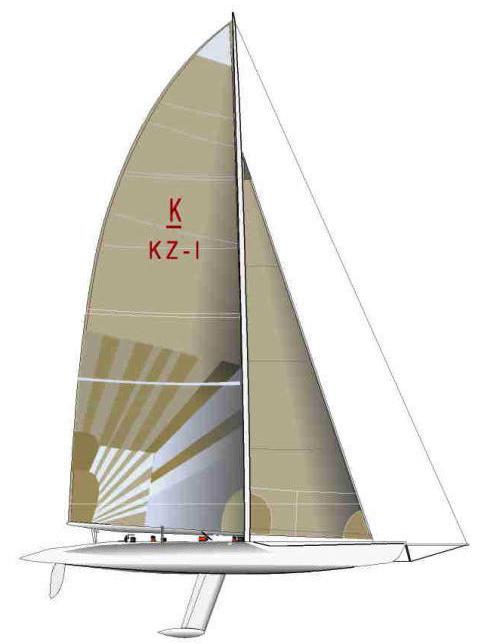 |
| The NZ 1994 challenger |
But what would have been a very interesting challenge, in what regards sailing yacht development, turned sour because while the New Zealanders built the fastest monohull to date, the Americans chose to race on a catamaran, that was even faster, but that was an obvious mismatch to the spirit of the event, that was based on racing in yachts with similar characteristics.
It ended up in the American court that firstly attributed the Cup to New Zealand, due to a race between a catamaran and monohull being a gross mismatch and against the spirit of the Cup, but later the Supreme Court reversed the decision and the cup stayed in the United States.
This sad episode had at least a big benefice: after this, it would have been even more ridiculous to continue racing on boats based on an 81-year- old rule, boats hugely dated and with a poor and very outdated performance even if their development needed to be faster than the one of the neighbor cost a fortune.
A new box rule was created, one that would provide faster yachts and that would be used in the next five editions, the International America’s Cup Class (IACC). The new box rule, was intended “to produce wholesome day sailing monohulls of similar performance while fostering design developments that will flow through to the mainstream of yachting”.
 |
| IACC 1992 French Yacht |
A committee of designers (22) and prospective owners developed the Rule prior to the 1992 America’s Cup. Unfortunately, the new rules limited the hull beam to 4.5 meter and that in a 25-meter boat would imply narrow boats with a huge ballast (79%B/D) and that meant that the boats would be much lighter than the previous ones, due to considerably more draft, but still heavy boats, that were fast upwind but would not be able to plane downwind, being overall slow boats that could be easily beaten by other yachts of the same size without these restrictions on beam.
Not properly the F1 of the seas that we would have liked to see on America’s cup but a big improvement over the previous yachts.
Hard to understand how a sailboat with such a length/ beam and that B/D could have contributed to “fostering design developments that will flow through to the mainstream of yachting”, but the new box rule (IACC) brought racing on boats that were not hugely outdated.
 |
| IACC 2003 Swiss winner |
The first edition with these yachts (1992) was a success: 7 nations and 8 yachts fighting to be the challenger that ended up to be the Italian boat which was beaten on the America’s cup by the American defender.
Even if the first Cup on the new boats was won by the American yacht, 1992 and the new class, ruled after a certain point by collective management, marks the beginning of the end of the United States' big domination in America’s Cup. Since then in 8 editions, the United States won three, as many as New Zealand (that can still win this year’s edition) and Switzerland won two.
The 1995 edition started well with 10 challengers from 8 nations and seemed to continue the internationalization of America’s cup, but the increase of costs due to constant change of rule technicalities (five versions of the IACC rule), led to an escalation of costs, and that edition ended up having fewer countries participating, only 5 and 7 challengers. The New Zealanders won and America’s Cup left America for the 2nd time, now to New Zealand. In the 2000 edition, there were 11 challengers from 7 countries and New Zealand defended the Cup with success.

In 2003 there were 9 challengers from 7 countries and the cup was won by Switzerland, and because Switzerland had not ocean waters, the races were hosted in Valencia, Spain. Swiss won again the 2007 edition that had 11 challengers from 9 countries.
All seemed to go well in what regards the popularity, the number of nations and the number of participating yachts and even in what regards the evolution to a more modern and fast yacht, the AC90, a new box rule proposed by the Swiss team and accepted by the Challenger, a Spanish yacht club.
 |
| IAAC versus AC90 |
The new class would provide a 90ft yacht that would be beamier, lighter, 50% stiffer, and considerably faster, but then the challenger was contested in its right to issue a challenge by the American team Oracle.
The Americans, that had not only been unable to win the Cup on the last three editions as they had not even been able to challenge it (being defeated on the series to choose the challenger) managed this way, winning a legal action ruled in American courts, to be appointed as the official challenger and therefore being able to change the rules in what regards the chosen yacht for America’s cup.
They rejected the proposed monohull box rule (AC 90) and without an agreement over the boat choice, reverted to the original Deed of Gift and the 2010 America’s Cup was disputed again without limitations others than length, and that resulted in huge multihulls, without any another challenger than the American, due to high costs.

In what regards sailing sport, a very uninteresting America’s Cup with a giant Swiss catamaran against a giant American trimaran with a fixed-wing, that proved to be substantially faster and brought back America’s cup to America.
But if the sportive interest was low, it was very interesting in what regards sailboat development, with the first flying yachts in America’s Cup.

From then on it would not make sense to return to relatively narrow monohulls that would not even be able to plane fast downwind. The AC90 was not a revolutionary boat but just an improvement over the previous cup yacht, with more draft, a large transom, more hull form stability but still with a narrow hull that was not designed for maximum performance….but conditioned by the space available in berths in Valencia marina!!!
Tom Schnackenberg, the NA that was developing the class, started with an initial idea of a yacht with 26 meters, with a 5.7 beam (conditioned by Valencia traveler lift capacity!) and a 6.5m draft, to end up, after discussion with the interested teams, in a far less exciting yacht with 26 m length, 4.8 m beam and 5.0m draft.

The choice seemed to have interested many challengers; they were initially 12 from 7 countries. But soon it was evident to all that the yacht would be much more expensive than what was previewed and, due to the escalation in costs, only 3! out of 12 remained.

The American defender prevailed for very little with the NZ boat winning all the first races and the American one managing an almost impossible recovery, winning successively all the other races among protests of cheating due to a new control system of the foils. Oracle had already been found guilty of cheating previously, but this time nothing came out of it and the American Oracle team won the 2013 edition.
In the 2017 edition, among a controversy with the lack of safety (a boat destroyed and a sailor dead on the previous edition), it was decided to race in a smaller catamaran, but confusion followed when the AC62, initially chosen, was substituted by an even smaller boat, the AC 50, and the Italians retired in protest. Only five challengers remained and the NZ team beat the American one.

When it was expected some sort of stability that would allow fewer costs and more challengers, this edition (2021) marks a new revolution with the NZ team refusing to continue to use catamarans and proposing a revolutionary flying monohull, the AC75 with two wings with foils that work also as ballasted “keels”, a monohull they said would be able to be faster than the previous catamarans, being able to exceed 50 kt and right itself up from a capsized position.

It seems that the safety problems were solved, no pitch-pooling till now, and the capsizes brought no big problems, except on the American boat due to a battery that went loose (but that should not have happened and it was easy to solve). However, the yachts, contrary to what was expected, were unable to recover from a capsize, even if they would not turn upside down and remained lying at 90º. Not difficult to solve that, with a bit more ballast on the wings, but that would diminish their ability to lift on the foils with light wind, something that should be addressed in the evolution of these boats.

These yachts have proven to be spectacular, faster than the previous catamarans, able to sail over 50 kt, and if criticism can be made it has not to do with the boat’s performance, or close performance between the yachts, but with the need to have eight muscle guys working almost permanently at grinders to produce the power to operate the boat systems.
We should not forget that on Cup boats before the era of the flying boats the crew needed to sail the boat had already big muscled guys on the grinders, even if for other reasons, and that these boats carry in fact a smaller crew than in any other yacht in America’s Cup history, except on the smaller AC50 and on the AC72 that had the same number of crewmen.

The problem here is that from the 11 crew members, 8 are grinder athletes and don’t need to know anything about sailing, just have to do what is asked them on the grinders and only crewmen 3 actually sail the boat. That does not make much sense. These grinders are used mostly to produce hydraulic energy but I don't see the difference regarding using hydraulic systems or electrical systems.
Regarding the need for human power to generate energy for the systems, the easiest way to manage its decrease is to make the crew smaller; taking four guys out of the crew will probably solve it partially and would introduce another interesting factor in racing: the need to manage the available energy on the boat. The use of hydrogenerators and solar panels can also contribute to solve this problem and their development will be very useful for sailing in general.
Also, the use of a bigger battery bank, not for using previously stored energy to run the systems but to manage the energy generated in the boat during the race, can contribute to ending the disproportional number of grinders: eight on a crew of eleven.

Those batteries, that would be discharged and verified at the beginning of the race, would be used as a storage system, for energy generated in the boat during the race and would allow for fewer grinders, that now are used to generate the needed energy at any given time, with the yachts having very little energy storage capacity.
If we compare these boats with the boats used in the decades, previous to the use of multihulls, we would have to agree that they brought again the America’s cup to its origins, meaning great racing on the fastest yachts on the planet, mixed with extraordinary sail yacht development.

The Cup had been about that since its origins and for 141 years, if we exclude the unfortunate period of 29 years during which it was raced on outdated boats (12m class). During those years there was great racing, but without the original spirit of doing that on the fastest sailboats around, contributing in a decisive manner to yacht design evolution and to sail evolution.
But there is something really bad on this edition, something that should be addressed in a decisive way: the very small number of challengers. That has to change and in what regards that we should look to the past, to the IACC class, the one that was able to reunite more challangers.

Measures should be taken to assure that this happened due simply to the very innovative boat design and the necessary development costs and that now, with much less development work to do, with all the mechanical and hydraulic parts being the same and provided by independent contractors, maintaining the stability without rule changes (that imply more costs) it is possible to have a high number of challenges for the next edition.
That means that any changes that imply the use of hydrogenerators, solar panels, or other ways to generate or store energy produced on the boat should be developed and manufactured, as the other systems, by an independent contractor and provided to all teams, forbidding all alterations.

The past proved that stability was essential to lower costs and to increase the number of challengers and challengers from many countries are needed to turn America’s Cup into a true world top sail championship, not only a sailing one, but also a design one.
And something more is absolutely needed to make the America’s Cup a true world championship and that is preventing the possibility of hostile challengers attributing the management of the yacht choice and alteration not only to the Defender and Challenger but to a group formed by all that had participated on the previous edition, or editions and intend to participate on the next ones.

It is also necessary for independent arbitration in what regards rules, regulations, and interpretations. It is not acceptable for the arbitration to be provided by the courts of only one of the countries that participate, the American courts.
The arbitration should be international and independent of any country and if therefore it is necessary to change the name of America’s Cup, well, I don’t see a problem, call it the World’s Cup. That’s the spirit that should be maintained as well as the conditions to have a fair and independent competition with many participants, on the most advanced and fast contemporary sailboats.


