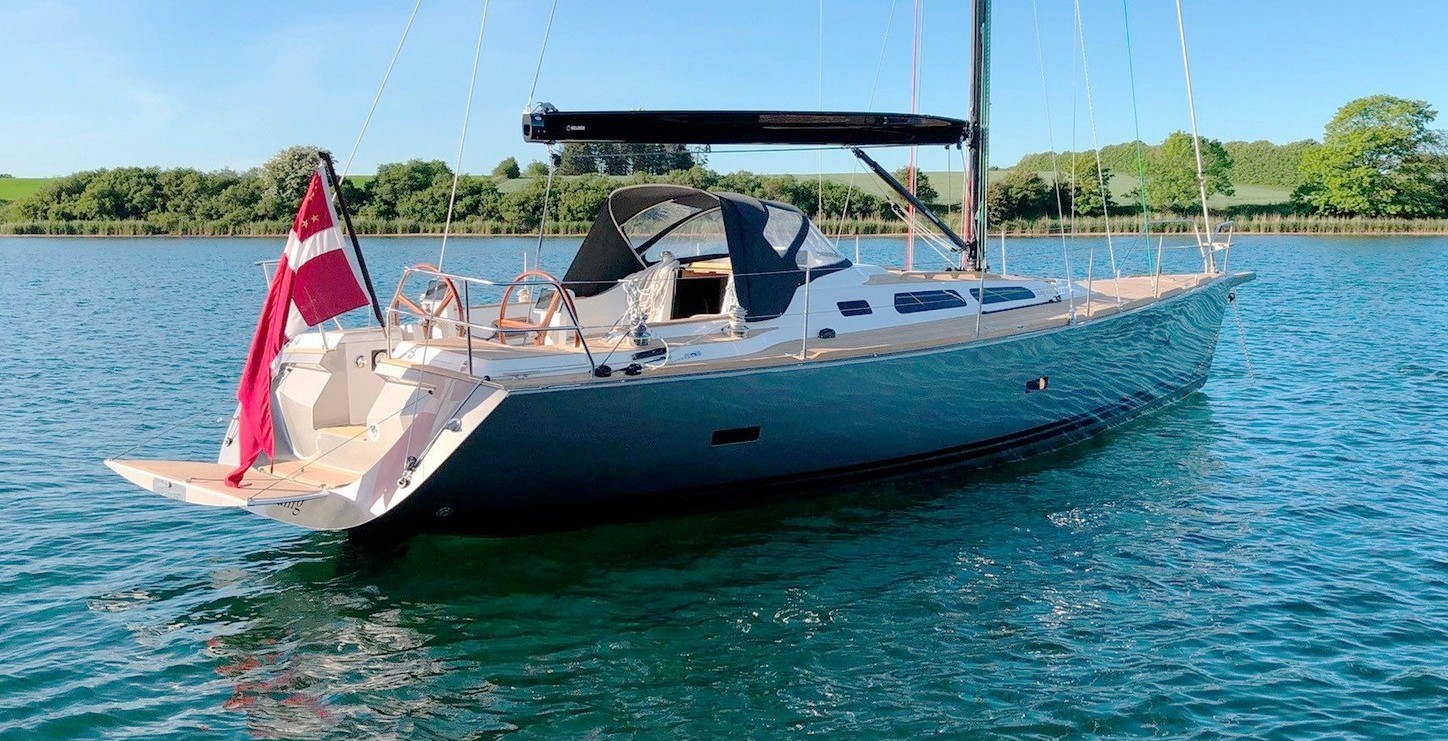
If this was a car this yacht would look like a Lamborghini, or something ultra-modern, sportive, and fast. Does the Sunbeam 32.1 have only the looks or has it what it takes to be as fast on the sea as a Lambo on the roads? Meaning a big engine and the means to control all that power.
On a sailboat, the engines are the sails and the stability that allows resisting the heeling forces. The bigger the stability, also called stiffness (for the smaller heel angles, the ones that are used for sailing) the bigger the sails the boat will be able to carry and more power will be available.
The engine is not the only relevant part, the other is the proportion between drag and power and if we were talking about cars, drag would correspond mostly to the weight and aerodynamic performance, on boats it is a bit more complex because water is much denser than air.
Sunbeam 32.1
Regarding hydrodynamics, not only the wetted area is important (related to weight) as other factors assume bigger importance, factors that have to do with boat underwater shape while heeling, hull form coefficients and wave drag, not to mention windage.
But let's keep it simple and basic: regarding hull form the Sunbeam 32.1 is sleek, with fine entries and a relatively narrow hull. It looks the hull of a fast boat, but if we look at the rocker and at the shape of the underwater hull, we will see that they are very different from the ones of sailing "Ferraris", or "Porsches", and the hull does not look like anymore to the hull of a very fast boat.
Comparing it with the hulls of Dehler 30OD and JPK 10.30 the differences are evident, and the Sunbeam 32.l underwater body looks pregnant and with a bigger freeboard, that is very well disguised by two chines. Evidently, the much bigger wetted surface on the Sunbeam has to do with a very different displacement, 4150kg for the Sunbeam, 2800kg for the Dehler and 3776kg for the JPK.
On top Dehler 30OD then JPK 1030
The Sunbeam, with 29ft length, is the smallest, the Dehler has 30ft and the JPK 33ft. The Dehler has 3.28m beam, the JPK 3.24m and the Sunbeam is the narrowest, with 2.98m. That means that for having the same power it has to compensate with extra ballast, but it is the opposite, the Sunbeam has not only less draft, on a similar T keel (1,80m to 2.2m and 2.0m) as is the one with the smaller B/D, 30.1% for 33.6% on the Dehler and 39.7% on the JPK.
Oceanis 30.1
So, the Sunbeam has a bigger wetted surface, less hull form stability, less RM coming from the keel and from the Lamborghini shape, if compared to a "Ferrari" and a "Porsche".....it remains only the shape, not the substance.
If we continue and extend this comparison to the sail area, sail control and running rigging we will reach the same conclusion: this boat was designed to look like a real sports boat but not to sail like one.
The rigging is a very simplified one, without a traveler for the mainsail or for the genoa, with a self-taking rail for a jib and only two winches to deal with the sails and reefing. I asked if more winches or a genoa and main traveler could be mounted and received no answer.
Above, Sunbeam 32.1, below Oceanis 30.1
On the technical data they talk about an optional genoa, but genoa rails are not shown anywhere and a genoa with a german mainsheet system and only two winches will be very hard to operate, not to mention the single line reefing system. A german mainsheet system makes not any sense for a boat this size. If an aft mainsheet is used on a boat this size, the more practical and efficient system is a direct mainsheet system with blocks.
I assume that a genoa is not possible, at least in a practical way, because two more winches would be necessary for a different and more complex running rigging, and they were not previewed.
To a much smaller stability (stiffness) corresponds a much smaller SA/D: the Dehler has a 32.0 SA/D for a 109.9 D/L, the JPK has 29.8 SA/D for a 119.3 D/L, the Sunbeam has 22.1 SA/D for a 167.1 D/L.
So, no doubt about that, those aggressive high-performance looks have no correspondence to the boat performance, and if we look better we will see that the main hull chine serves nothing other than an aesthetic purpose since it does not correspond to the waterline, on any heeling angle.
In fact, if we look at the transom, which is not clearly shown in any of the pictures we can see that it is not a modern one, a U shaped transom like the ones that were common more than a decade ago and that the chine has no place in that type of hull or transom.
The not related U shaped transom and chine
The superior chine is more interesting and although I believe it was designed mostly to serve an aesthetic purpose, it will probably be useful in deflecting the spray and water when the boat sails fast upwind with waves.
Finally, showing the difference in stability and seaworthiness, both the Dehler and the JPK are certified class A boats while the Sunbeam 32.1 is only certifiable as a class B sailboat.
But if we compare this boat, which is marketed as a daysailer, with the slightly smaller Oceanis 30.1, also only certified class B sailboat, the stability differences, on a not very different hull (finer entries on the Sunbeam) are huge and this time in Sunbeam's favor.
In what regards LWL the Sunbeam has only 21cm more than the Oceanis, the beam is identical (2.98 to 2.99m) and the draft as well (1.80 to 1.88), but the much more efficient Sunbeam torpedo keel will much more than compensate the extra 8cm the Oceanis has in draft.
An even if both boats are only certifiable in class B the Sunbeam offers a lot more stability and seaworthiness, having not only a keel that maximizes the lowering of the CG but also a much bigger B/D: 30.1% to 24.3%. This allows also the Sunbeam to carry more sail and to be a more powerful and fast sailboat (except maybe downwind). This difference in performance results very clear if we look at the SA/D and D/L: The Sunbeam has a 22.1 SA/D for a 167.1 D/L while the Oceanis has 18.6 SA/D for a 170.8 LWL.
So, yes, The Sunbeam will sail a lot better than an Oceanis 30.1, a sailboat that has been highly acclaimed by the press (and that I don't like) and it has a similar program, daysailing with some weekend cruising.
The Oceanis is built the same way all Oceanis are built, with single skin and a counter molded structure. The Sunbeams are better built than the Oceanis but the information they gave regarding this boat is scarce, besides mentioning a self-supporting structure (?) and a sandwich hull.
The interior, if we look at the drawings, seems very nice even if the one of the Oceanis seems more practical and bigger. If well built the Sunbeam interior can be very interesting for the type of sailing and cruising that is on the program. It is not only the interior that is very nicely designed, the cockpit space too, with everything well done, functional and ergonomic, including a beautifully designed bimini/cockpit cover.
The outside space is maximized at the cost of interior space and the Sunbeam cockpit is really big. The way the swimming platform is integrated on the cockpit deck is a bright touch, allowing for a space that is suitable for deck chairs and it is unseen on this size of boats.
The problem I see with this sailboat is that instead of calling for an innovative naval architect to design a contemporary top-performance hull and sailing boat, then asking a top general designer to treat the living spaces, they started the opposite way. They asked first the general designer to design the boat and the one responsible for the hull design, and for the sailboat, is not even mentioned.
I believe this video says it all in what regards boat design directives: The main designer is not a yacht designer, in fact in his works I cannot find any other sailboat and the main design directives, as you can see, have nothing to do with sailing but with using the boat as a living space. For that purpose, this boat looks great....not so much as a sailing boat, even if as a sailboat it is way better than the Oceanis.
But that is natural when you start thinking first about designing a beautiful boat and only later making it a sailboat too. They first looked at living spaces and design shapes and only after to sailing performance. This approach is not unseen and it is more and more common, but makes less sense on a daysailer, which is many times used just for sailing and where sailing performance and sailing fun is probably more important than any other design criteria.
Sunbeam 32.1
The Sunbeam 32.1 looks good, the design work is innovative but as a sailboat there is nothing new about it, quite the contrary, the hull is unnecessarily narrow, for performance, the transom design dated and the sail running rigging and sail hardware is limited, as well as the sail performance.
That does not mean it is a bad sailboat, just that it is not as fast or innovative as it looks, and while many of these expensive daysailers point to sailors that have the money for a luxury finish, they point also to sailors that like to have fun sailing a powerful fast and beautiful yacht, with all sail controls to give the sails a perfect shape, and that it is not certainly the case with the Sunbeam 32.1, that has no backstay, no rail for the main, no rail for the genoa, only two winches for all the sails and for reefing.
The Sunbeam 32.1 offers uncomplicated simple sailing for a beginner, and even if offering better sail performance than an Oceanis, there are plenty of luxury small daysailers that offer much better performance and much more sailing fun as well as some potential for racing.
The Sunbeam 32.1 standard yacht costs about 167 000 euros, excluding VAT, the Beneteau Oceanis 30.1 72 192€. The Sunbeam offers the same program as Oceanis, with a luxury finish and high-quality design, on a sailboat that sails better than the Oceanis, but that is not a performance sailboat and not pointed to the ones that will use it to have fun while sailing, and occasionally will race it.
In 2007 I was still looking for the boat to substitute my 5-year-old Bavaria 36, not because the boat had any problem, or because I wanted a newer one but because the Bavaria was not what wanted as a yacht for the retirement days, nothing to do with the interior, cruising amenities or even storage space, but with the upwind potential with stronger conditions. I explained the "problem" on the Luffe post, here:
So, one year after having sailed the Luffe 40.04, I went to France to see/testsail some boats and visit some shipyards being one of them JPK. JPK stands for Jean-Pierre Kelbert, the founder and owner of the shipyard, which at the time was a very small one.
He had only produced two boats, the JPK 9.60 (2003) and the one I was interested in, the JPK 110, a 36fter cruiser-racer that had been launched 2 years before.
The shipyard, as a yacht shipyard, was a very recent one (4 years old), but not only were the boats fast and very competitive on offshore races and Transats (the 9.60 had won the Transquadra and the Fastnet), as they have proven to be very resistant and well built.
The 36ft was not as successful as her little sister but had already won several offshore races and at least one of the boats was being successfully used as a fast performance cruiser by a French sailor. This description, by an owner, about how the boat sailed with bad weather, had convinced me to check on that boat as a possible candidate for the Bavaria replacement.
Notwithstanding being a very recent yacht builder, JPK shipyard had already a big experience in top quality composites: since 1992 they produced high-quality windsurf boards for professional or top amateurs, and also composite parts for some of the best and bigger racing shipyards like CDK Technologies or Multiplast.
I had booked a meeting with Jean-Pierre, and, even if I knew that it would be impossible to test sail the 110 (few boats built and none readily available, being out in different locations, most of them racing or preparing to race), he was building one that was already in an advanced state of completion, and he could show me that boat.
Talking with JPK was a very pleasant experience, he obviously knew not only a lot about boatbuilding but also a lot about sailing. He had been the European Windsurf Champion (1988, 1989), and later, racing his boats, many times with clients, he had become a very successful sail racer, in duo and with a crew.
From the top: JPK111, 38FC and 39FC
I wanted a boat for cruising fast and since my wife does not share my passion for sailing (just for cruising), being this a powerful sailboat, I wanted a boat with a rigging adapted for easy solo sailing and even if that boat was being rigged for crewed racing he knew exactly what I was talking about and suggested not only to mount the winches in other position but also suggested other running rigging changes that made all the sense and that showed that not only he knew exactly what was needed to make solo sailing easier, as he was willing to modify the rigging to my needs.
I was very impressed with the boat, the quality of the work and with Jean-Pierre, who besides having a huge experience and knowledge, is a very nice guy, honest and straightforward. I remember that he invited me for a beer and I had to declined because I had a test sail and a visit to another shipyard that afternoon.
RM 1200
He asked me what was the boat and the shipyard and I told him it was a RM 1200 and Fora Marine (at the time also a small shipyard even if several times bigger than JPK) and even if potentially I would choose between his boat and the RM 1200, without being asked, he told me that the RM 1200 was a different boat but well made and a very good cruising boat.
For different reasons, I chose neither the RM 1200 nor the JPK 110. The JPK 110 was ruled out not because of the way it sailed, neither due to the quality of the cruising interior (that was a very nice one for a fast boat), but due to the small forward cabin and due to an outside lack of storage. It had storage space on the cockpit floor, but with a very unpractical access, through a small hatch.
JPK 38 FC
Five years later, in 2012, JPK would launch the boat I was looking for, the JPK 38FC that seemed to be designed for me, well, maybe I would have preferred it slightly less beamy and more light wind/upwind balanced, in what regards sail potential maximization, but the essential was there: fast, with a sail performance not too much compromised by a downwind maximization, well built with a very nice interior, big enough cabins, and enough outside storage space with good access.
The new JPK 39FC is an evolution of the 38 and they had the courage of not making an MKII, but an entirely new boat even if the alterations over the previous hull seem to be small, but important, not so much in what regards how the boat sails, but regarding interior space, namely the forward cabin that was a bit small on the 38.
JPK 39FC
The 39 is longer (11.72 to 11.38m) but has about the same beam (3.98 to 3.99m). The 39 is proportionally less beamier (length to beam) but it has slightly fatter bow sections, a rounded bow, inverted on the top, comes already with a big retractable bowsprit, and has a completely new, very interesting cabin design.
The wider bow sections and the rounded bow allows a much wider front cabin and even if it diminishes very slightly the upwind ability it will increase the downwind and beam reaching potential, not only due to the increased hull form stability but also due to the increased buoyancy on the forward sections, contributing to keeping the bow up while planning downwind, preventing it to dig on waves.
All the other dimensions are the same except for displacement that was 5000kg on the 38 and is now 5500kg on the 39. The ballast on the standard 2.15m draft keel (cast iron fin, lead torpedo) is the same, 1900kg.
This gives a lower B/D to the 39, (34.6% to 38.0%). The safety stability and AVS will be slightly worse than in the 38 but even so largely sufficient. That difference in B/D will be mostly noted on the 39 upwind performance with stronger weather, even considering the bigger 39 LWL, (11.0 for 10.4m). The bigger displacement will also have a negative influence on the downwind planning performance.
But 500kg seems a big difference for just 34cm difference in length, maintaining beam and it is possible that the JPK 38FC is heavier than the projected weight, and in that case, the difference in what regards B/D will be less and probably represents just a better adherence to reality.
The drawing shows a big retractile bowsprit (carbon) but there is an intriguing hole on the bow on hull 1. Due to the inverted bow, it will be difficult to solve the anchor stand problem and the easiest solution seems to have it integrated on the bowsprit, but that seems not to be the case.
That hole on the bow seems too low for an anchor stand. I am puzzled and curious about the solution they will find for the problem.
Regarding the interior, the bigger bow cabin allows a better layout and even a three cabin solution that I don't see as a good solution for most users, providing little storage space and a very small head.
The two-cabin layout has a bigger head that even so remains small, without a separate shower. But if the position of the aft cabin is inverted it will be easy to have a head with a separate shower that can be used also as a wet locker, losing not much in what regards storage space and having the advantage of a nicer and bigger saloon. Such alteration should be possible without considerable costs.
JPK 39FC 2 two cabin layout
With this alteration the JPK 39FC will have two good cabins, a big head, a big galley, a wet locker, a big chart table, enough storage space inside and outside, a nice and comfortable saloon, the option of a swing bulbed keel (1.30/2.70m), and a tankage of 360L of water and 90+90L diesel (option).
It will be close to perfection for a couple, or a couple with kids, to do a budget circumnavigation, or extensive sailing in the trade winds on a fast boat, without being too handicapped if after that, or during the circumnavigation, out of the trade winds, the boat is sailed in areas where upwind sailing is dominant, like the Med or the Baltic.
Hull - JPK 38FC
The JPK 39FC will pay a lot less than a bigger boat in marinas and ports, will have less expensive maintenance while being as fast as much bigger sailboats. If I had such a sailing program the JPK 39FC would probably be the boat I would choose (on a budget), but it is not the case and for sailing mostly on the Med or Baltic, I would probably choose a different boat, one with better upwind ability, even if this boat should be considerably better and more comfortable upwind than a Pogo 36, that is smaller and has already more beam.
But regarding the Pogo, besides this being a more well-balanced boat in what regards overall sailing, what seems remarkable in this design is that they managed to solve the problem of forward visibility from inside the boat and the need for a considerable standing height without making the boat look ugly. I find the cabin design elegant, a very clever design that allows having on the interior good standing height without increasing a lot the freeboard.
Hull - JPK 38FC
The outside cabin height seems smaller than what it really is due to its length, it should also provide great all-around illumination and views from the exterior, which are supplemented by three narrow but long port-hulls. The interior standing height should be good too. The interior should not be very different from the 38, a nice one, will be much less spartan and nicer than the one from the Pogo.
The engine is a small 30hp Volvo with an option for a 38hp Yanmar that will be able to move the 5500kg without problems and wasting little fuel and the 90+90L (optional) diesel tankage should be more than enough.
Hull- JPK 38 FC
Some will be asking if a boat with 11,72m weighing only 5500kg will not be necessarily a lot less strong and less seaworthy than for instance a Hallberg Rassy 372, which is smaller in length (11,35 to 11.72) and beam (3.60 to 3.98m) but that it is much heavier (7500 to 5500kg).
And that would be the case if the boats were built the same way with the same materials, but they are not and that makes all the difference. While the JPK hull is built like the one of a racing boat, with better materials, vinylester and polyester resins (polyester on the HR, except on the outside layer that is vinylester), sandwich using vacuum infusion ( sandwich composite, hand laid on the HR), Airex as core (probably similar quality Divinycel on the HR), boat structure directly infused on the hull (matrix structure bonded and laminated to the hull on the HR), sandwich infused composite bulkheads, bonded and laminated to the hull and deck (plywood bulkheads glued and laminated to the hull and deck).
I am quite sure the HR is well-built and a very strong boat but it is not built in a way to save weight (maintaining the strength). The vacuum infusion process and the bigger use of vinylester resins will allow saving on the hull 300 or 400kg, while the use of infused composite sandwich and the directly infused boat structure will save other hundred kg, and more savings will come from a composite infused interior (galley and head) and lighter cabinets.
JPK 38FC interior
There is a difference of 2000 kg between the two boats that would be bigger if the HR had the size of the JPK but we could see that half of that difference is on ballast and that perhaps about 20% or 25% of that difference is just due to a more efficient keel design and more draft on the JPK (2.15m draft to 1.99m and a lead bulbed keel versus a cast iron, lead torpedo keel).
And in this case ballast can be misleading, because the, JPK (excluded the keel) is much lighter (by building techniques and materials) than the HR and therefore much less ballast is needed for obtaining the same B/D. The JPK 39FC has a 34.6% B/D while the HR 372 has 38.6% but if we apply a 20% correction due to the less efficient HR keel and draft then the comparable HR B/D is 30.9%.
Note that I am not saying negative things about the HR372 that is a very good boat and marks HR turning point versus better sailing boats, I am just trying to explain why the JPK 39FC can be much lighter without being significantly weaker.
It is also important to understand that even if the JPK 39C has a better GZ curve (arms curve) the smaller HR 372 has probably a close overall stability: the RM curve is obtained by multiplying boat mass by heeling arm (at all heeling points) and the overall stability corresponds to the total area under the positive part of the RM curve. The 36% HR mass will be compensated by the bigger JPK arm.
The bigger JPK GZ on all heeling points is due to a bigger hull form stability (much more beam) and also by a bigger corrected B/D (lower center of gravity), which will give it also better dynamic stability and better safety stability for an AVS that should not be very different, between 120 and 130º (HR372 has a 128º AVS).
HR 372 bulbed keel
The point here is to give a comparative reference in what regards overall stability and seaworthiness with a well-known seaworthy yacht, the HR372 a medium weight cruiser that most will consider being adequate for bluewater sailing with a comfortable safety margin, one that will not be inferior to the one offered by a JPK 39FC.
Probably bigger, if we consider the better dynamic stability, the better safety stability, and the bigger ability to escape bad weather, due to much bigger overall speed, especially while beam reaching or sailing downwind.
A faster passage will be potentially a safer one because fewer days will be passed on passage and the bigger the possibility to remain inside the right meteorological window one wants to sail.
JPK 38FC optional arch
The JPK 38FC comes already with carbon dual tillers, carbon bowsprit, 3D genoa tuning system, 6 winches, mainsail rail and foldable propeller. The list of options is not big and includes things like a sandwich composite arch for solar panels and to carry the dinghy (4321 €), the prices of extras seem correct as well as the price of the standard yacht, 205 100€ with the standard 2.15m keel, 225 800€ with the optional swing keel (all prices at the shipyard without taxes).
What is offered for the price seems very good: a safe, very fast, very well built yacht, with a nice interior that will have relatively economic maintenance due to small sails (lightweight), small engine and small size (marina costs). But if you are interested in one it is better to hurry because right now the delivery time is already one year and I bet that when sailors see the real thing the waiting time is going to double very quickly.
This is a yacht for lovers, not for the ones that are rational about interior space, cruising amenities or even overall top speed, for a 40ft cruiser-racer. No, this boat is about sailing fast, but in a particular sailing spirit, a traditional one, where the boats are supposed to heel and glide over the water, slicing the waves, going fast with small sails.
As you can imagine I am a sailboat lover and 16 years ago I fell in love with the first version of this yacht, the Luffe 40.04, then a new model, and went to the shipyard, in Kolding, Denmark to see how the boats were built, to have a talk with the owner and builder, Oluf Jørgensen and to see how it sailed.
The part of the talk did not go so well because Oluf did not speak English, and we had to communicate with the help of a shipyard worker, that was not fluent in English, but the shipyard told me a lot about the way the boats were made, and about Oluf passion for yachts and for building them. I was quite impressed.
Then he took us to the nearby marina where he had the first 40.04, his personal yacht, that as I have found later was fully equipped for racing. It was a windy and cold morning blowing over 20 knots, gusting 30 but the waters of the Kolding Fjord were protected, and we (me and my wife) were used to sail in strong winds.
We had changed 3 years ago from a traditional 80-year-old heavy wooden sailboat to a brand new Bavaria 36 equipped with all sorts of extras to make it a better sailboat (lead keel, bigger mast, top cruising offshore sails). We had already made many thousands of miles, enough to know that, contrary to what we had thought, the Bavaria was not the perfect sailboat, neither the boat we would keep for the retirement days.
The Bavaria 36 was a 2003 model bought in 2002, in Palma de Maiorca, and sailed home by us to Portugal. Equipped as it was it had many qualities: it was very light, sailed very well in light to medium winds, was fast downwind, but with strong wind and waves, against the wind, it was a deception: it had not the power or stability to sail close to the wind, and I had to open the angle a lot to generate the power to sail, resulting in a very poor VMG.
Because I was faster than friends that had similar boats (faster upwind than an Oceanis 393) I soon understood that it was not about the Bavaria but about the type of design, beamy boats with a low B/D, and my trip to Denmark, to test the Luffe 40.04, had to do with finding out how it would be to sail a boat that was the opposite from the Bavaria, narrow and with much more ballast, one that I was sure would have not the problem Bavaria had, sailing upwind, in strong conditions.
The 36ft Bavaria had 3.60m beam, the 39,4ft Luffe had 3.40m, the Bavaria displaced 4700 kg, while the Luffe displaced 6000kg. The Bavaria had a 28.5% B/D on a non bulbed lead keel (option), with 1.95m draft and the Luffe a 40%B/D on a lead keel with a kind of torpedo, meaning a keel with a low CG with more draft (2.08) and much more ballast.
When Oluf took the Luffe out of the Marina and started to pull the main out I was really surprised: it was a racing 3D carbon sail with no reefs! I had no idea how he was going to sail the boat with that big sail with no reefs in a strong wind.
I would have certainly not tried, but Oluf is a great sailor, an accomplished racer, and only with the main up he managed to sail the Luffe, depowering the sail when it was needed, and that means almost all the time.
Well, we could not only see how the boat sailed but we also learned one or two things about sailing on the limit, like if the Luffe was a dinghy.
Luffe 40.04
Even if not with the right sails, we could see that the boat went fast on all points of sail, but it was really the ability to close on the wind, even without the proper sail set-up, that really surprised us. Probably something like 10º or 15º closer than with the Bavaria, very fast and with the kind of power that would keep it going even against waves.
I loved the boat and the way it sailed but my wife, that knew already something about boats (we had already tried several different types of sailboats), excluded it right away from the list of possible replacements for the Bavaria:
The Luffe, out of light winds is a boat that sails always with a considerable heel, and on that particularly windy day, it heeled a lot, even more, to depower the sails, with Oluf having fun, and never losing control.
The narrow hull gives a lot less form stability than a beamy one but to the bigger stability corresponds a bigger drag and the need for bigger sails. Because the Luffe had a much bigger B/D on a deeper and more efficient keel, the power/drag was much bigger than the one on our Bavaria, and the motion upwind more comfortable, due to finer entries and less beam but to get power the Luffe needs to heel, to maximize the ballast effect.
For a cruising 40ft sailboat the Luffe 40.20 offers a minimalist interior, one that probably would not be bigger than the one of the current 36ft Bavaria (C38) that has 3.98m beam! a 24.3% B/D! on a cast iron keel with a torpedo and 2.05m draft.
The difference between the way this Bavaria will sail, compared to the Luffe, will be bigger than the one with my older Bavaria, and the difference in speed, in most situations, also. I find this Bavaria a mystery and it is hard to understand how the 2003 Bavaria 36 displaced 4700kg and the C38 (also a 36ft) displaces 9070kg.
Below Bavaria C38
The Luffe 40.20 is in fact the same hull I sailed 16 years ago but with some nice alterations like a new and more modern cabin design, 5 cm more freeboard to increase the interior height, an even better-looking interior, a bowsprit with an integrated anchor stand, two steering wheels (continues to have a tiller as an option) and a swimming platform.
The 40.20 looks gorgeous even if I find that a more modern bow would make it look better and improve the performance slightly, by increasing the LWL. And about performance, I bet that by now what many would really like to know is what the overall sail performance of the Luffe really is, if compared with other well-known fast yachts.
Well, in light wind it has really a very good and sweet performance, one that amazed the test sailors from the European biggest sail magazine, and they test a huge amount of sailboats each year. They have also found that the rudder sensibility was great, even in those conditions, when the feeling is many times lacking. If you read german you can download the full test on the link, if not you can at least watch the video. https://www.yacht.de/yachten_jollen/bootstests/im-test-luffe-4020-facelift-eines-ausnahmebootes-127744
But the best information, as usual, is from racing and a Luffe 40.04 has made the last Middle Sea Race, the boat on the photo, Prettynama2, with full track decks and with the crew not even bothering seating on the rail while going close upwind.
That shows on the results, being the Luffe overall only 25th in 34 that finished the race, but even if we know that the boat was not sailed as well as others, the comparative results in real-time can give some good information, especially because we can access the times in different phases of the race, with different wind and points of sail.
If we consider the full race, which had many different points of sail and wind conditions, the Luffe in real time made it in 5 days, 16 hours, and 38 minutes, slower by 4 hours and a half than a very well sailed J109 (8th overall), one hour and a half and two hours faster than the other two J109, also better sailed (13th and 14th overall).
It was about one and a half-hour faster than a Sunfast 3200 and a JPK 10.10, also better sailed (11th and 12th overall). It was slower than a J122E by 18 hours and slower than a JPK 10.80 by 12 hours, but these two boats were extremely well sailed, and that's why they were 4th and 5th overall, while the Luffe was only 25th overall.
There was also a Pogo 36 racing, with a duo crew. They finished the race but retired after finishing, probably because the results were bad. On a race without strong winds, the Pogo 36 was always slower than the Luffe on all points of sail, and on all intermediate points, losing more, upwind, and curiously downwind with weak to medium-weak winds.
If we look at the first part of the race, which was raced with very weak winds, mostly upwind, we can see from the real times at the end of the Messina Strait, that, even if in the overall provisional classification the Luffe was only 23th, in real-time it was faster than the JPK 10.80, faster than all J109 and only 16 minutes slower than the J122E, with 1 day, 3hours and 29 minutes of racing time.
From the Messina Strait till rounding Stromboli Island, it was almost always close to the wind with stronger winds and even if the Luffe was not making a great race (19th overall) in real-time was now one hour and a half slower than the J122E (14th), but half an hour faster than the better sailed JPK 10.80 (9th) and considerably faster than all other supra mentioned boats.
To understand how good Luffe is in light wind and upwind performance if compared with the lighter but much beamier Pogo style sailboats, even racing ones, we can see that in Stromboli the top racing Class 40 "Made in Midi", professionally skippered by Kito de Pavant, with a full crew, had only 4 hours and a half advantage (in 38 hours of racing) and the Luffe was 2 hours and a half faster than Vaquita, the other racing Class 40 and 4 hours faster than the Pogo 36.
It is good to remember that the Class 40 is a full racing boat, very light, almost without interior, huge draft, water ballasts, the Pogo 36 is much lighter than the Luffe with a very spartan interior, and that the Luffe 40.04 had teak on the deck, over the cabin and cockpit and had a very high-quality cruising interior.
It was on the last part of the race, beam reaching and downwind, that the Luffe lost more for the J122E and the JPK 10.80, maybe more than it was expected due to probably a tired crew, because they were also losing more in compensated time. But this gives a pretty good idea of the Luffe performance, outstanding in light wind, very good upwind, and fast, but less good than beamier fast yachts, beam reaching and downwind (out of light winds).
Overall a J122E or an XP38 are faster than a Luffe 40.20, except in light wind; downwind with medium-high winds and strong winds the Pogo 36 will be much faster, but not faster in what regards to overall performance, depending on wind strength. In what regards to sailing performance maximization it is pretty much the opposite of the Pogo, having a stellar performance where the Pogo is weaker, and vice-versa.
The Luffe is a pretty fast little boat but it is not only about sailing fast, but about going fast with style and in a minimal way. Being so narrow gives you the sensation of sailing a very nimble smaller yacht, with smaller sails, and a smaller but incredibly beautiful and well-finished interior.
The interior, the galley, the head and the cabins would be the size you would expect on a 36ft boat and smaller than the one of the very beamy 36ft boats, like the Bavaria C38 or a Pogo 36.
The kind of sailor that will choose a Luffe 40.02 will be a very particular one, kind of a romantic guy that doesn't need much space to live, but will not dispense the coziness and quality of the Luffe interior as well as the particular way the boat sails, fast, either while racing or cruising.
The sailors that would buy a Pogo 36 or a Luffe 40.02 have in common the love for fast sailing, but a different type of fast sailing, and the ones that will buy a Pogo would never buy a Luffe, and vice-versa. Having in common being fast the two yachts are opposed in many sailing performance aspects and in the interior concept, as a cruising boat.
Both sailors will not need much to be happy while cruising, but the guy that likes the Pogo enjoys having much more space, doesn't mind a spartan interior, the guy with the Luffe, doesn't mind having a much smaller interior, but would not miss a luxurious and cozy interior, the kind of guy that prefers small and perfect, than bigger, even if functional.
Ideally, a boat for a couple, or a couple with kids, being the aft cabin surprisingly big for a boat of this size, while still having a sufficient outside storage space, even for extended cruising. The water tankage is low, with only 160L but it should be possible to add a 100L supplementary tank.
Bavaria C38
The 30hp engine will be able to drive the sleek boat at decent speeds with a low diesel consumption and that, and the huge sailing potential with light winds, explains the small diesel tankage: 90L. This is a boat for sailors and the ones that use this boat as a sailing boat use the engine as an auxiliary one.
Having a Luffe 40.20 has another advantage: the hull is 17 years old and it looks almost as well now as it looked 17 years ago and the boat performance, 17 years later, continues to be a great one. How many boats will look that good 17 years after their launch? And presumably, it will look as good 17 years from now, simply because that type of hull, maximized for light wind and upwind sailing has reached a plateau, many years ago.
The only comparable boat is the Faurby 400, a very similar boat, curiously also built in Denmark and not very far from the Luffe shipyard. The building quality is high and very similar, both boats using a steel grid as structure, having sandwich hulls and decks, vinylester for the Faurby, vinylester or epoxy for the Luffe, divinycel as core for both and instead of bonding agents they use lamination for fixing the structure and bulkheads to the hull and deck.
The finish is amazing in both boats being the Faurby more traditional on the interior design and cabin design. The Luffe is just a bit more performance-oriented and with a better regatta track record, but in what regards cruising I would say that they are pointed to the same type of sailor, the boat dimensions are very similar.
If not for using it mostly as a racing boat, the choice between them will be a question of personal taste since what they offer in sail performance, cruising amenities and prices is not very different. The new 40.02 looks just a bit less classic than the Faurby 400.
Faurby 400
For the quality, the prices seem correct, taking into account that these boats are very well built, have an incredible finish, have 6 winches, a lot of equipment and the prices, contrary to most other yachts, refer to boats on the water and ready to sail away with sails, basic electronics in the case of the Faurby.
The Luffe costs standard 243 624 € and the Faurby 277 143 €, the Faurby seems to come with slightly more equipment standard but both boats have a big list of options that will be needed to make them look like the ones on the photos. Both prices are at the shipyard without taxes. Beauty, perfection and quality do not come cheap, that's for sure.
Faurby 400
Anyway, the equipment offered on the sail away version is different on both boats and only a comparison with similar equipment will provide a more accurate price difference, but I would say it would not be over the price that one should buy one or another.
These boats offer Hallberg Rassy quality, if not superior (in fact in what regards hull building they have a superior quality) and because they are much narrower and with a much smaller interior they offer a better performance/interior quality/ price ratio and will be an interesting choice for individualists that have very particular tastes, as different from the herd as these cruisers are different from all others.
Faurby 400
The survival of both brands through decades shows that sailors with a passion for narrow beautiful performance yachts, mixing a luxury finish with a particular type of superior sail performance, never mind the small interior, continue to exist, and justify the existence of both shipyards.
And I am very happy that is the case, it would be a shame that such beautiful boats like Luffe or Faurby ceased to exist. The boat market would be poorer without these two family brands, still owned by the same sail enthusiasts that had created them.
Their sailboats remind us of the true meaning of the word yacht, by opposition to sailboat cruiser, remembering us that a yacht was once always connected with a luxury finish, perfection, and beauty.