
When this boat was being built I made a post about the JPK 39FC, the successor of a great performance cruiser, the JPK 38FC. There is also a complete post about the 38FC:

http://interestingsailboats.blogspot.com/2016/01/jpk-38fc.html
But now that it was launched, and has even been tested
by a sailing magazine, a new post makes sense, even if not only to look at the
real thing, and not just the drawings.
And the
real thing looks much better than in the drawings, a beautiful boat, nicer than
the previous one, with a not very different hull, in fact in what regards
sailing performance it will be very close, but the 39FC is just a bit better in
everything, from sail area, to interior space and cruising amenities.

We
would be tempted to say that the 38 was even slightly beamier, taking into
account this one is longer, but it would not be fair to look at beam and
interior volume only in what regards maximum beam, especially in this case because
the 39 has fuller bow sections and fuller stern sections, allowing for a larger
front cabin but losing a bit in what regards bow finesse.

Of course,
the Pogo and the Bavaria are completely different sailboats, the Bavaria displacing
more than 10T, the Pogo 5.5T (the Pogo displacement similar to the one of the
JPK) and having bow entries much finer than the ones in Bavaria. In fact the
Pogo has the hull of an older Pogo Class40 racer and it is, like the JPK 39FC,
a very fast performance cruiser.


That misconception,
in what regards performance cruisers, is particularly strong in what regards
Pogo cruisers, that on the wind conditions for which they are maximized to
perform best (trade winds) are almost unbeatable (size by size), but that in
mixed conditions, even when they are strong ones, are not as fast as those performance
cruisers that supposedly where only fast on the paper (IRC /ORC), not on the
water.
Journalists have been responsible for this misconception, even if I remember that on one of the first test sails of the boat that would be called Pogo 12,50, a comparative test with a Dufour 40p, they had made a simulated a race, upwind and downwind, to find with surprise that even if on the water the Pogo speed was higher, both boats ended showing a similar performance, due to the Dufour better pointing and ability to sail downwind at bigger angles….and the Dufour 40p it is not a particularly fast performance cruiser, being considerably slower than a J122.
 |
JPK 39FC |
I have
posted many race results (in elapsed time) to show this, and the results in the
last Middle Sea Race, that was raced in medium and strong but variable winds,
show once more that the Pogo 12.50 is not as fast (in real time) as fast
cruiser-racers , when the wind conditions are varied.
In the last
Middle Sea Race there was a Pogo12.50 racing, and making it in 3days, 16 hours and 20 minutes, two JPK
11.80 made it in 3d 0h 22m and 3d 8h 21m, a First 40 (3d 9h 52m), 4 J122
(3d 10h 32m, 3d 10h 35m, 3d 10h 48m, 3d 12h 38m) and a JPK 45FC, that
made it in 3d 9h 19m, a surprisingly good result, especially because it is an
Australian boat, probably equipped for bluewater sailing.
 |
JPK 11.80 |
Anyway, the
point here is that the JPK 11.80 is much faster than the JPK 45FC and would be
certainly be faster than the JPK39FC. So let’s have a look at those two
designs to understand why the JPK 11.80 is much faster than the JPK39C.

 |
| Transom design: JPK 39FC and JPK 11.80 |
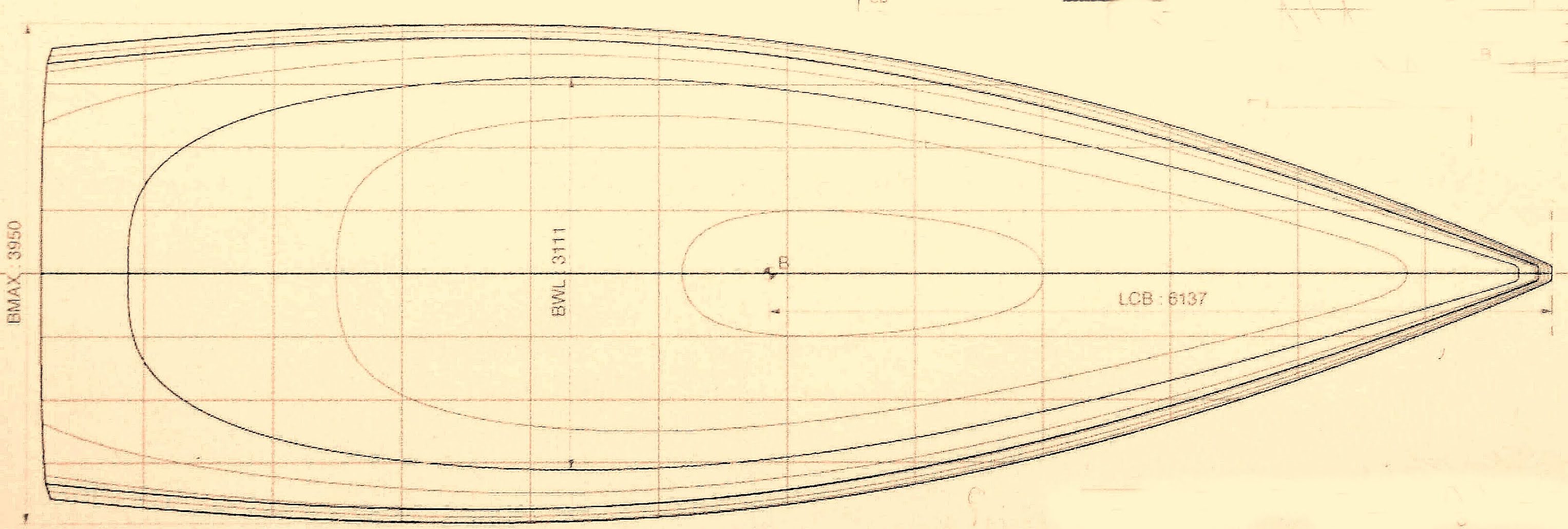
What differs is the hull design, having the 11.80 finer entries, the beam not quite all pulled back, and a very different transom design, a less voluminous one that allows more heel, without increasing drag so much.
Surprisingly, even if the hull length of the 11.80 is bigger, the 39FC LWL is considerably bigger that the 11.80 one. This has probably to do with the 11.80 being designed for sailing with more heel, and while heeling the LWL will be considerably increased asymmetrically, between one of the rudders and the bow.

Curiously
the 39FC is the lightest of the two (5500kg/5900kg) probably due to the two boats
being built in a similar way and with similar materials and the 39FC, having considerably less ballast (1900kg/2650kg).
This
difference in ballast, that is translated in a 34.6% B/D versus a 44.9% one,
more than compensates the difference in hull form stability and that, and a
slimmer hull, are responsible for the considerable bigger Power/Drag ratio on
the 11.80.
Note that
the draft is also smaller on the 39FC, 2.15m/2.34m but the ballast on the 11.80
probably refers to the IRC keel, without torpedo (can have a torpedo as an option)
and the difference in draft probably roughly corresponds in RM to the
difference in efficiency of the two keels (with a torpedo and an IRC keel), in
lowering the CG.
 |
 First, JPK 39FC, then JPK 11.80 |
To the hull
design you have to add the right ballast, knowing that, with too much ballast,
the boat will be slower with light winds and that with less than desirable
ballast, it will have less power upwind and on a beam reach.
To
complicate things, depending on points of sail and wind intensity the requirements
for maximizing performance are often contradictory, and when you improve on a
given performance, you lose on another.
 |
JPK39FC |
 |
| JPK 11.80 |
The SA/D
gives you an approximate measure of sail power, but displacement, even if important as a measure of drag, excludes the shape of the
hull, and hulls with the same displacement, but with less beam, finer entries, and less full
transoms, has, for the same displacement, a lot less drag than beamier hulls, especially
if wave drag is considered. They need a lot more sail for the same performance.
 |
| JPK 11.80 |
If we consider these two ratios as an absolute measure of boat
performance we will be surprised to find out that according to them the JPK39FC
is faster than the JPK 11.80, when we know that it is not the case, quite the
contrary and by a large margin. The 39FC has an upwind 26.8 SA/D, a downwind
45.1 SA/D for a 115D/L and the 11.80 has an upwind 24.9 SA/D, a downwind
43.0 SA/D for a 146.5 D/L.

 |
JPK 39FC |
Both boats
are very well built, using vacuum infusion, cored hulls with and airex core,
vinylester resin on the 11.80, vinylester and polyester on the 39FC, both have
a hull structure integrated on the infusion process (and becoming part of the
hull), both have cored composite bulkheads stratified and bonded to the hull
and deck.
I bet the
JPK 39C, that allies cruising sailing performance to a very nice spacious
interior with all-around views (and manages that without becoming ugly), is
going to be elected by the European sail press as European Yacht of the year,
probably on the performance cruiser category.
The price
is fair for the quality and without VAT, standard, at the shipyard the 11.80
costs 209958€ and the 39FC costs with the standard keel 196887€ and 216748€
with the swing keel, with all ballast on the keel.


