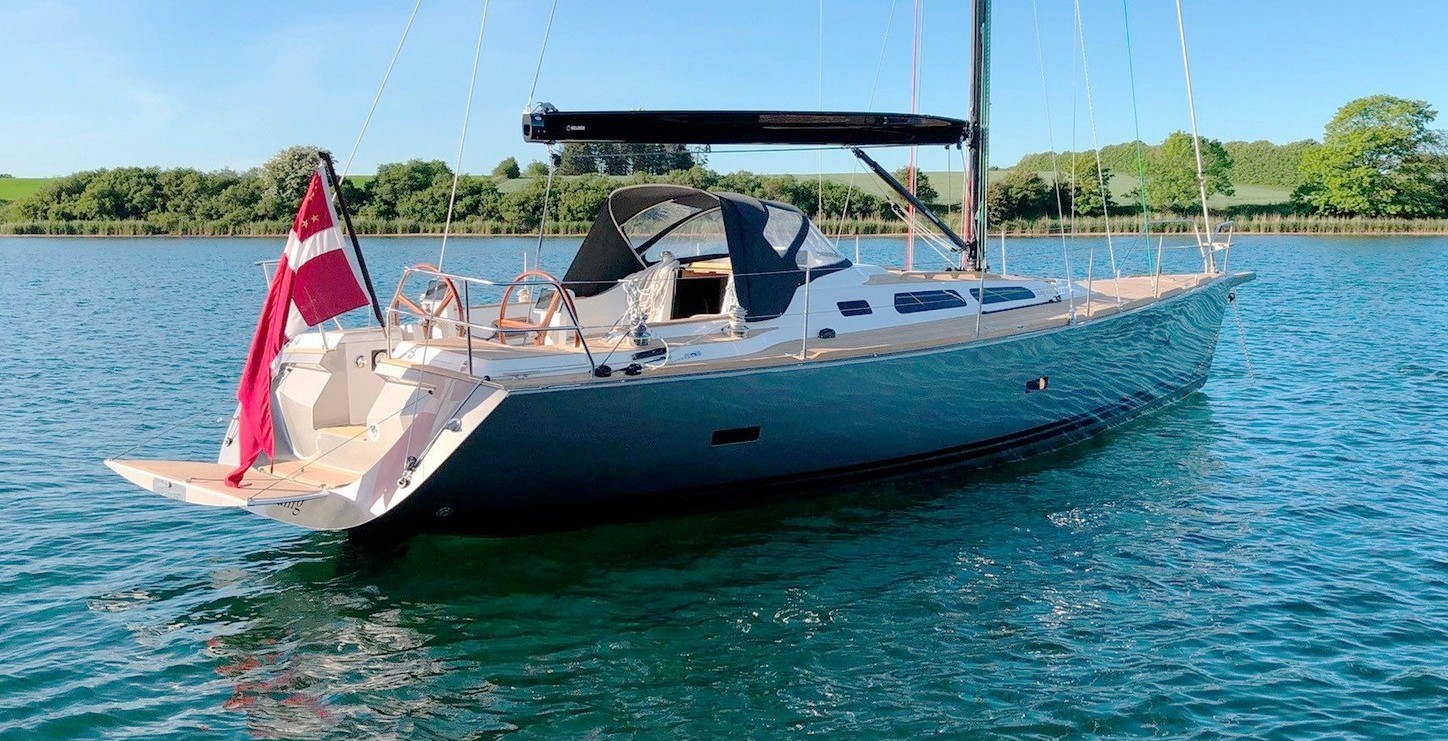
This is a yacht for lovers, not for the ones that are rational about interior space, cruising amenities or even overall top speed, for a 40ft cruiser-racer. No, this boat is about sailing fast, but in a particular sailing spirit, a traditional one, where the boats are supposed to heel and glide over the water, slicing the waves, going fast with small sails.


Then he took us to the nearby marina where he had the first 40.04, his personal yacht, that as I have found later was fully equipped for racing. It was a windy and cold morning blowing over 20 knots, gusting 30 but the waters of the Kolding Fjord were protected, and we (me and my wife) were used to sail in strong winds.

The Bavaria 36 was a 2003 model bought in 2002, in Palma de Maiorca, and sailed home by us to Portugal. Equipped as it was it had many qualities: it was very light, sailed very well in light to medium winds, was fast downwind, but with strong wind and waves, against the wind, it was a deception: it had not the power or stability to sail close to the wind, and I had to open the angle a lot to generate the power to sail, resulting in a very poor VMG.
Because I was faster than friends that had similar boats (faster upwind than an Oceanis 393) I soon understood that it was not about the Bavaria but about the type of design, beamy boats with a low B/D, and my trip to Denmark, to test the Luffe 40.04, had to do with finding out how it would be to sail a boat that was the opposite from the Bavaria, narrow and with much more ballast, one that I was sure would have not the problem Bavaria had, sailing upwind, in strong conditions.

When Oluf took the Luffe out of the Marina and started to pull the main out I was really surprised: it was a racing 3D carbon sail with no reefs! I had no idea how he was going to sail the boat with that big sail with no reefs in a strong wind.

 |
| Luffe 40.04 |
I loved the boat and the way it sailed but my wife, that knew already something about boats (we had already tried several different types of sailboats), excluded it right away from the list of possible replacements for the Bavaria:
The narrow hull gives a lot less form stability than a beamy one but to the bigger stability corresponds a bigger drag and the need for bigger sails. Because the Luffe had a much bigger B/D on a deeper and more efficient keel, the power/drag was much bigger than the one on our Bavaria, and the motion upwind more comfortable, due to finer entries and less beam but to get power the Luffe needs to heel, to maximize the ballast effect.

The difference between the way this Bavaria will sail, compared to the Luffe, will be bigger than the one with my older Bavaria, and the difference in speed, in most situations, also. I find this Bavaria a mystery and it is hard to understand how the 2003 Bavaria 36 displaced 4700kg and the C38 (also a 36ft) displaces 9070kg.
 |
Below Bavaria C38 |


That shows on the results, being the Luffe overall only 25th in 34 that finished the race, but even if we know that the boat was not sailed as well as others, the comparative results in real-time can give some good information, especially because we can access the times in different phases of the race, with different wind and points of sail.
If we consider the full race, which had many different points of sail and wind conditions, the Luffe in real time made it in 5 days, 16 hours, and 38 minutes, slower by 4 hours and a half than a very well sailed J109 (8th overall), one hour and a half and two hours faster than the other two J109, also better sailed (13th and 14th overall).
It was about one and a half-hour faster than a Sunfast 3200 and a JPK 10.10, also better sailed (11th and 12th overall). It was slower than a J122E by 18 hours and slower than a JPK 10.80 by 12 hours, but these two boats were extremely well sailed, and that's why they were 4th and 5th overall, while the Luffe was only 25th overall.

If we look at the first part of the race, which was raced with very weak winds, mostly upwind, we can see from the real times at the end of the Messina Strait, that, even if in the overall provisional classification the Luffe was only 23th, in real-time it was faster than the JPK 10.80, faster than all J109 and only 16 minutes slower than the J122E, with 1 day, 3hours and 29 minutes of racing time.

To understand how good Luffe is in light wind and upwind performance if compared with the lighter but much beamier Pogo style sailboats, even racing ones, we can see that in Stromboli the top racing Class 40 "Made in Midi", professionally skippered by Kito de Pavant, with a full crew, had only 4 hours and a half advantage (in 38 hours of racing) and the Luffe was 2 hours and a half faster than Vaquita, the other racing Class 40 and 4 hours faster than the Pogo 36.
It is good to remember that the Class 40 is a full racing boat, very light, almost without interior, huge draft, water ballasts, the Pogo 36 is much lighter than the Luffe with a very spartan interior, and that the Luffe 40.04 had teak on the deck, over the cabin and cockpit and had a very high-quality cruising interior.

Overall a J122E or an XP38 are faster than a Luffe 40.20, except in light wind; downwind with medium-high winds and strong winds the Pogo 36 will be much faster, but not faster in what regards to overall performance, depending on wind strength. In what regards to sailing performance maximization it is pretty much the opposite of the Pogo, having a stellar performance where the Pogo is weaker, and vice-versa.

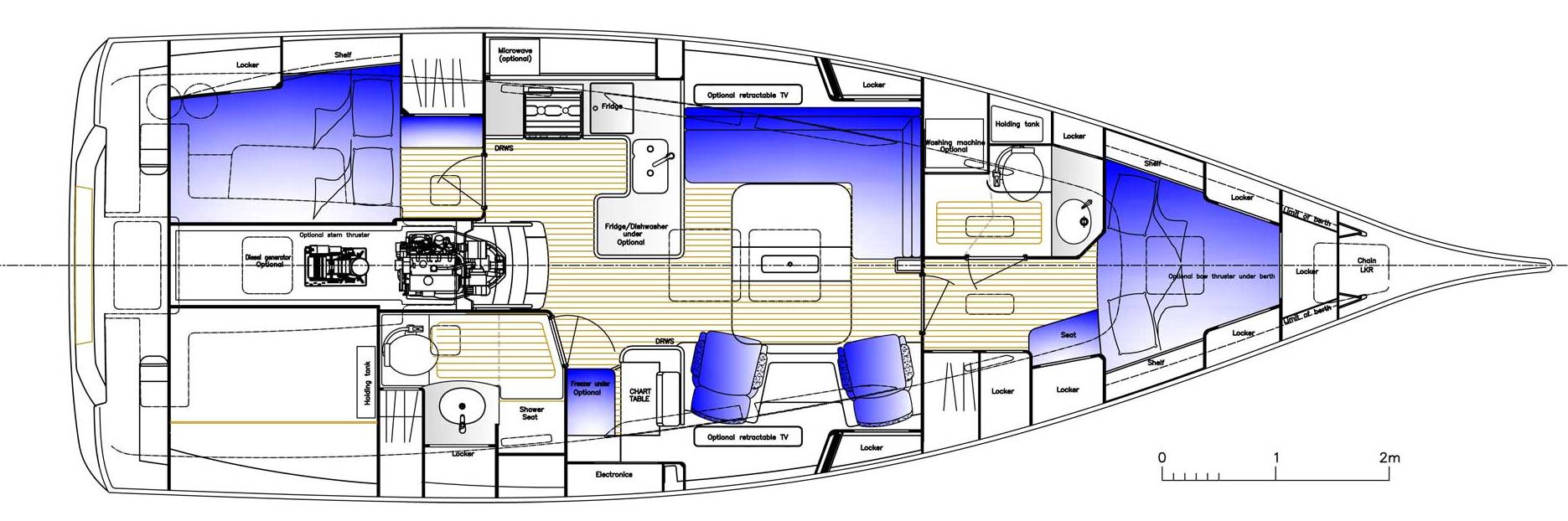
The interior, the galley, the head and the cabins would be the size you would expect on a 36ft boat and smaller than the one of the very beamy 36ft boats, like the Bavaria C38 or a Pogo 36.

The sailors that would buy a Pogo 36 or a Luffe 40.02 have in common the love for fast sailing, but a different type of fast sailing, and the ones that will buy a Pogo would never buy a Luffe, and vice-versa. Having in common being fast the two yachts are opposed in many sailing performance aspects and in the interior concept, as a cruising boat.
Both sailors will not need much to be happy while cruising, but the guy that likes the Pogo enjoys having much more space, doesn't mind a spartan interior, the guy with the Luffe, doesn't mind having a much smaller interior, but would not miss a luxurious and cozy interior, the kind of guy that prefers small and perfect, than bigger, even if functional.

 |
| Bavaria C38 |
Having a Luffe 40.20 has another advantage: the hull is 17 years old and it looks almost as well now as it looked 17 years ago and the boat performance, 17 years later, continues to be a great one. How many boats will look that good 17 years after their launch? And presumably, it will look as good 17 years from now, simply because that type of hull, maximized for light wind and upwind sailing has reached a plateau, many years ago.

The finish is amazing in both boats being the Faurby more traditional on the interior design and cabin design. The Luffe is just a bit more performance-oriented and with a better regatta track record, but in what regards cruising I would say that they are pointed to the same type of sailor, the boat dimensions are very similar.
If not for using it mostly as a racing boat, the choice between them will be a question of personal taste since what they offer in sail performance, cruising amenities and prices is not very different. The new 40.02 looks just a bit less classic than the Faurby 400.
 |
| Faurby 400 |
The Luffe costs standard 243 624 € and the Faurby 277 143 €, the Faurby seems to come with slightly more equipment standard but both boats have a big list of options that will be needed to make them look like the ones on the photos. Both prices are at the shipyard without taxes. Beauty, perfection and quality do not come cheap, that's for sure.
 |
| Faurby 400 |
These boats offer Hallberg Rassy quality, if not superior (in fact in what regards hull building they have a superior quality) and because they are much narrower and with a much smaller interior they offer a better performance/interior quality/ price ratio and will be an interesting choice for individualists that have very particular tastes, as different from the herd as these cruisers are different from all others.
 |
| Faurby 400 |
And I am very happy that is the case, it would be a shame that such beautiful boats like Luffe or Faurby ceased to exist. The boat market would be poorer without these two family brands, still owned by the same sail enthusiasts that had created them.
Their sailboats remind us of the true meaning of the word yacht, by opposition to sailboat cruiser, remembering us that a yacht was once always connected with a luxury finish, perfection, and beauty.