Friday, March 7, 2014

JPK 10.80 - First time out / first race


"The wind is from the west northwest between 20 and 30 knots on a delivery from the Larmor -Plage Trinidad / on / sea... the least we can say is that we will not be disappointed!
Starting with a close reach between 9 and 10.5 knots ...then we send the code 5 and went to planing mode between 12 and 16 knots of speed with a great stability.

The crew of eight waited inpatient his turn to take the helm and have fun. The lucky one was Eric Mordred that took advantage of some momentary higher winds (30 k) to sail the boat to 17.92K.

Less than 3 hours after our departure from Lorient we were already in Trinidad with a big grin !"
Then they talk about the results on that regatta Saturday 22 that I had already talked about on sailnet (2ème Challenge de Printemps) and where they made these results:

1st race:
SUN FAST 3600...........01:20:50
A 35 ........................01:20:56
JPK 10.80...................01:21:05

2nd race:
JPK 10.80....................01:27:38
SUN FAST 3600............01:28:38
JPK 110.......................01:30:15

3rd race:
SUN FAST 3600.............01:11:12
A 35............................01:11:53
JPK 10.80.....................01:12:13

4th race- coastal race:
A 35 ..........................01:10:42
SUN FAST 3600.............01:11:19
JPK 10.80.....................01:12:29

I said about those results (in real time):

"Very interesting results that show two boats very close in performances (JPK 10.80 and Sun Fast 3600) and also a A35 that is very close too. Pity we had not a JPK 10.10 racing. The 110 is a bigger, older and slower boat.... and even so come in 3th in one race."

Regarding those races they added these interesting comments:

"Saturday 22 the wind is perfect between 12 and 15 knots on the first regatta...having as main opponents.. the new Sun Fast 3600 and A35 ...clearly, we see immediately that there will a close match between these 3 sailboats with very small differences in the lead."... (they made 3th and 1st that day).....Sunday 23 the wind is sustained between 16 and 20 knots . ..On the first race of the day , we go fast enough to go along with some IRC1. A J122 an a A40 are very similar in speed and that is good!.. Unfortunately, the pulley genoa halyard explodes under load and we have the genoa on deck while repairing. (they made their worst results, 3th on the 1st race, 3th on the 2nd.).."In summary, it is clear that the boat goes fast and even very fast because without no validated reference or adjustments we are already fighting for the lead."http://www.jpk.fr/?mode=actualites
......
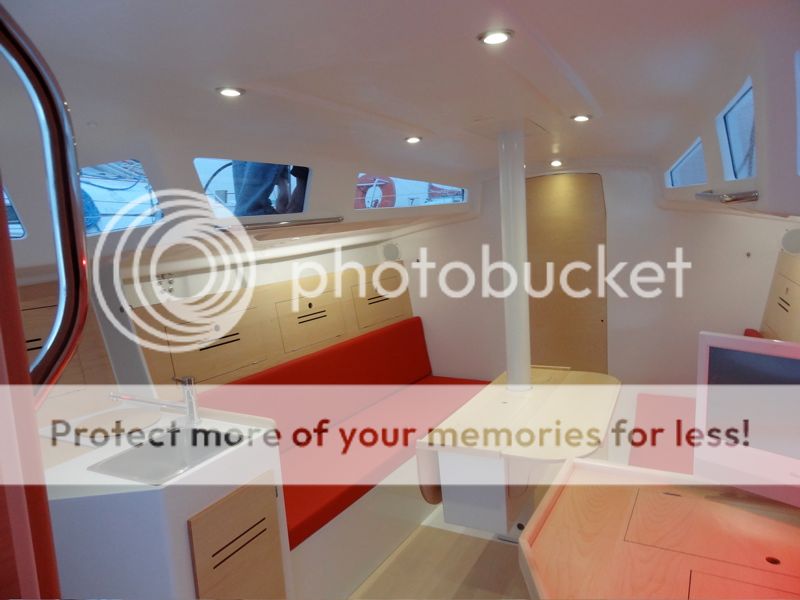
Sure that is a very fast boat, probably slightly faster than a JPK 10.10 or a A 35 on a Transat race but a boat on the same league in what regards regatta racing with the A35 and the JPK10.10, even on real time and the ratings of the the two other boats are smaller meaning that the JPK 10.80 has to be a bit faster on real time to win in compensated.

A great boat no doubt but I sometimes feel that many have a wrong impression about the performances of these very fast cruiser-racers and forget that size is very important in what regards performance. For instance Eric boat, a cruising Pogo 12.50 is way faster than the Sun Fast 3600 that is practically a racer (or than the JPK 10.80), the same in what regards a J122. Even a Pogo 10.50 has a superior rating. I don't think it would be a match on a regatta but in what regards a Transat would be probably faster.

Mr Pelicamo
I should have come over here first, before translating the account from French and posting a summary over on the old Interesting Boats thread at Sailnet. You did a better job and have more detailed information.

The JPK 10.80 result was quite good, considering the hardware failure as well as the fact they were using a borrowed 2011 main from an M34 and hadn't done any rig / instrument calibration. And hanging with IRC 1 boats upwind is very impressive indeed. Obviously they know what they're doing and are going be quite competitive in this boat, once the new Ullman main arrives and they get everything dialed in.


Hi Pelicano :-),
Thanks. Yes I agree, it is very impressive that they could hold on with an A40 and a J122 upwind even if I cannot see how that is possible with 16K wind unless the other boats were not sailed to their potential. I could believe it downwind but upwind?
I had a look at the results of that race in IRC1 and regarding the J122 and A40 he mentions, in fact the boats had done the race in about the same time: They have made it in 1h 12m 13s the J122 in 1h 14m 35s and the A40 in 1h 12m 19s but the other A40 that won the race made it in compensated made it in 1h 08m 27s (all times are real times).

Anyway it seems a very promising boat to me even if the real prove will be the next Transquadra, since this one was designed more as a short crew offshore cruiser-racer than a regatta boat. Considering that, the results in regatta are just even more impressive and It seems that the quite good cruising interior does not slow it down.
Do you have noticed that JPK is going to race this one with the owner on the Transquadra? Lucky guy. He does not only has the pleasure of making the boat, earn a life with that and in the end he is going to race "his" boat with the guy that had payed for it ;-)

OCEANIS 37

DCR
Hi Paulo - I was not a Sailnet member but followed your Interesting sailboat thread which I really enjoyed. Especially since you liked the Oceanis 37 which I love as a nice simple little cruising boat. I hope you continue with this blog which I will follow with interest.


Hi DCR!
Yes the Oceanis 37 is a great and relatively inexpensive cruiser, now even more, since the new 38 has come to the market. A boat with a good sailing performance a lot of stability and a nice interior with a big storage space for a 37ft boat.

The boat is still very interesting and certainly one of the boats to look out on the used market. The Oceanis 37 is so good that when it appeared on the market I considered having one upgraded for me (like Anders thought to do with the Oceanis 38), bettering its sailing performance. In the end with all those modifications (I asked for the price) the boat was not inexpensive anymore and did not justify the price difference for a true performance cruiser. Performance cruisers are substantially more expensive than a standard mass production cruiser like the Oceanis 37, one of the best for its price and boat type.

On the US they still sell the boat with a a big difference of price to the Jeanneau 379 and I have to say that if I was on the market for that type of boat, with a price difference of about 20/25000USD, I have many doubts I would chose the Jeanneau. There are not many differences on the sailing potential. That money would be enough for the boat maintenance for some years and would allow me to spend a lot of money in cruising extravaganza like some fancy marinas and some great dinners ;-)
A bit odd for me to say that since I like new boats and state of the art design and that is a measure of how good and advanced I considered that boat regarding its time: It's a 2006 great design by Finot/Conq.

http://sailboatdata.com/viewrecord.asp?class_id=7441

Anders:

Hi again Paulo! A quick comment on the Oceanis 37. Yes, a nice boat but for me totally out of the question. Why? A single small steering wheel in the middle so not decent possibility for the normal steering position sitting on the side deck.

Hi Anders,

Maybe I was not clear. I prefer the Oceanis 38, that I think is clearly a better boat than the Oceanis 37. what I said is that for a difference of about USD 25 000 I would have doubts in choosing a Jeanneau 379 over an Oceanis 37. I like a lot more the Oceanis 38 than the Jeanneau 379 that seems to me to be the less accomplished boat from the Jeanneau line. The Oceanis 37 could have as an option a bigger wheel but the 38 has a more modern hull and not only two wheels (that set up has several advantages) as well as two rudders, that are a better overall solution on a cruising boat and not only.

Regarding the Oceanis 38 I have only a doubt and time will tell if it is unfounded or not: The boat will have enough resistance to torsion (in demanding conditions) with a skeleton main bulkhead at the bow? I mean the one that separates the front cabin to the saloon that on that boat is really minimal. But of course, as we have already discussed I am talking about the boat as a family cruiser. The performance can be enhanced and in that case in some points of sail the boat can be as fast as some performance cruisers, but not on others, specially upwind. for that the boat would need a superior B/D ratio. The same with the Oceanis 37. What both boats have in common is a very interesting price for what they offer on the standard version.

Anders:
I do not think you can enlarge the wheel on the 37 that much. The Pedestal is not high enough. I did it once on a Dufour Classic 38,  it was much narrower on the aft cockpit and even so  I had to cut the cockpit locker lids slightly and  the wheel was still slightly too small with the boat heeled.


Paulo:
They had an optional bigger wheel for the boat but you are right, it would never be a perfect arrangement. The boat was not designed for that. To be perfect and to give a comfortable position seated on the side that wheel had to be huge, like on my boat or in any large transom performance boat and for that it had to " enter" the cockpit deck on a slot. That is one of the reasons that the two wheel setup has so quickly and almost universally adapted. Anyway the bigger wheel would make it better and  will give a more comfortable steering position than the standard one ;-)

Thursday, March 6, 2014

VIDEO: BEAUTIFUL AND A BIT SCARY:

FREE BOOKS: 55 MYTHICAL SAILBOATS

INTERESTING AND FREE:  (French): something to read tonight ;-)

Mythical at least by a French perspective (some fast ones too). If you cannot read French at least you can look at the pictures and lot's of them. That's the Hors Serie from the French magazine Bateau that they have made available online for free.

Try directly:
http://www.calameo.com/read/00244920963ec5c869d2f
If this does nor work click on the bottom and do the file:
http://www.a-p-c-t.eu/E06032014105935.cfm


BACK UP NAVIGATION LIGHTS

Do you already have stayed without one of the navigation lights while sailing at a high traffic coastal zone? That can be quite stressing, specially if the sea conditions does not allow for a change of  a bulb.
It happened to me several times but on last one, with a nasty F6 and all the night ahead on a high traffic zone (between Zaquintos and Italy), I decided that it would be the last.

So I started to look for a back up mast tricolor but I was quite shocked when I started looking at the prices. Of course I want led lights for low consumption but found out quickly and confirmed it in Dusseldorf, that all those top mast lights are very expensive even if only wanted as a back up system. The prices goes for around 500 euros and that was just too much for me...and then I found in Dusseldorf something for a bit more than 200 euros:
http://www.ledconcept.fr/feux-tricolor-3-secteurs-plus-feux-de-mouillage-led-a429.html
 and I was almost to buy it at the boat show..... and I am very happy I did not because later I found the same thing for almost half the price...and that is just to good not to share. ;-)


It can be sold as a tricolor mast for 55 euros or as a tricolor plus am anchor light for 129 euros, both including VAT.
http://www.nasamarine.com/proddetail.php?prod=SupernovaCombi
http://www.nasamarine.com/proddetail.php?prod=Supernova

I had already mine at home and they include a mast mount. I have opted for a simple tricolor wanting to maintain independent systems for more reliability.

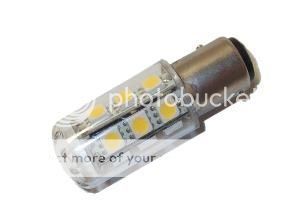
Off course, there is a catch, as most of the led lamps these ones only have a 2NM range and that makes them unsuitable for boats with more than 12M. In fact most led bulbs only give a 2NM range and the few ones that give a 3NM range are very expensive. That explains why those top quality mast lights are so expensive (even if someone had told to me, not very reliable). Anyway and even if I have a 12.50M boat, I only want them as a back up and certainly a 2NM range (instead of a 3NM) is much better than nothing.

Talking about the replacement of the existent bulbs on the traditional system on my boat (that is already led but not with 3NM bulbs) for 3NM bulbs the best I could find regarding price was this offer: 3 for the price of two and a half (80 euros) from the same manufacturer that was selling that tricolor for almost the double of the price LOL.
                                      
http://www.ledconcept.fr/pack-de-21-a-50-ampoules-de-navigation-bay15d-a-led-a436.html

Can someone find better or better priced regarding a led lamp to substitute a 25/30W incandescent bulb?

SUN ODYSSEY 349

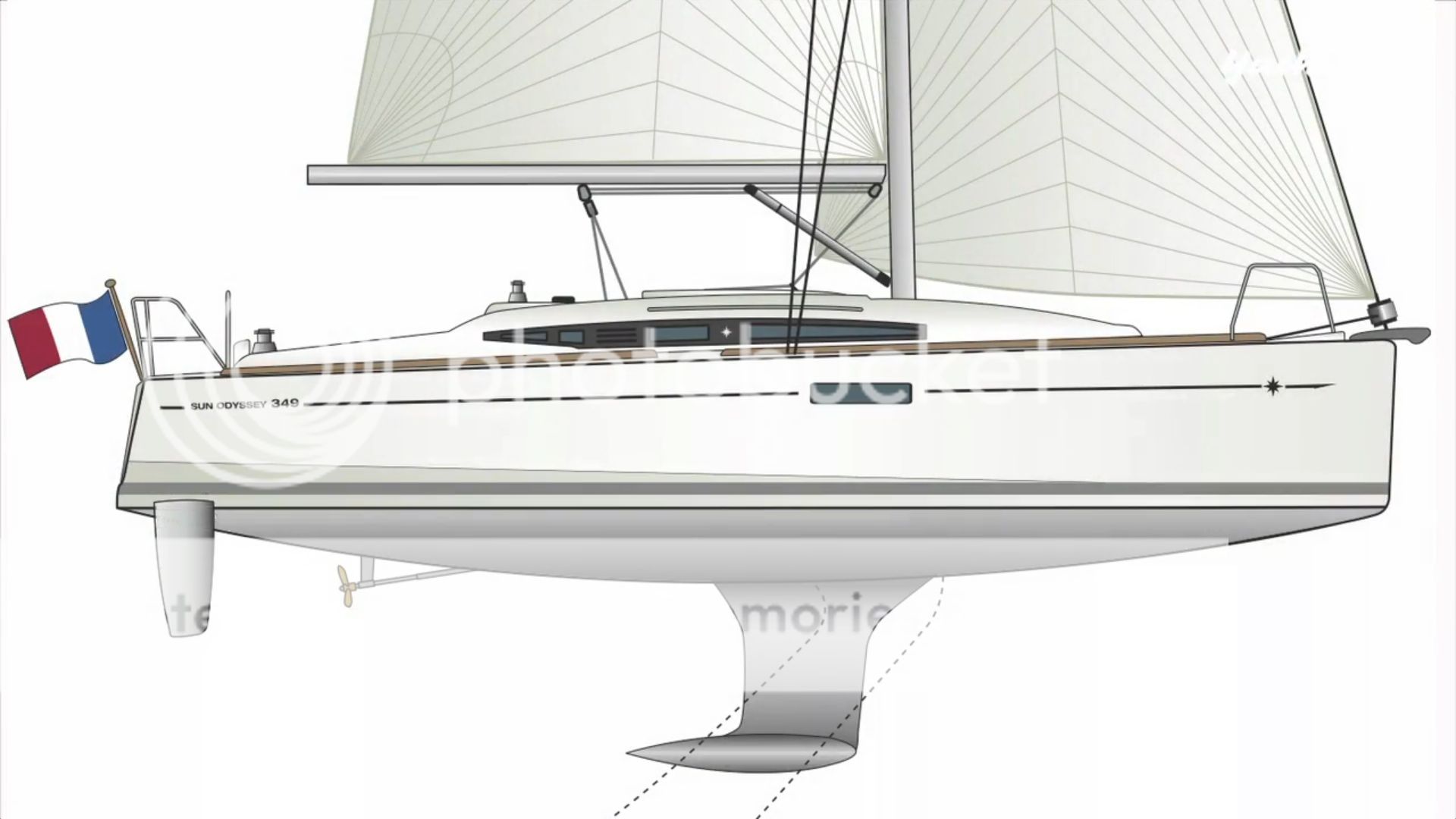
First movie with by yacht.de that had already tested the boat. The movie is very interesting not only because it is the first and because they give a good view of the boat but also because they tested at the same time a version with a standard keel and a version with the new swing keel version. The performance does not seem to be very different and that is just great.

Here is the link:
http://tv.yacht.de/video/Starke-Rivalin%253A-Sun-Odyssey-349/149df537a516e6a7642844be3ffb40b1

Eric De Smedt - SWING KEEL PERFORMANCE

Paulo,
I expected that, even with a similar centre of gravity, the swinging keel would perform at least a litlle better because of its higher aspect ratio?

Hi Eric!
If I understood rightly the new swing keel will have 2.54M while fully deployed and the standard keel will have 1.98M. I believe they are designed to provide the same righting moment. I don't have enough data on the new keel but it is possible that the weight of the keels are similar, maybe even the swing keel a bit lighter. The drag of the fixed keel will be smaller but the grip of the swing keel upwind should be marginally better, as you say, due to a bigger draft. Maybe you are right and not only it matches the performance of the standard one as it can improve a bit the angle upwind and that can be a better performance improvement than the loss due to a slightly bigger drag in all other sailing positions.

They do not mention it on the video (and the performance of both boats seem very similar) but as Anders reads the magazine I count on him to post about what they say regarding that on the test boat article.;-)

I don't know if they are going to make a deep draft performance version of that boat, I would say a torpedo keel between 2,15 and 2,30m. A keel like that should have a marginally better performance than the swing keel. Regarding the standard one with 1.98M, I think that if not better the swing keel is certainly not worse.

http://www.performanceboating.com.au/wp-content/uploads/doc/105/2013/1542-Jeanneau-SO349-inventory-2014.pdf

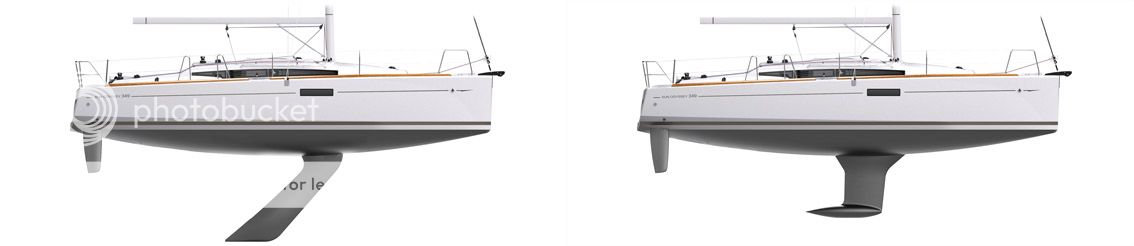
SO 349: MODERN SWING KEEL / MODERN TORPEDO KEEL


Let's take the opportunity that has been given by Jeanneau when they created the conditions for boat testers to test simultaneously their version of the 349 in the standard keel version and swing keel version, these two:
The drafts are 1,98m for the standard keel and 1.26m/2.54m for the swing keel. Regarding the weight of the ballast they refer the same weight, being the swing keel calculated to give the same RM but in fact I read somewhere that the CG of the swing keel was just a little bit lower and that should give it a marginally lighter keel (for the same RM). Regarding this subject I had already said:


"Lifting keels are around for many years and some, like the Southerly even have ballasted ones but only with a percentage of the total boat ballast on them, but hydraulic lifting keels with big draft and all ballast on the keel are a relatively new concept even if they are widely used already by many smaller production French shipyards.
They are by far the best solution in what regards a need of small draft maintaining boat performance in boats were a truly lifting keel (vertically) occupies too much interior space and that means all boats smaller than 40ft and even bigger.
Regarding lifting keels, if well designed on relatively small sailboats these keels have the advantage of allowing for more draft when deployed lowering the CG and giving a great performance upwind."

Eric had pointed out that the version with the swing keel had probably a better performance due to the higher keel aspect ratio and I replied saying that probably that was true regarding upwind performance but not in what regards downwind since the torpedo keel would have less drag and that if that torpedo keel was a deep performance keel, with about 2,20/2.30m, I believe it would have a better performance than that swing keel.

As the boats have been tested by several boat magazines I was very eager to see if we were right so as soon as I received Voile magazine I went for that test and I was quite pissed when I found out that they did not had taken care to verify if both boats were on the same condition in what regards tankage and they were not, having the one with the swing keel more water on the tanks (full tanks) and a stored dinghy. Even more unsatisfied when I discovered that boat test were made at the same time, with the guys from the Yacht.de magazine on one boat and the French on another (they exchanged the boats) so the same somewhat tinted results will be extensive to the Yacht.de test.

Well, something is better than nothing so the results were these: Close to the wind the performance was identical. On a beam reach the performance was identical. Downwind the performance with the boat with the standard keel was better and the boat slowly but without any doubt went away.
To know if this was due to a less drag downwind on the standard keel (since the advantage of the bigger grip of the deeper swing keel has not any beneficial effect downwind) or due to the extra 150/200kg of weight (water + dinghy) on the boat with the swing keel is impossible to know, as well as if the performance would be better upwind or on a beam reach without that weight. Anyway a very close match but one thing is true....... the SO 349 looks good with a Swing keel ;-)

Sosa - SWING KEEL UP DOWNWIND?

Hi Paulo,
First I would like to thank for not giving up and for keeping with this fantastic blog. You (as well as all the other contributors to the threat) have been a valuable source of information. It’s is the first time I ask anything in a blog/forum so here we go: Do you know whether when they were sailing downwind, the Jeanneau with the swinging keel had the keel up or down? Do you think there would be any benefit of keeping the keel up in these conditions?

Hi Ivan,
Thanks, you are welcomed. I am sure they had the keel down when sailing downwind. French aluminum centerboarders pull the keel up while sailing downwind and that allows them to sail faster with less drag but in that case the boat stability is not altered since they don't have any significant ballast on the centerboard. That is not the case with a swing keel of this type that has all the ballast on it. when pulled up you are diminishing significantly the boat stability, not a thing you want to do while sailing, even downwind.

Anders Bengs - SUN ODYSSEY 349

I looked through the Yacht de magazine boat test on the Jeanneau 349. They were in general very positive and where up to some extent surprised by the fixed keel version being slightly quicker. The polars say the opposite. But they also concluded that it was difficult to evaluate since the swing keel version had a fixed propeller and full tanks.
They say that the boats are surprisingly stiff and for that the form stability contributes a lot. They also say that the boats sails beating on choppy seas with a soft motion. They also liked the innovative interior (as I did when I saw it on the boat show in Gothenbourg).

What they do not like is the new pricing system used by Jeanneau and Beneteau. Sure, you can get a boat cheap but when properly equipped it gets expensive. For instance, the Oceanis 38 fully equipped is more expensive than the Dehler 38 standard and that with important equipment of lesser performance/technical quality.
One more comment regarding swing keels. Sure, it’s nice to get into shallow bays/harbors but while sailing I feel somewhat scared by the thought of having it nearly 3 m below the water line. In many of our marked transits, up here, and in the shallow waters near Denmark, 3 m is stretching it over some stones or sand bank. But of course, it can be always swigged up. But how well does the boat maneuver with the keel up?

Hi Anders,
Thank you very much for your collaboration that was just great.
Yes I agree with the German testers, a fixed propeller on one boat and a feather one on another will make that comparison even less accurate than the difference of weight regarding the full water tanks on only one. The French say nothing about that.

Regarding the price of equipping a standard boat with equipment, specially in what regards to better its performance, going skyrocket the ones that started with that were Bavaria and Hanse LOL. When I bought my Bavaria 36 in 2002 the standard price was about 90 000 euros and the boat costed me close to 150 000 euros ;-) Also when some years back I wanted to improve an Oceanis 37, making it a performance boat, I found out that it was not more expensive to buy a standard performance cruiser and as you say that one would come with a better performance hardware anyway.

Regarding the question about maneuverability I believe that the keel up will only make it difficult in tight port maneuvers, not in normal handling but Eric is the one that can reply to that.
Eric - SWING KEEL
A fixed three blade propeller... that must cost at least a knot and will probably be much more important for speed than the keel version.

There's absolutely no way to sail with a swinging keel partially or fully up.First because the head of the keel is only firmly held in the keelbox when the keel is fully down. As soon it is lifted, the head rotates out of the box and is not firmly held anymore. Sailing would then be dangerous.Secondly because lifting the keel shifts the CG (and lateral resistance) upwards but also backwards. This makes the boat unbalanced to sail.And third because lifting the keel does not reduce drag, on the contrary. The lifted keel is less hydrodynamic. When motoring, lifting the keel reduces speed with almost a knot.
The lifted keel increases directional stability (which is OK when motoring) but therefore reduces maneuverability, transforming the boat in some kind of a longkeeler with a greater turning circle. Add to this twin rudders that get almost no prop wash and a light hull, and you know docking this kind of boats can be challenging...

Thanks Eric,
Yes, a fixed three blade propeller would take a lot of speed to the boat. I don't know if a full knot but at least 1/2K and that is already huge. The French say nothing about the boats being equipped with different propellers and I find hard to believe that on a beam reach the boat with the swing keel (with a fixed 3 blade propeller) could have maintained the same speed of the boat with a standard keel with a feathering propeller. it just does not make sense.
Thanks for your explanation about the use of a swing keel. On the only time I sailed on a boat with one the skipper had to lower partially the swing keel to be able to maneuver the boat on the marina and to put it back on its place.

VIDEO: 33ft SAILBOAT ON 50k WINDS

So, since some of you are around already (welcome to all :-)  let's start with a great video, a recent one, that shows how seaworthy a Benetau Figaro II can be, if sailed expertly, even if pushed over the reasonable for the conditions:

Just some days ago Nicolas Lunven and Eric Péron had a filming section scheduled for February 28  and even with 50 to 60K winds and Storm Andrea on the way they decided to keep the appointment. Very impressive images of this duo that is training for the next Transat, the AG2R. They said that besides having an appointment to make a movie they wanted to test the boat in extreme conditions to see if everything worked fine. The only thing that broke was the VHF antenna support. a stronger one will be fitted.

It seems to me these two are ready for the Transat :-)