Saturday, March 22, 2014

THE FIRST BRAZILIAN LADY TO CIRCUMNAVIGATE SOLO

Izabel Pimentel has just arrived at Rio de Janeiro this month completing a high latitude solo circumnavigation on the company of his cats. The idea was a non stop circumnavigation but his small 34ft boat was rolled by a huge wave and the mast rigging was damaged. She went to Easter Island for repairs. The Story of that capsize is told here by her, a very feminine description :-) It is in Portuguese but you have a translator installed. Very interesting read :

http://izabelpimentel.blogspot.pt/search?updated-min=2013-01-01T00:00:00-08:00&updated-max=2014-01-01T00:00:00-08:00&max-results=11
http://izabelpimentel.blogspot.pt/search?updated-min=2014-01-01T00:00:00-08:00&updated-max=2015-01-01T00:00:00-08:00&max-results=1

Izabel lives in France on her boat, an old aluminium Romanée, a design from Philippe Harlé (1973), a boat well ahead of its time and it was on this "oldie" that she circumnavigated:
http://pouvreau.romanee.free.fr/index.php?option=com_content&view=article&id=2&Itemid=2


Izabel is a system's analyst and a very experienced sailor having already made successfully a mini transat race. She is now in Brazil and will sail his boat and home to France were she lives and works. Here you can see some photos of his boat and voyage photos:

https://picasaweb.google.com/112103410413959481318

Friday, March 21, 2014

ON DESIGN: SAPHIRE 27 VERSUS SEASCAPE 27

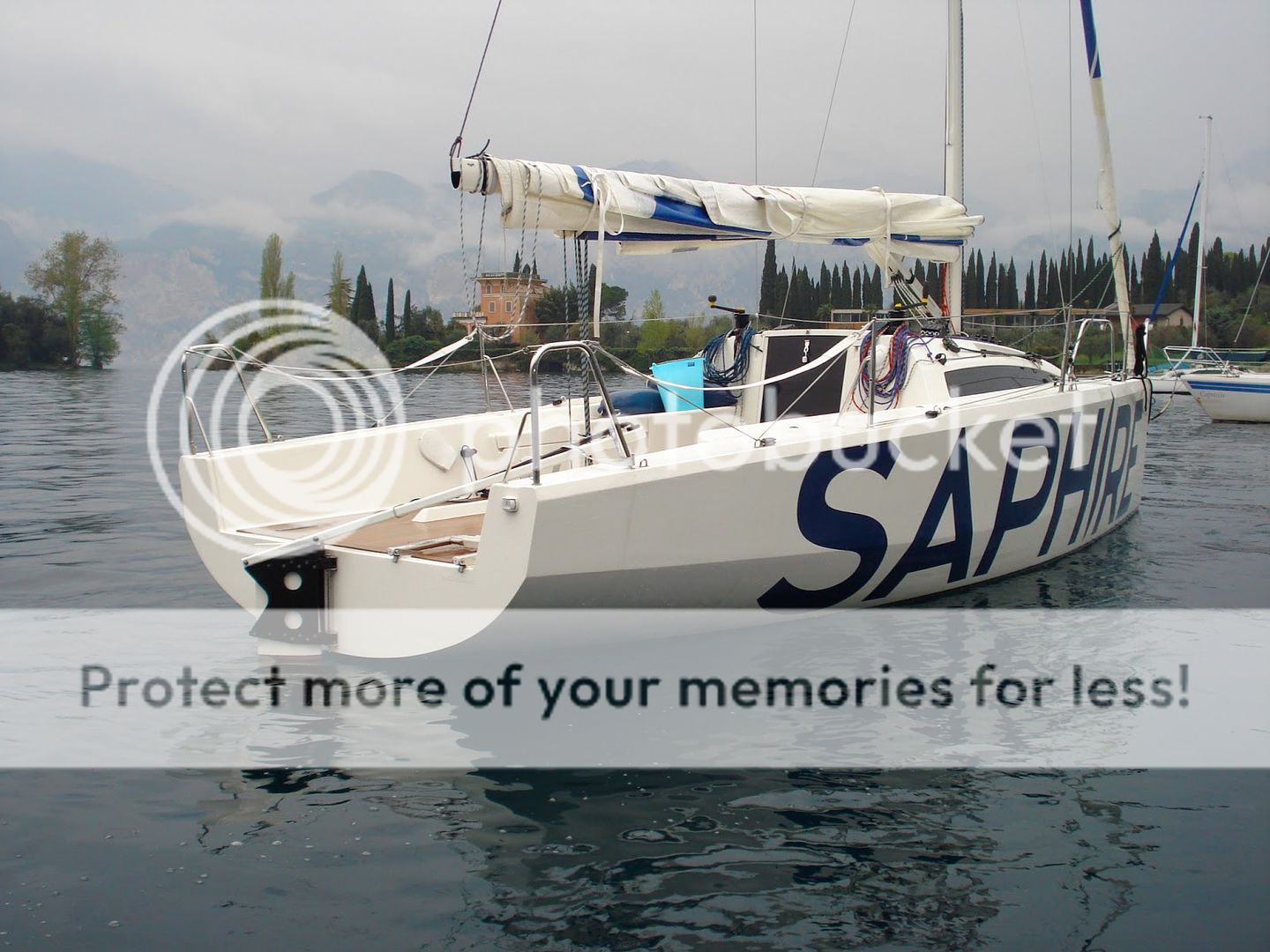
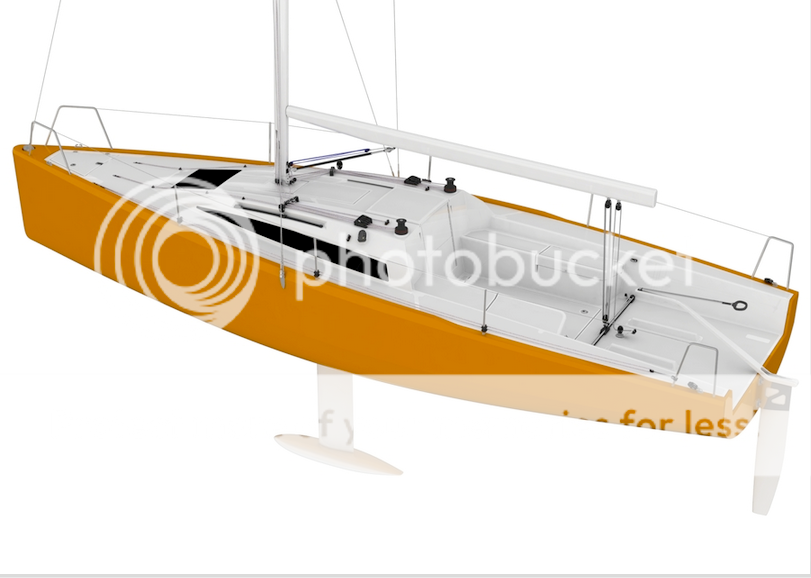
Saphier 27
Seascape 27
A first look at the boats, particularly to the large transom of the Seascape 27 would lead many to think that the Saphire 27 is a much narrower boat, and they would be wrong since the max beam of the two boats are very similar, 2.54M for the Seascape and 2.50M to the Saphire. So, this is not a comparison between beamy and narrow boats but a comparison between two types of hulls, one more along traditional lines and the other with all beam pulled back. Both boats come from designers very experienced with these type of hulls, both with winning racing boats, both successful sail racers themselves but while Sam Manuard was (is) mostly a solo racer, Claudio Maletto was a team player at least since he passed from dinghies (1978, world champion in 470) to yacht racing. As an introduction to different types of hulls let's look to a very interesting comparison (pity the Saphire is not there) but we can see the blue shape of the Seascape 27 over other well known fast boats and we can see quite well the differences:

The Seascape and the Saphire also have very different keels and rudders, the Seascape with a twin rudder setup (one on the Saphire) and both with variable draft but using the Seascape a swing keel and the Saphire a lifting torpedo one. Regarding draft the Seascape has 0.85/1.95M and the Saphire 0.40/1.70m. The ballast is very similar respectively, 600kg to 500kg and the Seascape is a bit lighter, 1250kg to 1300kg. The Seascape has not only a bigger draft as also a bigger B/D ratio (48% to 39%) a differences that the more efficient shape of the torpedo keel will not be able to compensate. The beam pulled aft as the superior RM from the hull will give to the Seascape a bigger overall stability.  It carries 45M2 of sail area upwind (with a jib) while the Saphire has 44M2 with a 106% genoa.
Let's have a good look at those two hulls and its differences, particularly in what regards the stern, and its influence on the hull design:

Even with similar beams we can see that the hulls are very different. Some would say that the hull of the the Saphire is like that on account of rating  (it has the shape of most ORC boats) and that the shape of the Seascape is better in what regards performance but more penalized in rating. The results of a test made by yacht.de, with both boats at the water at the same time, show that is not the case and that both boats (hulls) have advantages and disadvantages in what regards sailing performance.
Not surprisingly the results confirm what I have been observing for years regarding the performance of this type of hulls in racing (real times).

With light winds (5k), even being heavier and having slightly less sail area the Saphire was slightly faster and pointed a bit better. That can surprise many but I have seen similar typed hull boats, for instance the Salona 38, having a very good upwind performance in light winds, better than lighter but bigger stern boats that are faster on most other conditions. That has to do with a smaller wet surface due to a slimmer hull on the transom area. We can see that both boats have a chine but besides the beam all pulled back on the seascape (given to the hull a much more rounded shape) we can see that the chine on the Saphire is higher and will allow much more heel before entering in action. On the Seascape just with a small angle of heel that chine would be on the water, adding hull stability but also increasing drag.

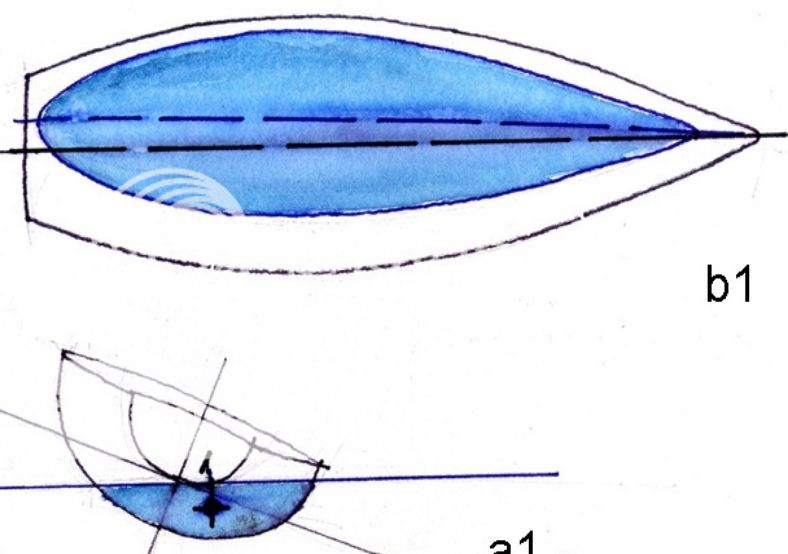
Even so, while on the Saphire it is important to have weight on the bow to raise the stern (and diminish wet surface) on the Seascape it is more important to create heel and put the boat sailing on its chine. It seems a contradiction but it is explained by the difference in hull design and the way these boats with all beam pulled back seat on the water when heeled, being optimized to sail with less drag on an asymmetric optimal waterplan, with some heel. That gives them a bigger LWL and explains the advantage of two rudders (to have always a rudder centered with the waterplan). This difference is fundamental to understand the strong points and weak points of each type of hull. Finot explained those differences on an article some years ago (see drawings on the right).

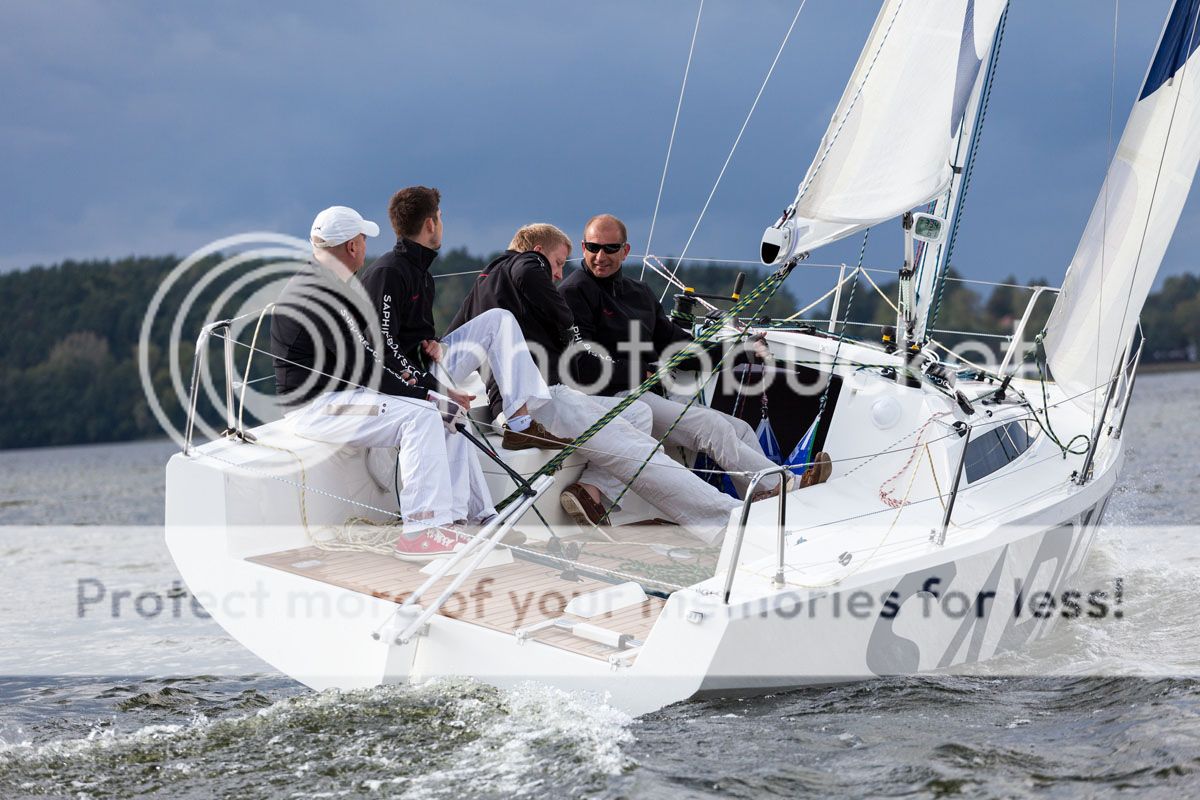
In what concerns regatta the hull design and the single ruder of the Saphire gives it an advantage regarding not only maneuverability but also the acceleration out of a tack. Still regarding steering the one of the Saphire is more informative while the one of the Seascape is completely neutral. That neutrality is less rewarding while steering manually but it is an advantage while the boat is on autopilot, making it easier to control. These relates to the differences between the designers that have a reflex on the boat: the Saphier a better regatta boat, the Seascape a better short crew and offshore boat, not only by its superior overal stability but by the the superior easiness of control and less roll limited by the transom design that not surprisingly is the type of transom that we find on solo racers.
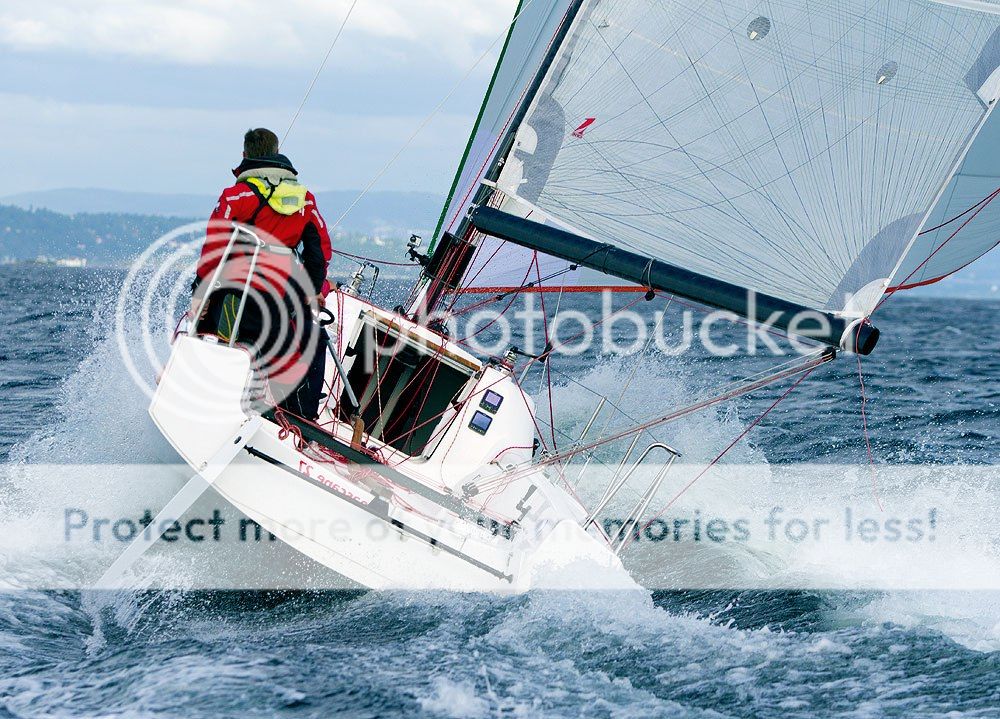
With a stronger winds (12/15K) the two boats go upwind at the same speed and  with the same pointing ability. Maybe in what regards pointing ability the superior draft (1.95 to 1.70m) of the Seascape is compensating what seems to be the better upwind potential of the Saphier hull. Anyway equal performance for both boats at least in flat water. Probably with waves the Seascape would be more slowed by a bigger wave drag and the Saphier would be faster, at least with 15K since this is the limit for the Saphire in what regards reefing. with higher winds the superior form stability and higher B/D ratio (that makes the Seascape a more powerful and stiff boat) could somehow compensate that drag disadvantage, passing the waves with more power (and less comfort). They did not had more than 15K winds but the impression they got was that the stronger the wind, the better the Seascape seems to go.

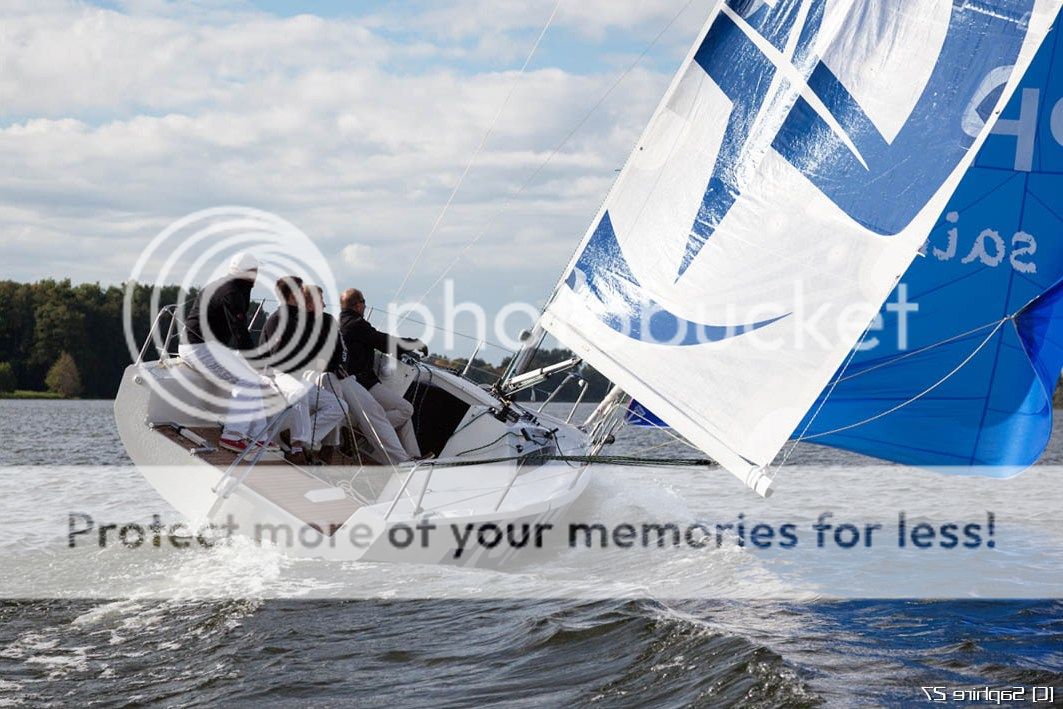
Saphier 27

They say that under geenaker the boats go at the same speed but don't say if it is downwind or at a beam reach. I assume it is on both situations but it seems clear to me that with higher winds, specially on a beam reach the Seascape would be faster since it is a more powerful boat and can maintain all sail up with more wind. Downwind with a spi in absolute terms it is hard to say but it is clear that the Seascape would be a much easier boat to sail fast even solo or with a small crew while the Saphire will require an experienced crew and a careful handling of sails and crew weight distribution.

Seascape 27
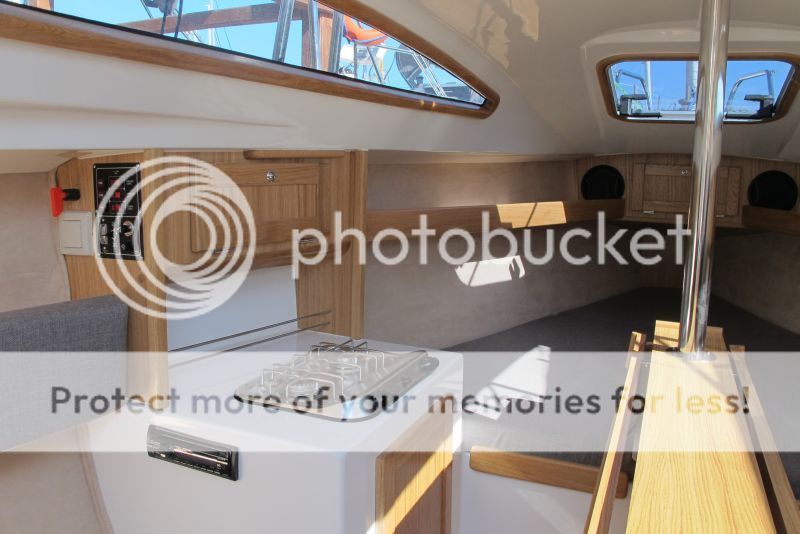
In what regards performance cruising and for all practical effects the Seascape would be a much faster boat downwind, just because it is much easier to sail it fast. The overall stability and easiness of use makes the Seascape a best offshore boat (not protected waters) and a better overall coastal cruiser in what sailing is regarded. In what regards accommodations they are a bit spartan on both boats but enough for a sportive kind of coastal cruising or for a week end with the family. Anyway regarding the interior you can see for yourself. In what concerns basic price the Seascape on the Standard version is about 20% more expensive, probably because of its hydraulic swing keel but that can be different after all extras are summed and that difference can eventually be smaller. The Seascape basic price is 63 900 euros and the one from the Saphire 49 000 euros.

Michael Tobler :
Just a quick update on the ORC weights for Saphire No 4: 1428kg and Seascape No 7: 1540kg. For the measurement they need to be equipped in the same way with engines, but without sails. As you know, overall weight has a big Impact on the stability of the boats. Unfortunately, there was only Little wind during the comparison and it will be a pleasure to see the two boats racing in strong winds.

Thanks Michael!
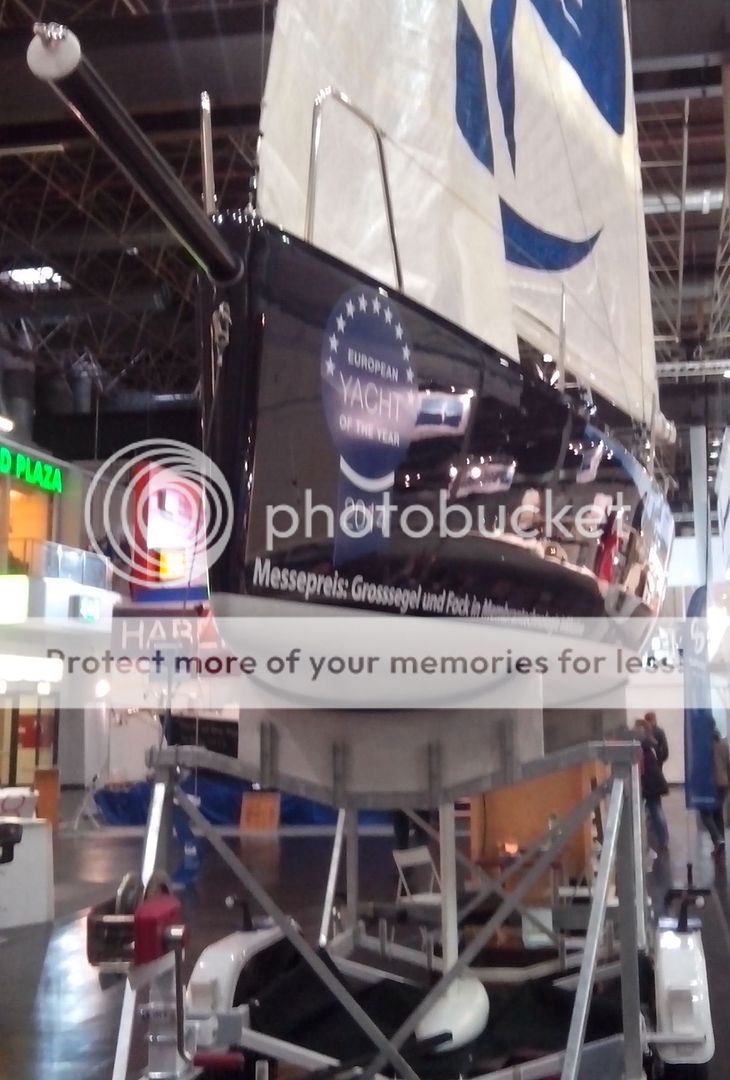
Congratulations for your lovely boat and the European boat of the year award. I saw it in Dusseldorf and it just looked great. Just for the record the weights I have mentioned were the weights stated by the builders, 1250kg for the Seascape and 1300kg for the Saphire 27. I believe by what you say that the boats were weighted before the test sail so the clarification his here. It seems that all of a sudden the "lighter" boat becomes the heavier boat ;-)

Thursday, March 20, 2014

PHOBOS 22 / SAPHIER 27

THE PHOBOS 22S
The Phobos 22 was tested recently by yacht.de and they had posted some nice pictures and a movie:
http://tv.yacht.de/video/Phobos-22%253A-Sportlicher-Kleinkreuzer/b77cda1a60aba471a57441d2acfa56ae
 They found it fast, interesting and able to sail with gusting winds. the max speed registered on the test was 8.5K downwind (with Spi) and that is just great for a 22ft boat that costs 25000 euros, but it is good not to forget that this is a boat not much different from the Viko 22s even if with less freeboard.

These boats  are practically dinghies  assisted with some ballast and boats that upwind, except in very light winds will need the weight of the crew for counterbalancing heel. Not properly the ideal type of stability for a cruising boat, even a small one. I doubt this one will have a better final stability than the 22s. Strictly a lac or a protected water boat an even so, boats to sail with care in gusting situations. This type of boat is inexpensive to build and have in their price their biggest advantage. They may be the right and possible boat for many. Certainly will be much better than nothing on in land waters...and 8.5k speed seems fun to me ;-)
http://www.boatshop24.com/en/dalpol-yacht-phobos-22-sport-year-2013-/Sailboat/357766#

THE SAPHIRE 27
Both boats have in common to be easily trailerable and they have a not a very different weight but the similitude stops there. The Sapphire is not only bigger as it is a true sports boat with an adequate stability for a weekend cruiser due to a bigger draft, almost all ballast on a bulb (on the Phobos 22 most of it is on the bottom of the hull, inside the boat) and a bigger B/D ratio. The price is also completely different with the Saphire costing in excess of two times more. It is a boat thought for sheltered waters even if will not have a problem in coastal waters if not in very rough conditions.


Here you can see a Safier 27 going downwind and probably some of you are thinking: Another maximized boat to go fast downwind, well, not this one, quite the opposite. This is an upwind boat with a good performance downwind too. This was the boat elected this year as European boat of the year (special category) and it surprised all with its incredibly good performance in very light air, being faster than other much bigger performance cruisers. This is a relatively narrow boat (2.5m) with a lifting torpedo keel (0.45/1.70M) and a big B/D ratio (39%), a boat that is not designed to be solo sailed (even if it can be) but to be sailed in optimal conditions by a very small crew (2 or 3).

This is one of my favorite small boats and I find it perfect for racing, for weekend cruising or day sailing, specially in protected waters. Lot's of sailing fun and enough interior space for a family with two small kids. The other favorite is the Seascape 27, a completely different boat that has in common with this one the size, speed (with different strong points), the pleasure in what regards sailing and to be trailerable. On one of the next posts I will do a comparative between the two. It will be interesting since they are very different boats with different hulls and keels but both with a great sailing performance (even if with different strong points).

More movies and information here:
http://www.saphireboats.com/
http://de.saphireboats.com/system/files/60/50193ea976.pdf

SAD NEWS ABOUT ANASAZI GIRL AND THE BURWICK FAMILY

They were rescued out of cape horn on very difficult conditions by the Chilean Navy after his boat lost its mast. Several big storms on the area had lead to a previous capsize due to what James described as a huge breaking wave. The mast resisted but he thinks that it was weakened and that lead to the posterior loss. At the same time it was rescued a steel sailboat also after having lost the mast and sustained serious damage. I would not have exposed a one year old child on a small boat to the conditions of Cape Horn. I am really happy to know they are all well and very sad about them especially about the kids that lost the only home they knew, their home.
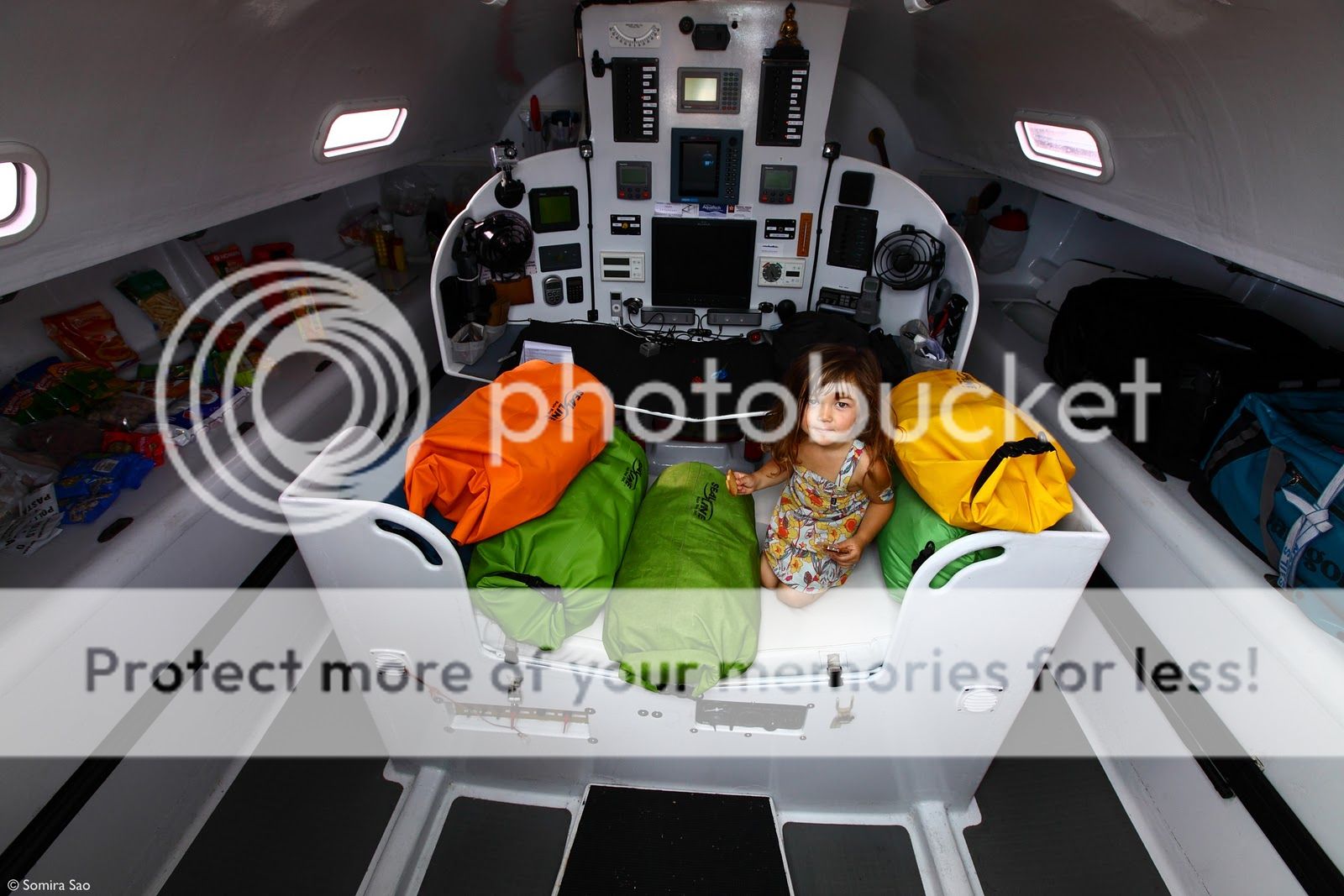
On the old thread I had talked about the Burwick family and about Somira great photos. An unusual family circumnavigating with small kids on a 13 old Finot Open 40ft racer. It seems that for them the comfort of a racer was enough as a home while James Burwick was taking them around the world on a circumnavigation. They were true sea gypsies:

James Burwick is an old salt that fell in love with a younger woman and made not only the impossible dream to start a family at a mature age but also to live the dream to voyage in a sailboat around the world with them. He was for all his live an outdoor man used to live in tents, his wife was a refugee, also used to lack of comfort so probably this explains the choice of the boat: The best in what regards price, efficiency, speed and safety (for that size) but certainly not the more comfortable. It seems to suit them well as their camping tent around the world. Somira transformed herself in a remarkable photographer: Please don't miss Somira photos and if you like you can even buy some. They really are that good:
 https://www.facebook.com/somirasa 
An interesting interview:
TZ: Why are you sailing around the world with your kids, and what does the rest of your route look like?
JB: We are not really sailing around the world. That is not the goal or the plan. We are giving the gift of the sea to the children. We are spending the formative years with them 24/7. We're doing a program of experiential education. We like very much the Southern Hemisphere so we have been sailing in the westerlies downwind. We are in New Zealand awaiting the birth of our third child, due Dec 22. We have no plans at present. This is a real gift for us.

TZ: How have you dealt with questions of safety for the young ones, and what sort of rules and procedures have you put in place?
JB: It is all about risk management. On deck, full body harness, no life jacket. Make the clip [to the safety line] or take the ride [into the sea]. We clip in. No compromising at this time. I sometimes demand crew confined to their berths. The kids know why this is happening, and it is cool with them as this means either story time, book reading, or movies.
TZ: How do your children feel about your voyage?
JB: They are are bit young to ask. Raivo is two and T-bird is four. She was asked upon arrival in Auckland how the passage from Melbourne was. She replied, "It was short, just 10 days." 
TZ: Are they aware that they are doing something unusual? 
JB: Yes, they are. They see the other life experience, the rooms with toys and houses with things, and at the end of the day, they want to go back to the boat where it is simpler.
http://www.sailingworld.com/blogs/sailboats/extreme-family-voyaging-the-anasazi-girl-way]TimZimmermann Speaks With James Burwick on Anasazi Girl about Life Aboard |Sailing World

Some happy developments happened later. After the difficult family rescue by the Chilean Navy, they managed also to tow the boat to Puerto Williams and James Burwick  flew from Puenta Arenas to pick it. Chapeau to the Chilean Navy!!!
 The boat was already for sale and has now a reduced price. They intend to change to a catamaran that will give more space to the family.
It seems they are alright and happy: Just look at these Somira photos (with the kids) in Puerto Williams. Great photos and the kids could not look better :-)

more here:
http://anasaziracing.blogspot.pt/

All the best to all of them!

Wednesday, March 19, 2014

STABILITY - 1 : MISLEADING INFORMATION ABOUT STABILITY

This is the first post of a series about stability. I will be using some of the information provided on the old thread, improved and better organized trying to provide a complete view about the subject.

 Let’s start to look at some misconceptions starting by the notion that the “capsize ratio” can give a good idea of a boat stability; that the stability of a boat can be judged looking only at the B/D ratio; that the AVS alone is per se a good measure of a boat overall stability; that a more seaworthy boat is necessarily one with a very small inverted stability, or no inverted stability at all. 

First let me tell that this is a complicated matter and that no simplifications are of much use here but if conveniently explained it is not difficult to grasp or understand the big picture and when understood it will provide a much better global understanding on boat stability and on boat design making easier to understand contemporary boat design tendencies and even to chose a better and more adapted boat to one’s needs, or to stay away from the ones that are not suited.

THE CAPSIZE RATIO :
Many years ago the technical committee of the Cruising Club of America created a very simple formula that was suppose to determine if a boat had blue water capability and for doing that they centered the criteria on boat stability. The capsize ratio formula compares beam with displacement since supposedly excess beam contributes to capsize and heavy displacement supposedly reduces capsize vulnerability. The formula is just the maximum beam divided by the cube root of the displacement in cubic feet: 
Capsize Ratio = Beam/Displacement.333
I don’t know if this was of some use long ago in some particular types of boats but today it is just an odd mixture of misconceptions without any use regarding evaluating boat stability, much less to evaluate a boat ability for offshore work.

The first oddity is the misconception that an increased beam makes a boat easier to capsize. That is just the opposite, beam makes a boat more difficult to capsize (and that’s why multihulls need more energy to be capsized than a monohull). The second one is that weight per se is always a favorable factor in what regards resisting a capsize and the third one is a huge omission on that formula: the position of the boat center of gravity that has a major influence in what regards stability. The CG on a boat with the same weight can vary hugely with the B/D ratio of the boat, with the type and efficiency of the keel design and with the draft of the keel that is normally related with the position where most of the ballast is located (lower or higher depending on draft).

BALLAST DISPLACEMENT RATIO (B/D)
The ballast displacement ratio is the percentage of weight of ballast regarding the total weight of the boat in light condition. It is an important factor to stability because the ballast is put has down as possible on a sailboat and therefore on the same boat more ballast will contribute to lower the center of gravity (CG). The lowering of the center of gravity is one of the factors that contributes to more stability (more righting moment) being the other two: beam and weight.
But as I had said, this is true only in the same boat or in a boat with similar hull characteristics with the same beam, the same type of keel, the same draft. Only with all those conditions reunited the increase in B/D ratio is meaningful indicating that the boat with a superior ratio will be a more stiff and powerful boat (more stable), and if both have the same weight, that it will have an overall bigger positive stability and probably a smaller inverted one (this one relates not only with the CG position but also with the cabin design).

Regarding different boats the B/D ratio can be very misleading in what regards the boat CG and the effect the same has on stability. Let’s have as example two 40ft performance cruisers one with some years already, the 1996 Jim Taylor  Sabre 402 and the 2011 Finot/Conq Pogo 12.50: The Sabre has a considerable bigger B/D ratio (39%) than the Pogo (34%).
The ones that think that B/D per se is an indication of a superior stability would say that the Sabre has a superior stability, especially a superior reserve stability and a better AVS. Well, no, the Sabre 402 has an AVS of 114º while the Pogo 12.50 has one of 124º. That is due to mostly with different keels: An almost non bulbed keel with less draft on the Sabre (1.89M) and a swing keel with most of the ballast on the bottom and bigger draft (3.00M) on the Pogo 12.50. That gives to the Pogo a lower CG not withstanding the inferior B/D ratio. 

The misconception that beam is greatly prejudicial to the boat AVS (that comes from that capsizing ratio conception) is also clearly proved false on this comparison. If that was the case the huge difference of beam between the Pogo (4.50m) and the Sabre (4.06) would not have allowed that big difference on the AVS favorable to the Pogo, even considering its lowest CG.
  (AVS stand for angle of vanishing stability and means the point where positive stability vanishes and after that becomes negative, meaning the angle where the boat will become inverted and when inverted, the angle that it has to reach to re-right itself. Reserve stability or final stability is the boat positive stability that is not used for sailing, regarding high angles of heel, but that is fundamental for the boat seaworthiness and to bring it back from a 90º capsize.)


Regarding the same model with different keels with different drafts, the practice in European brands is to give to all boats the same overall stability increasing the ballast on the keels with smaller draft to compensate and give the same CG to the boat.  The same stability does not mean that the boat sail as well. A smaller draft keel (with more ballast) increases the overall weight of the boat, increases drag (because it has to be thicker and therefore with a lower aspect ratio) and because being less deep works less well as a foil to keep the boat on track close upwind.

 For the ones that think that all this is not very important just remember that the difference in speed between a fixed propeller and a feathered one is between 0.5 and 1k and that a difference of 5º upwind will translate in a very considerable distance lost.
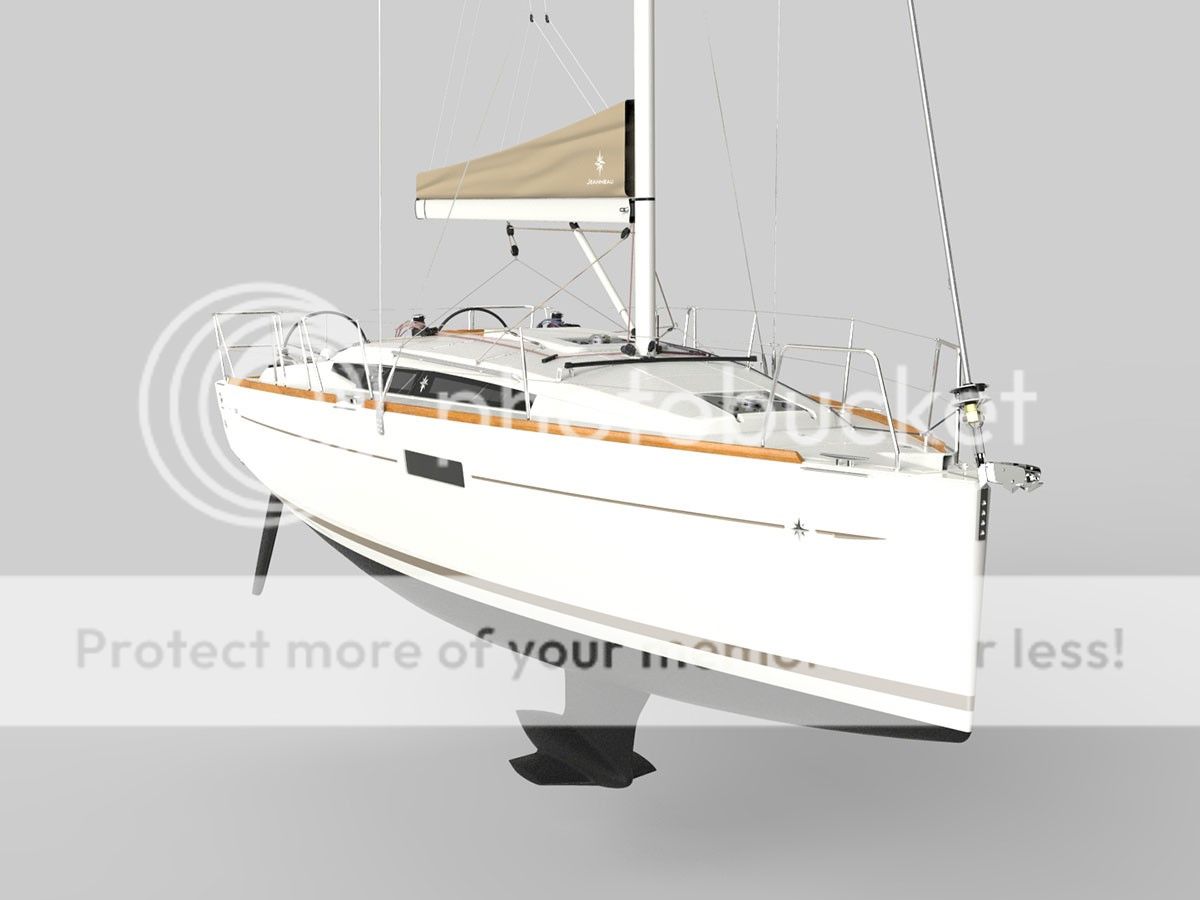
A good example of a boat with a varied offer in what regards keels is the Jeanneau SO 349  with at least 3 keels available, fixed swallow draft keel, a standard keel and a swing keel with a variable draft, a very deep one when deployed (and a very low one when up). All the keels will give to the 349 about the same stability and AVS, the same ability to carry sail but the fixed low draft keel will add 300kg to the boat weight and will have all the negative effects already described. They tried to compensate with wings on the low draft keel and it will work better but not with less drag and not as well as a bigger foil.

 Regarding the comparison between the standard keel and the swing keel we have already talked about that (previous posts). It seems that the swing keel has a slightly lower CG and that means that it is lighter but the weight of the interior lifting mechanism probably will make that difference negligible.  I heard that the Polars would give the swing keel a better performance and I believe so, at least upwind but the testers just messed up with the comparative test and it is hard to tell. Anyway, at least it has a comparable performance regarding the standard keel. 

AVS:
Two misleading points remained to be addressed: that the AVS alone is per se a good measure of a boat overall stability and that a more seaworthy boat is necessarily one with a very small inverted stability or no inverted stability. I will join two others: That a boat with a better ratio between positive and negative stability is always the one with better overall stability and that the boat that have a reputation of being more seaworthy (stability) is not always so when compared with a cheaper main market mass production boat.

Regarding AVS it is pretty simple: Imagine a nice round wood cylinder on the water. Perfect AVS (180º) and however it would not cease to capsize, I mean being its positive stability as big as it’s negative (considering any arbitrary side as the “deck”) the cylinder will roll at will.
Let’s consider now a board floor from your boat on the water. The board will have a huge stability and it will be needed really a big wave (in proportion to its size) to have it capsized but once capsized it will remain inverted for as much time as it was on the “right” side. The board compared to the cylinder will have a huge positive stability but also a negative stability as big as the positive and a 90º AVS.

Off course if someone was given the choice to be out on the sea balancing himself over a cylinder or over a board with adequate floatability the choice would be evident. In fact the second craft is called a raft and was used on multiply circumstances as a water craft. The cylinder will have a much better AVS (180º) but it is obvious that the raft would be a much safer vessel and therefore the AVS alone is per se not a good measure of boat overall stability and a more seaworthy boat is not necessarily the one with a very small inverted stability or no inverted stability at all.

SMALLER INVERTED STABILITY:
From here and regarding the design to get a seaworthy sailboat the ways have someone parted in two different directions: the one that consider that having the biggest positive stability is the way to go, and you have the multihull family and the monohull family that consider that a boat should have as much positive stability as possible and as little negative stability as possible, meaning that the ratio between the positive and negative stability should be as high as possible. Such a boat will need a much bigger wave to be capsized comparing with the one needed to put it back on its feet. Later we will see that even this is not so linear and true as it appears to be.

Regarding multihulls stability is an easy story: The bigger the ratio between length and beam the better, even if at some point the risk of pitchpolling has to be considered too and of course, the CG should be as low as possible.
Regarding monohulls it is not as easy and many variables enter in play. Sure, the ratio between positive and negative stability is much more important than the AVS per se, providing this one is an acceptable one, but not an absolute. I mean that not always the boat with a bigger ratio is the more seaworthy boat, or the boat with a better reserve stability. We will see later what an acceptable AVS is and why but for now let’s just focus on that ratio between positive and negative stability and for that nothing better than a practical example:

Let's assume two boats with the same length, same weight, same B/D ratio same type of keel, same draft, one narrow other beamier. Let's assume that the proportion between the negative and positive stability is similar. That should not be very far since they will have a similar CG. Let's assume that proportion is 3 to 1. The beamier one will have more positive and negative stability, the narrow one less positive stability and less negative stability in about the same proportion. Let’s say that difference in stability (negative and positive) is of 50%. Let's assume that the energy needed to capsize the narrower boat is the one of a breaking wave with 2m. That means that the boat would right itself up with a breaking wave of 0.66m, or with a normal non breaking bigger wave. The wave energy needed to capsize the beamier boat will be bigger. It will correspond to the one of a wave 50% bigger, that means a 3m breaking wave and it will also need the energy of a bigger wave to right itself up, in this case a 1m breaking wave, or a correspondent bigger non breaking wave able to roll the boat till its AVS point.

What is the boat in you would want to be, the one that needs a 3m breaking wave to be capsized and 1m wave to be re-righted or on one that will need a 2m wave to be capsized and a 0.66m wave to be re-righted?

In the end there are boats better or worse designed in what regards final (or reserve) stability and one very important factor is the force the boat is making to re-right itself (proportional to its weight) after a 90º knock out, but beamier or narrow boats are not by itself more or less seaworthy even if in what regards smaller boats beam can be very important to give it an overall better positive stability. We will see this with more detail ahead.

 The last point in this list of misgiving concepts, the one that a boat that have a reputation of being more seaworthy (stability) is always so when compared with a main market mass production boat, will be treated in another post through a practical example.


Eric - MERENA CLASS 40 - CHARTER ON FAST BOATS

I met Alexis in Nieuwpoort, both our home port (in fact his berth is very close to ours). A very nice guy with no airs at all. And he runs a very nice blog too.

Yes, from the movies it gave that impression and the prices, particularly for doing some races with him, look also very attractive.

Fact is that many that follow this blog charter sailboats,so let's have a look to where one can find some interesting boats to charter, I mean boats where you can cruise but also boats where you can have some fun sailing and we begin by this small company that starts to be a reference: http://www.fastsailing.gr/
The movie on the bottom is made on one of their boats. They charter Pogos and the boats are not difficult to sail for a medium experienced sailor, particularly the smaller ones (I think they are waiting the delivery of a Pogo 30) and certainly will provide a different view about cruising and  sailing fun. Sure the prices are higher (like the prices of the boats) but nobody says that performance and fun comes cheap. Their prices for the Pogo 12.50 will be similar to the prices you can find for a First 45 with about the same age (almost new). Their base is conveniently located near Athens airport.

Another interesting option regards Salona in Croatia that has a huge fleet of almost new boats for charter, directly from a company that belongs to the shipyard at very reasonable prices: http://www.salona-sailing.com/en/charter.html

If your preference goes to First sailboats, here: http://www.firstsailing.sk/en/regatta/first-sailing-week-2013 , also on Croatia and on the same marina that has the Salonas (Kastela, near Split airport) you can find them. They have a big fleet of first 35 and First 45 and none First 40, giving weight to what I have been saying about the First 40: almost a crime the way the boat is not fitted for cruising when some simple alterations would resolve that unsuitability without taking nothing to its performance.

Unfortunately it is not easy to find relatively new performance cruisers for charter since most companies prefer typical charter boats so the exceptions are always useful to register and I believe it is even more difficult in the Caribbean. Maybe Guadalupe, French Martinique, is best place to find them, given the French taste for fast boats. Here you can find some interesting ones, even if with some years, among them an Opium 39 two Cigales and a Dufour 40: http://www.caribbeansailingescape.com/

Tuesday, March 18, 2014

SAM MANUARD ON THE DESIGN OF PERFORMANCE CRUISERS:

Sam Manuard is one of the most talented young designer from the new French generation and one that started is career as a racer on the mini class, designing his own boats (he still races). Today he is one of the more successful designers on class 40, with his last designs winning a lot of races. Regarding performance cruisers his most relevant work is the Seascape 27, a great and fast small week-end cruiser-racer boat. It seems there are plans for a bigger one. Have a look at the seascape 27 and Manuard's site:
http://www.thinkseascape.com/en/seascape-27/

He made some very interesting statements regarding the actual and future tendencies of performance cruiser's Design that seem very relevant to me:

Watching the incredible development of offshore racing yachts in the past 20 years, we realized that the gap between custom-made racing and mass production yachts was getting bigger and bigger. Even though some brands finally started following the trend set by the racers, by applying chines to the hull and twin rudders on the transom, we believe the gap is far from being closed, as it lies deeper in the mentality of the boatbuilders.

Until recently both racing and cruising yachts were too heavy to plane which meant that your boat-speed was defined by the length of the yacht measured on the water line. With other words, longer was by default faster, and better hull shape and lower displacement of the yacht could only help her get to her maximum speed a bit sooner.
 The main problem was sailing downwind where yachts quickly ended up with excessive energy generated by their sails which couldn’t be transfer to speed due to yacht’s inability to plane. This energy was therefore burned as excessive rolling that often ended up in so called “death rolls” which broached or even worse, uncontrollably jibed the yacht.

You can see here what he is talking about here (on the second one just look at the beginning, -34 sec - till that mad figure with the spi):


Consequently, spinnakers were used only by experienced crews, and downwind sailing in strong wind was neither fast, nor safe nor comfortable. More importantly, those racing yachts were not much different to fast cruisers. Since none of them could plane, heavy wooden furniture didn’t make a major difference in performance.

And then the racing boats started to plane.

Industry launched a new term – the race-cruisers. At the beginning, racer-cruisers looked more like racers, while today, with the notable exception of J-boats, Pogo Structures, and a few other non-mainstream manufacturers, look more like cruisers with bigger steering wheels and better ergonomics on the cockpit. The problem with the modern racer-cruisers is that they are weight sensitive. Add 10% displacement and, instead at 15K the yacht will start to plane at only 20 knots of wind. However, this is true (planing speeds) only if a gennaker is used.

Not being able to handle big gennakers at high wind speeds, some crews will therefore be stuck at the uncomfortable and slow displacement speeds, even though the hull would allow them to plane.
 The modern racer-cruisers should therefore provide their crews all the necessary comfort without bulky heavy luxury in the interior and exterior. The main luxury that this kind of a yacht has to offer is her safety, ergonomics and performance close to those of the modern racing yachts, but achievable with a shorthanded crew.

Yes, I understand very well what he says: On my boat I know that an experienced crew can go easily over 15K....but just a look at the size of my geenaker had prevented me to use it solo (maybe if I mount it on a light furler, but that is expensive). The answer for that is a lighter boat (a smaller one would help too ;-)) where the sail area will be substantially less and therefore more manageable. The big beam, fat ass and strong initial stability of an solo Open racer style hull would help too. Not surprisingly is that the kind of performance-cruisers that Sam Manuard is designing.

Let's have a look at his designs, first the Seascape 27 (I really am waiting with a lot of expectations their bigger boat) and his most accomplished racer, the new GDF/Sebastien Rogues 40class sailboat: