It seemed too good to be true, but the fact is that the boat is on the water and certified as Class A. That does not make it properly a bluewater boat but gives you the assurance the sailboat has passed the stability requirements that are needed for that certification, and they are, for a small sailboat, so high, that very few sailboats this size are able to have them.

It is even more difficult when the beam is limited due to the need for road transport in a trailer. Sailing this boat you will know you are sailing in an extraordinarily seaworthy boat for its size.
To my knowledge, this is the only class A that is trailerable and to understand how that is difficult to achieve it suffices to say that the bigger Oceanis 30.1 is only certified as class B, and can only dream to achieve the seaworthiness and safety stability of the smaller S8 (26.3ft).

There is a reason for the Oceanis to be a Class B, and that reason is money: to have considerable more B/D in a sailboat is expensive due to the need for bigger hull reinforcements and bigger hull structure as well as the need of using superior quality materials, for assuring that the superior B/D does not translate also in an increase of the boat displacement, and therefore in a lower performance with lighter winds.

The S8 is proposed in two different versions, the DS8 and the CS8, a daysailer and a cruising yacht, having the same hull (immersed part), keels, but a different cabin, one more voluminous, offering the space for a good cruising interior, and a sleeker and lighter one. The less voluminous interior makes the S8 look absolutely gorgeous.
Both versions can be offered certified in Class A or Class B, depending on different keels, with more or less ballast, more or less draft. This has not only influence in what regards the boat stability, price, but also in what regards the easiness in putting the boat in and out of the water and in the trailer, but contrary to the First 27 all versions are easily trailerable. On the First 27 that only happens with the considerably more expensive version with a swing keel, which was the original one on the Seascape, but now is a marginal one, due to price.

This performance, particularly the upwind performance, looked too good to be true, and many doubted that the S8 could be so fast upwind, but the doubts disappeared when the DS8 was tested by Nacho Braquehais, a top Spanish sail racer (Americas's cup, TP52), that said that the overall performance was similar, if not better, than the one of a J70, and that upwind the performance was no doubt better!

On the boat structure, and bulkheads, marine plywood is used, and bonded with epoxy, and laminated to the hull and deck. The deck is made using vacuum infusion in an epoxy glass sandwich that has closed-cell PVC foam as a core. All furniture is included in the boat structure and in the end hull, deck, bulkheads, and furniture end up forming a monoblock, giving a great rigidity to the yacht.

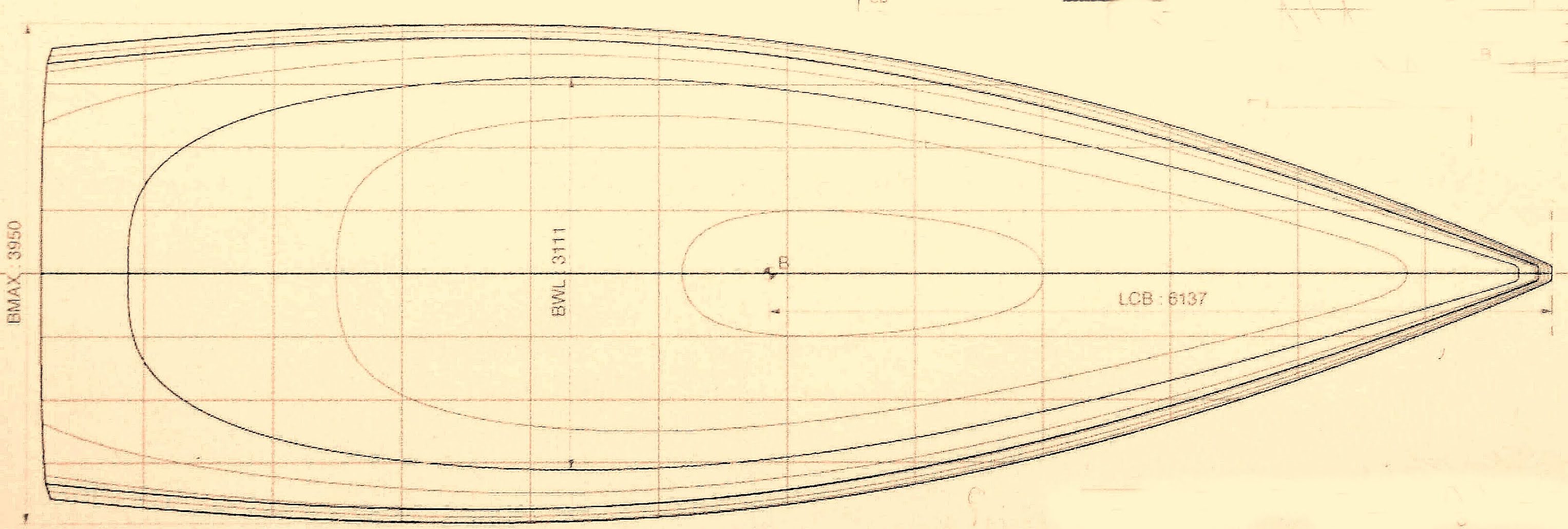
The S8 hull is 7.95m long, 2.49 wide and can have three different keels: a swing not bulbed one with 420kg ballast, with 0.50/2.00m draft and two torpedo lifting ones, with 350kg and 570kg ballast, for 0,5/1.75m draft and 0.5/1.95m draft.


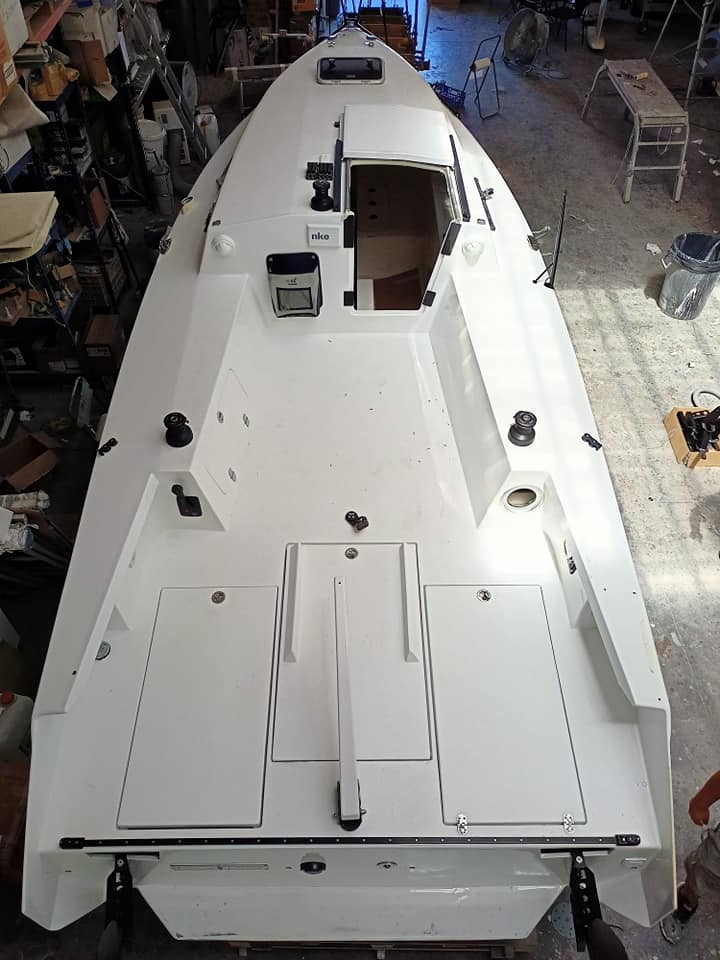
Regarding the type of engine choice, it depends: If some racing was on the program, I would ask Axel to do me a version with outboard engine on a well, similar to the one that is offered in the First 27 (Seascape 27). I believe that there is space for a 10 to 20hp outboard with electric start, and that would be more than enough, saving about 200 kg in the boat displacement (that in a 1500kg sailboat is a lot), not to mention that it would be less expensive, not only the engine, but the maintenance and even an eventual replacement.
If I was not interested in racing, or in taking from the boat all the speed I could get, I would have the 15hp inboard engine that provides better reliability and a bigger battery charge when running, at the cost of a bigger price and considerably more weight. The difference in speed the lighter boat will gain would be very little upwind, more noticeable downwind, in what regards the wind speed needed for the boat to plan, and some difference in what regards light wind sailing.

Who, will be interested in this sailboat? Well, for sure a younger version of me LOL, this boat is the answer for young sportive sailors that have a small family, like to cruise fast in a seaworthy sailboat, with a nice cozy interior, that are still working, have not much time and want to save money, keeping the boat in a garage, not paying an expensive marina berth.

This boat, like the other Sarch, has systems to lower the mast and to raise the keel that makes it relatively easy for two to put it on the water, or from the water in a dedicated trailer, which is also offered by the manufacturer.
Of course, high tech and high performance come with a high price and even if I don´t find it high for what is offered, this boat is a bit more expensive than a First 27, even considering the one with the swing keel, the only one that is easily trailerable and comparable. They say the model with a fixed keel is trailerable too but you would need a crane, and will have to tow it very carefully due to the high CG.

From what I could understand a F27 SE with a swing keel costs about 85,000 € without an engine and with dracon sails. That compares to 86,560€ for a DS8, also Class B, but with much better quality 3D Nordac North Sails and an 8hp outboard. Both prices are without VAT.
They offer two dedicated trailers with 4 wheels, both with brakes and a winch, one is able to carry 1350kg, the other 1500kg, for respectively, 4240€, and 4650€. This allows Europeans to pick a Sarch directly at the shipyard, without transport costs. The shipyard is in Spain, near Alicante.