Friday, December 3, 2021

THE FIRST TRAILERABLE CLASS A IS NOT A DREAM ANYMORE: SARCH S8

It seemed too good to be true, but the fact is that the boat is on the water and certified as Class A. That does not make it properly a bluewater boat but gives you the assurance the sailboat has passed the stability requirements that are needed for that certification, and they are, for a small sailboat, so high, that very few sailboats this size are able to have them. 

It is even more difficult when the beam is limited due to the need for road transport in a trailer. Sailing this boat you will know you are sailing in an extraordinarily seaworthy boat for its size.

To my knowledge, this is the only class A that is trailerable and to understand how that is difficult to achieve it suffices to say that the bigger Oceanis 30.1 is only certified as class B, and can only dream to achieve the seaworthiness and safety stability of the smaller S8 (26.3ft).

And the differences between the two are not only about safety stability, because the superior ballast,  draft and the much lower D/L (due to a high tech building) will give a lot more stiffness to the S8, and stiffness equals power to carry sails. That big overall stability will make the S8 uncomparably faster, a very fast yacht, by any parameters.

There is a reason for the Oceanis to be a Class B, and that reason is money: to have considerable more B/D in a sailboat is expensive due to the need for bigger hull reinforcements and bigger hull structure as well as the need of using superior quality materials, for assuring that the superior B/D does not translate also in an increase of the boat displacement, and therefore in a lower performance with lighter winds.

In fact, in what regards sailing, the S8 has nothing to do with the Oceanis 30.1, but more with the First 27 (Seascape 27), and that means a racing performance. The First 27 is a very fast sailboat, but, contrary to the Sarch S8, it is not a Class A sailboat, and the cruising interior has nothing to do with the cruising version of the S8, more like the S8 daysailing version.

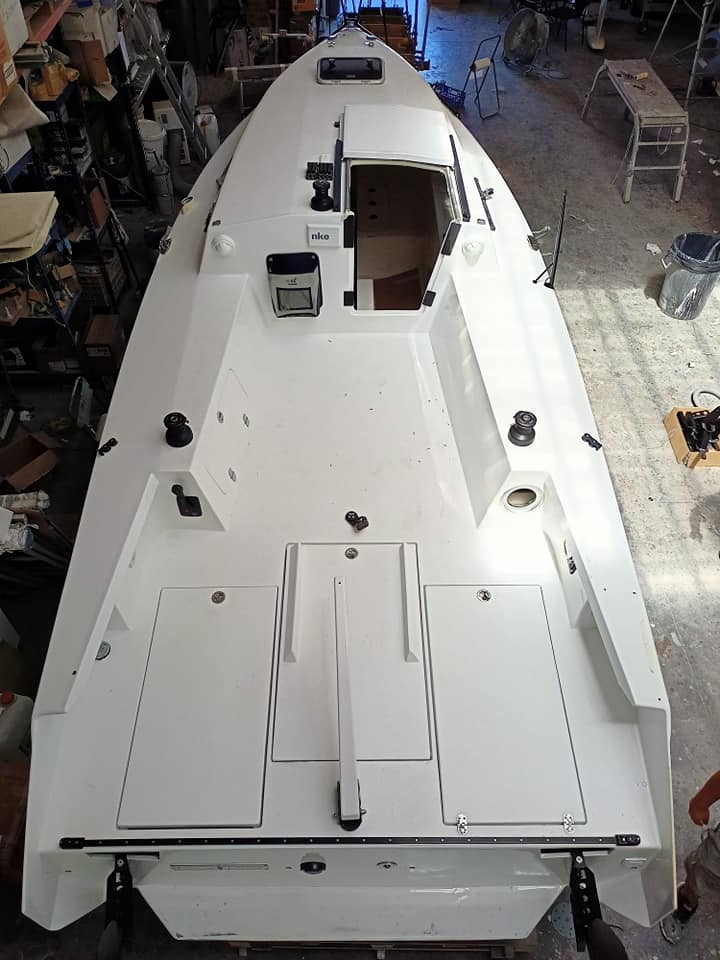
The S8 is proposed in two different versions, the DS8 and the CS8, a daysailer and a cruising yacht, having the same hull (immersed part), keels, but a different cabin, one more voluminous, offering the space for a good cruising interior, and a sleeker and lighter one. The less voluminous interior makes the S8 look absolutely gorgeous.

Both versions can be offered certified in Class A or Class B, depending on different keels, with more or less ballast, more or less draft. This has not only influence in what regards the boat stability, price, but also in what regards the easiness in putting the boat in and out of the water and in the trailer, but contrary to the First 27 all versions are easily trailerable. On the First 27 that only happens with the considerably more expensive version with a swing keel, which was the original one on the Seascape, but now is a marginal one, due to price.

The first sailboats (from both versions) have already been exhaustively sail-tested by the builder, Axel Sarch, and the results are very good, upwind and downwind. With 17kts of wind, gusting over 25kt the S8 was able to sail at over 7kt upwind and at 12.5kt downwind.

This performance, particularly the upwind performance, looked too good to be true, and many doubted that the S8 could be so fast upwind, but the doubts disappeared when the DS8 was tested by Nacho Braquehais, a top Spanish sail racer (Americas's cup, TP52), that said that the overall performance was similar, if not better, than the one of a J70, and that upwind the performance was no doubt better!

All the Sarch are built the same way, a high quality built: the hull is made with a carbon/glass sandwich with a core of marine grade okume plywood, using epoxy resin. The inside sandwich layer is glass, the outside carbon, with a single layer of glass, for cosmetic purposes.

On the boat structure, and bulkheads, marine plywood is used, and bonded with epoxy, and laminated to the hull and deck. The deck is made using vacuum infusion in an epoxy glass sandwich that has closed-cell PVC foam as a core. All furniture is included in the boat structure and in the end hull, deck, bulkheads, and furniture end up forming a monoblock, giving a great rigidity to the yacht.

This high-tech building allows for a light and strong boat. The DS8 has 1218kg displacement with the standard keel without a bulb (class B), even less with the bulbed keel (1118kg - ClassB) and 1338kg with the heavier bulbed keel (Class A).  The cruising version (CS8 Class A) will be about 150kg heavier if an outboard is used and, if the inboard engine is mounted, it will be about 300kg heavier. 

The S8 hull is 7.95m long, 2.49 wide and can have three different keels: a swing not bulbed one with 420kg ballast, with 0.50/2.00m draft and two torpedo lifting ones, with 350kg and 570kg ballast, for 0,5/1.75m draft and 0.5/1.95m draft. 

In the class A configuration the S8 has between 42.6% and 33.8%B/D (depending on the version and equipment),  in the Class B version it has between 31.3% and 23.8%B/D (and less 20cm draft). The standard keel (Class B) is not comparable to the others in what regards B/D because it is not bulbed, and it is all in cast iron, while the other two have lead torpedos, but probably, being heavier and having more draft, it has a performance similar to the lighter torpedo keel. The class A keel is a high-tech keel made with a composite fin, and that allows the lead bulb to be heavier (a great part of the 570kg of ballast) lowering the keel CG and increasing RM.

With so many options you should be thinking about which one I would choose. Well, it depends on the use I would give to the boat: if for racing and weekend cruising I would choose the daysailer (DS8), that I find gorgeous, and would have it with an outboard. Regarding the keel, it depends on the type of racing, with a crew, 4 to seat on the rail in inshore regattas, probably the ClassB would get better results in handicap racing. For offshore racing, duo, or solo, the heavier Class A keel would give certainly a better performance and probably better also with a crew.

For more extensive cruising I would choose the cruising version, which has a very nice and good cruising interior, can have a true marine head, with a black water tank, a decent galley with a gimballed two-burner stove (option), and a good-sized refrigerator.  On this one, I would choose without any doubt the Class A keel, for the better seaworthiness it will provide.

Regarding the type of engine choice, it depends: If some racing was on the program, I would ask Axel to do me a version with outboard engine on a well, similar to the one that is offered in the First 27 (Seascape 27). I believe that there is space for a 10 to 20hp outboard with electric start, and that would be more than enough, saving about 200 kg in the boat displacement (that in a 1500kg sailboat is a lot), not to mention that it would be less expensive, not only the engine, but the maintenance and even an eventual replacement.

If I was not interested in racing, or in taking from the boat all the speed I could get, I would have the 15hp inboard engine that provides better reliability and a bigger battery charge when running, at the cost of a bigger price and considerably more weight. The difference in speed the lighter boat will gain would be very little upwind, more noticeable downwind, in what regards the wind speed needed for the boat to plan, and some difference in what regards light wind sailing.

Anyway, even in its heavier version, the Cruising Class A, with an inboard engine and a displacement of 1688kg, or a bit over (depending on equipment), is a very fast sailboat, and the extra weight contributes to increasing the stability and to make it a less nervous sailboat, and that can be a good thing for extensive cruising.

The SA/D and the D/L of the heavier Class A cruising version with inboard give an idea of how fast this boat is:  It has an upwind of SA/D 29.1, downwind 64.1, for a D/L of 109.7. If we consider the Class A version with an outboard the numbers are the ones of a true racer: upwind SA/D 34.0, downwind 74.8 for an 83.9 D/L.

Who, will be interested in this sailboat? Well, for sure a younger version of me LOL, this boat is the answer for young sportive sailors that have a small family, like to cruise fast in a seaworthy sailboat, with a nice cozy interior, that are still working, have not much time and want to save money, keeping the boat in a garage, not paying an expensive marina berth.

It will also be suited for cruisers that like to race and have the same concerns. For cruisers and racers alike it offers the possibility to transport the boat on a trailer to distant cruising grounds, or race locations, inexpensively and fast, saving in time (that they don't have) and in money.

This boat, like the other Sarch, has systems to lower the mast and to raise the keel that makes it relatively easy for two to put it on the water, or from the water in a dedicated trailer, which is also offered by the manufacturer.

Of course, high tech and high performance come with a high price and even if I don´t find it high for what is offered, this boat is a bit more expensive than a First 27, even considering the one with the swing keel, the only one that is easily trailerable and comparable. They say the model with a fixed keel is trailerable too but you would need a crane, and will have to tow it very carefully due to the high CG.

It is difficult to find price information for the First 27SE, because almost all the information regards the fixed keel version, which comes without an engine but with sails, and it is considerably less expensive than the swing keel version.

From what I could understand a F27 SE with a swing keel costs about 85,000 € without an engine and with dracon sails. That compares to 86,560€ for a DS8, also Class B, but with much better quality 3D Nordac North Sails and an 8hp outboard. Both prices are without VAT.

The daysailer (DS8) Class A, with the heavier torpedo keel costs 87 560 € and with an inboard 15hp Yanmar engine, 99 400€. The cruiser (CS8) Class A costs 97 580 € and 109 420 €, respectively, with an 8hp outboard, or with the interior Yanmar engine, both come with 3D Nordac sails. The Class B version, with less ballast and less draft, costs 1000 € less in each of them. All at the shipyard without VAT.


They offer two dedicated trailers with 4 wheels, both with brakes and a winch, one is able to carry 1350kg, the other 1500kg, for respectively, 4240€, and 4650€. This allows Europeans to pick a Sarch directly at the shipyard, without transport costs. The shipyard is in Spain, near Alicante.

Wednesday, November 24, 2021

5.80 MINI - 6.50 MINI, COMPARATIVE PERFORMANCE IN A TRANSAT

I have already talked here about the 5.80, a new class of offshore racing sailboats designed by a Polish yacht designer, Janusz Maderski, sold in plans and home built by the racers. One wonders about the need for a class smaller than the mini-transat class (6.50 mini), but even if many of these 6.50 mini are built by the ones that are going to race them, the point is that some find them too expensive.

Well,  the 5.80 is certainly not expensive, built with plywood, over plans that cost 300€. They say if it is entirely home-built a completely equipped boat would cost about 20 000€. It seems too optimistic to me, but it would be certainly much less expensive than a completely equipped mini 6.50 racer, even if home-built.

The design has nothing to do with the one of a mini transat racer, that follows the design line of other transat racers, like the 40class and IMOCA class, yachts designed to be easy on the autopilot, with a downwind maximized performance and a big hull form stability.

The 5.80 design is odd, I would describe it as outdated. If one looks at the boat sideways, it seems modern, but the side view is contradicted by a bird's view, or by the hull design. The design can have to do, at least partially, with the intention of having an easier boat to build and a less expensive one, and what counts in a racing boat is the performance not if the design seems outdated or not.

The 5.80 has a considerable ballast even if the draft is small (1,40m), compared to the 6.50 mini-transat racers, but even so, the 5.80 should be relatively seaworthy, considering the small size and displacement, but not as seaworthy as a 650 mini, that has a considerably superior overall stability.

Due to being a bit smaller ( less 70cm) and with a less technical building, the 5.80 is going to be slower, but how much slower is the question. On the mini racers, we have seen that the differences in performance between the Protos (much more technically developed) and the Series ( production boats) are many times small, notwithstanding the huge difference in complexity and price. 

Will something similar happen between the 5.80 class and the 6.50 Series class? Will that outdated look be just a look, without a big influence on boat performance? Let's have a look:

As you probably know the last edition of the 6.50 mini Transat finished recently, without safety problems, even if many boats chose to take shelter on the Spanish coast due to 50kt winds. Anyway, the French Sailing Federation and the Mini Transat organizers, as usual, found it necessary to accompany the transat with several support boats, in case there were problems with the small racers, due to the possibility of heavy seas and winds.

The 5.80 Transat, that is being raced, has not that safety measure, that seems unnecessary to the organizers since the boats are supposedly designed for the Globe Race, a circumnavigation race that will happen in 2024, and will have far worse conditions than the benign ones that you will find in the South Atlantic at this time of the year. 

This race is just a kind of preparation for the big event and the boats, contrary to the 6.50minis, are not specifically designed for a Transat, but for a circumnavigation race.

I will not repeat on this post what I think about the suitability of the 5.80 for a circumnavigation race (you can read it on the posts linked below).

In this post, besides calling attention to this Transat, which is a big adventure, I will try to compare the performance of the two mini-classes, the 5.80 and the 6.50, while racing a Transat. When the race finishes we will have more information, and I will post it in the comments, but by now we have already some information for making that comparison.

The 6.50 mini-Transat started with 90 racers, a  number limited for safety reasons by the organization (there was a waiting list), and it was raced in two categories, the Protos (25), that as the name indicates are one-off, more technically developed and more expensive sailboats and the Series (65), that are boats made by shipyards, production sailboats.

From the Protos, 3 have abandoned the race, from the Series there was also 3 abandons, but due to the larger number of participants the finish rate was better, and 95.4% of the Series completed the race. That is an incredibly high rate for any race, much more for a Transat.

The 5.80 Transat started 23 days ago, sailing out of the South Portuguese Coast to the Canary Islands, with 6 racers, all having already finished the first leg, which serves also as qualification for the 2nd leg. The fastest boat took about 4 days 20 hours 55 minutes to make it, averaging a 4.85 kt speed. For this unexpected high speed contributed the last 36 hours were they got winds between 20 and 30kt gusting 40kt with the boats being able to plan, and making double-digit speeds.

On the Mini Transat first leg they sailed from the Atlantic coast of France to the Canary  Islands, but almost all looked for shelter (due to 50kt winds) on the coats of Spain, for 24 hours or more, and, among the Series, the only one that has not done that was a single racer, not a top one, but that due to it was the first among them to arrive at the Canaries. As the 2nd leg showed, that racer was far from being among the fastest, in the Series class finishing 22nd.

If things had been normal, the 5.6kt average speed of the first among the Series would have been way higher. The first Proto averaged 7.80kt. On the 2nd leg, the differences between the average speed of the first Series and the first Proto were more "normal" (6.70kt to 7.70kt).

Looking at this data we can see that a 5.80 class for being as fast as a 650 mini proto would have to be 57% faster, and for being as fast as a 650 mini Series (production), would have to be 37% faster, and this for a 28% difference in hull length. It seems that the 5.80 are not only outdated in what regards looks but also in what regards performance.

If the 5.80, on the Transat, maintain an average of 4.85kt they will make the crossing in 20 days 9 hours and 30 minutes, but on the first 6 days of the 2nd leg, they averaged only 2.7kt of boat speed. I hope they can get a better average after passing Cabo Verde (they are midway), if not this is going to be a very long Transat and even if they can make a better average I don't know if the small boats have enough water and food for a 30 day passage and I am quite sure that some of the boats will take more than that.

At the final of the race, with more miles sailed, we can have a better idea about the relative performance between the two racers, the 5.80 and the 6.50. I will add that information to the post.

Certainly, this is an adventure and a race.....but even if the boats are not 40 years old designs, like on the Golden Globe Race, the comparative performance to modern boats is no better. We will see how many will manage to finish the race. One of them has already given up and is not doing the 2nd leg. They are now 5 boats racing this Transat:

http://yb.tl/globetransat2021#

Friday, November 19, 2021

NEW FIRST 36, A MUCH AWAITED YACHT

Since Seascape was bought by Beneteau, and their yachts were renamed First, that there are rumors and announcements of a new First, designed by Sam Manuard (the designer of Seascapes),  a yacht following the design criteria of the Seascape 27, but bigger, a fast ClassA cruiser-racer.

Since the time Manuard designed the Seascape 27 his career as a designer of a fast racing yacht grew a lot in relevance, and from a top designer of mini-racers, he became gradually a top 40class and a top IMOCA designer, so, it was with great interest that the new design was awaited. But it took several years to happen, and from a 30/33ft cruiser-racer, it ended up to be a 36ft yacht.

We all expected something as innovative as the Seascape 27 was 10 years ago, but things are complicated in a big company like Beneteau, with many deciding what to design and build, and the new boat, that after all was not designed only by him, ended up being quite a disappointment, for those that waited for a very innovative yacht.

In fact, the boat, due to high freeboards and classic lines looks like an Oceanis or a Dufour, a deja vu design. Beneteau wanted the new boat to be so many things at the same time, that the many mixed compromises ended up producing something that looks bland and not exciting.

In Beneteau's words this yacht is about "the pursuit of the ultimate balance", being this balance not about creating a cruiser-racer able to win offshore races, inshore races, solo or duo, "but about a perfect balance.....between comfort and performance, elegance, and utility..."

The word "elegance" is a bit tricky because it normally refers to past concepts of beauty and a continuing line of development, much as "in the tradition" and makes no sense on this type of performance yacht, where words like sexy, which refer to having contemporary radical racing lines, would be much more adequate.

But "elegance" was what they tried to achieve on the First 36, and therefore it is explained the deja vu look, and I would say that in what regards elegance, it was a failed attempt, since due to high freeboards it is impossible to give it the looks of a smaller First 53, and it ended up very far from Beneteau objective, that was a "classical and timeless aesthetic". As the one responsible for the First 36 design (Lorenzo Argento) says

" First 36 is following the same design language of her larger sister – First Yacht 53, building on the timeless aesthetic of his work on Wally and Brenta."

Of course, what counts for them is sales, and I cannot say if they are right in what regards this boat to become a  big success, it all depends on how the boat sells, and for that, besides the sailing performance, the price, the looks and the interior layout are very important. 
In what regards price (more expensive than an Oceanis 40.1), it seems to me too high for a sailboat that is fast, but does not look like a very fast sailboat, with no visual references to top racing, and looks more like a much less expensive mass-production yacht.
The ones that buy this type of yacht want it to be very competitive in what regards IRC/ORC racing or want the looks of the sailboat to scream FAST and INNOVATIVE (not elegant) or both.

For the ones who want first and mostly to race competitively, and also do some cruising with the boat, the First 36, does not seem to have what it 

First 36, Sunfast 3600, JPK 10.80, J122e
takes to be competitive in face of the competition, namely the JPK 10.80 and the Sunfast 3600.

For the ones who want to cruise and race (50%) the J112e offers a much better interior, much more elegance, that kind of "classical and timeless aesthetic", and for sure, much better results in IRC/ORC racing.


First36 

I bet that over the water the JPK 10.80 and the Sunfast 3600 will be faster, The J112e will be probably only faster in light wind and maybe upwind, but on handicap should have no problem in beating the First 36, and that is not surprising because the J112e is designed by an expert in handicap racing, and the First 36 is designed by a specialist in offshore trade-wind racing designs, without a big experience designing for IRC/ORC racing.

Maybe I am being a bit too harsh on this evaluation, but it really pisses me off that after such a long waiting time, with so great expectations regarding a sexy innovative cruiser-racer by Sam Manuard, all we got was a supposedly elegant, fast cruiser, with a "timeless aesthetic", meaning a traditional design.

Let's see how the First 36 compares with the competition in regards to dimensions and technical characteristics: The First 36 has 11.00m hull length, the JPK 10.80 has 10.80m, the Sunfast 3600 10.80m, the J112e 10.99m. The First 36 has a 3.80m beam, the JPK 10.80 has 3.65m, the Sungfast 3600 3.55m, the J112e 3.60m.


Sunfast 3600

First 36 has a 32.3%BD, a torpedo keel with 2.25m draft, for a 4800kg displacement; the JPK 10.80 has 45.3%BD, a straight keel with 2.20m draft for a 4750kg displacement, the Sunfast 3600 has a 41.8%B/D, a bulbed keel with 2.13m for a 4950kg displacement; the J112e has 33.8%B/D, a bulbed keel for a 5125kg displacement, with 2.10m draft.   

The First 36 has an upwind sail area of 80m2 and downwind 180m2; the JPK 10.80 has an upwind sail area of 73m2 and a downwind sail area of 160m2; the Sunfast 3600 has 69.8m2 upwind and 136.8 downwind and the J112e has 71m2 upwind and 180m2 downwind.


JPK 10.80

The First 36 is light and the beamier of the 4. Only the JPK is lighter, but regarding the JPK and the Sunfast, the First low displacement is obtained through less ballast weight (less 600kg than on the JPK, less 518kg than on the Sunfast, less 181kg than on the J112e). And this assuming they can build the First with that displacement, but even so, if we take out the extra ballast on the J112e, the First would be only 144kg lighter.

The First is the one with more sail area but also the one with more drag, especially wave drag, due to being much beamier than all the others and that means it needs more sail area to go at the same speed. It will have a very good performance downwind and it is possible that it will be as fast, or even slightly faster than the JPK and the Sunfast, in medium-strong to strong winds (and certainly easier), but it will lose to the two in all other circumstances and probably will lose for the J112e in lighter winds and upwind.


J122e

Certainly, a very nice hull (Sam Manuard) spoiled by the overall design (Lorenzo Argento), but a bit too much maximized for beam reaching and downwind sailing for being a winner in most sail races. I also doubt that the rating is going to be a good one for IRC/ORC racing.

The interior looks pretty much that of a cruiser-racer very much race-oriented, and it offers a more practical galley than the ones in theJPK and Sunfast, with a true stove. However, the JPK interior looks cozier and the J112e interior is uncomparably better and nicer, looking like the one of a good quality cruising boat. 


Sunfast 3600

In the First, the worse is a truly a very small head, that they call innovative. When I visit the boat I will be very curious to see how small it really is, and where is the innovation (besides being too small).

So, just pretend that you have the money and tell me which one you would choose? knowing that regarding price the First is as expensive as the others, including the J112e, which has a much better interior finish. 

It seems that the JPK and the Sunfast are slightly less expensive and that is quite surprising. But, of course, we are talking about prices at the factory and about standard boats, and on a fully equipped boat, the difference of price between any of these yachts should not be big.

Depending on the chosen equipment, more cruising, club racing, or top racing, the prices on these boats ready to sail should be between 230 and 280 000 euros, including around 20% European VAT. Expensive? Certainly regarding the amount but not regarding building costs.


JPK 10.80
That's the price of a well-built sailboat, and if they could make it for less money they would because less expensive boats sell better and the competition is strong. 

The price of one of these boats is about the same price that would cost a mass production 40ft sailboat from one of the major brands, and it explains why mass production yachts are built the way they are, using polyester resins, non cored hulls, no vacuum infusion, a "contre-moule" as hull
structure, use plywood bulkheads and only bonding agents to secure all in place. 

These fast cruiser-racers are built using vacuum infusion techniques (some of them in a single shoot), have cored hulls, most use only vinylester resins, have cored composite bulkheads, bonded and glassed to the hull and deck, the structure frame is glassed and bonded to the hull (and sometimes infused with it). That is why they can be light and strong. That's also why they are better sailing boats and much more expensive ones. 


J112e

For the increased price it also counts bigger winches, 6 instead of 2 or 4, better and bigger sail hardware, and in what regards this the differences in price are sometimes 4 times more for same-sized and apparently similar material, but with completely different load capacity. The increased B/D of these boats also contributes to make them more expensive because that demands a stronger hull and a bigger structure to absorb bigger efforts. 

You pay what you get and for many, a mass-production boat is enough for their needs, in what regards sail performance and build quality, so why pay for more that you don´t need? 

For the ones who want a top sailing machine, they should know that the price would be much higher, the same way nobody expects to pay for a Dacia or a Fiat, the same one pays for an Alpine or a Lotus.

First 36
Saying that the Lotus or the Alpine are expensive, compared to a Dacia or a Fiat, makes so little sense, as saying the same comparing the price of an Oceanis 38.1 with the price of any of these fast cruiser racers. 

In fact, they cost about 50% more than an Oceanis, of about the same size, and that is way less than the difference between a same-sized Fiat and a fast small sports car. For me, the problem with the First 36 is that being a sportive boat it looks like a Fiat, and who would like to have a Lotus that looked like a Fiat, even if it has good performance? OK, I am exaggerating, but you get my drift.


Monday, November 15, 2021

JPK 39 FAST CRUISER VERSUS JPK 11.80 CRUISER RACER

When this boat was being built I made a post about the JPK 39FC, the successor of a great performance cruiser, the JPK 38FC. There is also a complete post about the 38FC:

https://interestingsailboats.blogspot.com/2021/05/jpk-39fc-best-small-fast-voyage-cruiser.html

http://interestingsailboats.blogspot.com/2016/01/jpk-38fc.html

But now that it was launched, and has even been tested by a sailing magazine, a new post makes sense, even if not only to look at the real thing, and not just the drawings.

And the real thing looks much better than in the drawings, a beautiful boat, nicer than the previous one, with a not very different hull, in fact in what regards sailing performance it will be very close, but the 39FC is just a bit better in everything, from sail area, to interior space and cruising amenities.

Valer (the NA) and JPK resisted the temptation to increase volume increasing beam (as almost every brand is doing) and this boat has about the same beam as the previous model (3.98m to 3.99m).

We would be tempted to say that the 38 was even slightly beamier, taking into account this one is longer, but it would not be fair to look at beam and interior volume only in what regards maximum beam, especially in this case because the 39 has fuller bow sections and fuller stern sections, allowing for a larger front cabin but losing a bit in what regards bow finesse.

But if we compare JPK 39FC with the Bavaria C42, two cruising boats with a not very different hull length (11.72m to 11.99m) we will see that the difference in beam is huge (3.98m to 4.30m). If we compare the JPK 39FC beam with the one of a Pogo 12.50 (that contrary to what it looks has not a much bigger hull length – 11.72m to 12.18m) we can see that the difference in beam is even bigger (3.98m to 4.50m).

Of course, the Pogo and the Bavaria are completely different sailboats, the Bavaria displacing more than 10T, the Pogo 5.5T (the Pogo displacement similar to the one of the JPK) and having bow entries much finer than the ones in Bavaria. In fact the Pogo has the hull of an older Pogo Class40 racer and it is, like the JPK 39FC, a very fast performance cruiser.

So, what does that huge difference in beam between the JPK and the Pogo mean? It means that the Pogo is very much maximized (like all 40class racers) for downwind sailing, transats or trade wind sailing, that is what the 40class racers are all about, while the JPK 39 has a much more all around balanced performance, even if in the design of the transom does not diverge much from the one in the Pogo, a design that increases rapidly hull form stability (and drag) with heeling, making it a very stable platform for solo or short crew sailing and easier to be steered by an autopilot especially when sailing fast.

There is a common misconception, that has been serving to justify, performance-wise, the huge increase of beam in cruising sailboats, and even in performance cruisers, the brands stating that this huge increase in beam is favorable to sail performance and that the reason why racing boats are narrower is to make them competitive in IRC/ORC handicap racing, implying that beamier boats, not being designed specifically to be competitive under those rules, are faster.  That’s a publicity stunt (considering overall sailing performance).

That misconception, in what regards performance cruisers, is particularly strong in what regards Pogo cruisers, that on the wind conditions for which they are maximized to perform best (trade winds) are almost unbeatable (size by size), but that in mixed conditions, even when they are strong ones, are not as fast as those performance cruisers that supposedly where only fast on the paper (IRC /ORC), not on the water.

Journalists have been responsible for this misconception, even if I remember that on one of the first test sails of the boat that would be called Pogo 12,50, a comparative test with a Dufour 40p, they had made a simulated a race, upwind and downwind, to find with surprise that even if on the water the Pogo speed was higher, both boats ended showing a similar performance, due to the Dufour better pointing and ability to sail downwind at bigger angles….and the Dufour 40p it is not a particularly fast performance cruiser, being considerably slower than a J122.


JPK 39FC

I have posted many race results (in elapsed time) to show this, and the results in the last Middle Sea Race, that was raced in medium and strong but variable winds, show once more that the Pogo 12.50 is not as fast (in real time) as fast cruiser-racers , when the wind conditions are varied.

In the last Middle Sea Race there was a Pogo12.50 racing, and making it in 3days, 16 hours and 20 minutes, two JPK 11.80 made it in 3d 0h 22m and 3d 8h 21m, a First 40 (3d 9h 52m), 4 J122 (3d 10h 32m, 3d 10h 35m, 3d 10h 48m, 3d 12h 38m) and a JPK 45FC, that made it in 3d 9h 19m, a surprisingly good result, especially because it is an Australian boat, probably equipped for bluewater sailing.


JPK 11.80
A pity the Pogo 50 from Fast Sailing did not race on this edition, it would be interesting to compare the performance with the JPK 45FC, which I believe would not be very different, even if the Pogo is a bigger boat. The JPK 45FC, like the smaller sister, the 39FC, are not so maximized for downwind sailing, as the Pogo, and that would translate in better results, size for size, in a race with mixed winds.

Anyway, the point here is that the JPK 11.80 is much faster than the JPK 45FC and would be certainly be faster than the JPK39FC. So let’s have a look at those two designs to understand why the JPK 11.80 is much faster than the JPK39C.

The JPK 11.80 is the most successful 39ft cruiser-racer in a long time, having won this year the Fastnet and would have won the Middle Sea Race, if they had not changed the finish line. It had won already that race back in 2018, among many other races and regattas.

The JPK 11.80 is a cruiser-racer designed for racing and winning, and the hull is designed for maximizing performance, the JPK 39FC is a performance cruiser, designed to be fast but also to have a maximized interior space (and storage) and to be easy to sail, especially with a short crew.

Transom design: JPK 39FC and JPK 11.80

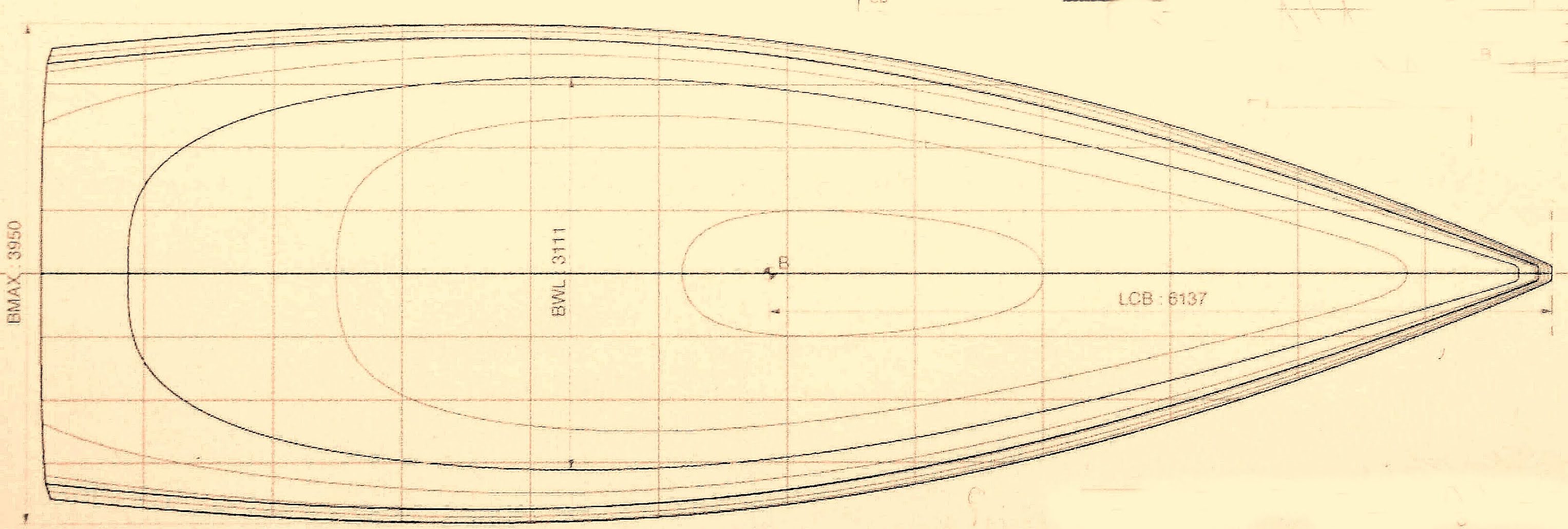
This comparison is very interesting because both boats have not only a close hull length and LWL (first the 39FC, then the 11.80): 11.72m-11.00/11.80-10.39m, but also a similar max beam, 3.98/3.95m. 

What differs is the hull design, having the 11.80 finer entries, the beam not quite all pulled back, and a very different transom design, a less voluminous one that allows more heel, without increasing drag so much.

Surprisingly, even if the hull length of the 11.80 is bigger, the 39FC LWL is considerably bigger that the 11.80 one. This has probably to do with the 11.80 being designed for sailing with more heel, and while heeling the LWL will be considerably increased asymmetrically, between one of the rudders and the bow.

While the JPK39FC hull has more hull form stability, the 11.80 hull assures a better power/drag relation, and it is that what makes it a faster sailboat. The 11.80 has less hull form stability but more coming from the bigger ballast, when the boat heels.

Curiously the 39FC is the lightest of the two (5500kg/5900kg) probably due to the two boats being built in a similar way and with similar materials and the 39FC, having considerably less ballast (1900kg/2650kg).

This difference in ballast, that is translated in a 34.6% B/D versus a 44.9% one, more than compensates the difference in hull form stability and that, and a slimmer hull, are responsible for the considerable bigger Power/Drag ratio on the 11.80.

Note that the draft is also smaller on the 39FC, 2.15m/2.34m but the ballast on the 11.80 probably refers to the IRC keel, without torpedo (can have a torpedo as an option) and the difference in draft probably roughly corresponds in RM to the difference in efficiency of the two keels (with a torpedo and an IRC keel), in lowering the CG.


First, JPK 39FC, then JPK 11.80
It is not about the power, but about power/drag that fast sailboats are about. Beamy hulls increase much drag, especially wave drag, and reduce light air performance, while if the hull is too narrow, it will go more deeply in the water and will make the boat more difficult to attain planning speeds.

To the hull design you have to add the right ballast, knowing that, with too much ballast, the boat will be slower with light winds and that with less than desirable ballast, it will have less power upwind and on a beam reach.

To complicate things, depending on points of sail and wind intensity the requirements for maximizing performance are often contradictory, and when you improve on a given performance, you lose on another.


JPK39FC
The different compromises are today evaluated through computer programs (CFD) and many hull variations are tested to try to get the better option for overall performance, but the truth is that only through racing will we know for sure, if the computer got it right or not, and the funny thing is that Jacques Valer, the magician that designs the JPK, the most successful IRC racers of the last years, is known to have come late to assisted computer design, and can be considered an old-timer, in what concerns using a computer for sailboat design. Of course, what counts are results and nobody designs boats that win more races than Valer.

JPK 11.80
I use to post SA/D and  D/L as a measure of boat performance, but the comparison of those ratios, between these two boats, serves mostly to show that those ratios have to be seen with caution, because they exclude a very important piece of information, the  power/drag relation.

The SA/D gives you an approximate measure of sail power, but displacement, even if important as a measure of drag, excludes the shape of the hull, and hulls with the same displacement, but with less beam, finer entries, and less full transoms, has, for the same displacement, a lot less drag than beamier hulls, especially if wave drag is considered. They need a lot more sail for the same performance.

JPK 11.80
D/L gives you a measure of the boat lightness but does not give you a measure of how much of the weight is used on ballast to increase boat power.

If we consider these two ratios as an absolute measure of boat performance we will be surprised to find out that according to them the JPK39FC is faster than the JPK 11.80, when we know that it is not the case, quite the contrary and by a large margin. The 39FC has an upwind 26.8 SA/D, a downwind 45.1 SA/D for a 115D/L and the 11.80 has an upwind 24.9 SA/D, a downwind 43.0  SA/D for a 146.5 D/L.

What makes the design of the 11.80 truly amazing is the success in combining these different requirements and different compromises in a way that makes the boat really fast in a very variable set of conditions, from the low middle to high winds, downwind, and upwind. 

The weakest sailing condition regards very light winds, but the performance is not so weak as it would be expected, due to the very good performance with medium and stronger winds, obtained through the maximization for those conditions. That’s the overall balance that makes it a winner.                     JPK 11.80


JPK 39FC
What makes the 39FC an amazing design is the ability to offer an excellent spacious cruising interior without compromising too much sail performance, a balanced performance, having in weak winds the weakest spot (worse than the 11.80). As strong points, the easiness in sailing fast with medium to strong winds (due mostly to hull transom design that limits heeling, making it a steady sailing platform), and the easiness in sailing fast on autopilot.

Both boats are very well built, using vacuum infusion, cored hulls with and airex core, vinylester resin on the 11.80, vinylester and polyester on the 39FC, both have a hull structure integrated on the infusion process (and becoming part of the hull), both have cored composite bulkheads stratified and bonded to the hull and deck.

I bet the JPK 39C, that allies cruising sailing performance to a very nice spacious interior with all-around views (and manages that without becoming ugly), is going to be elected by the European sail press as European Yacht of the year, probably on the performance cruiser category.

The price is fair for the quality and without VAT, standard, at the shipyard the 11.80 costs 209958€ and the 39FC costs with the standard keel 196887€ and 216748€ with the swing keel, with all ballast on the keel.