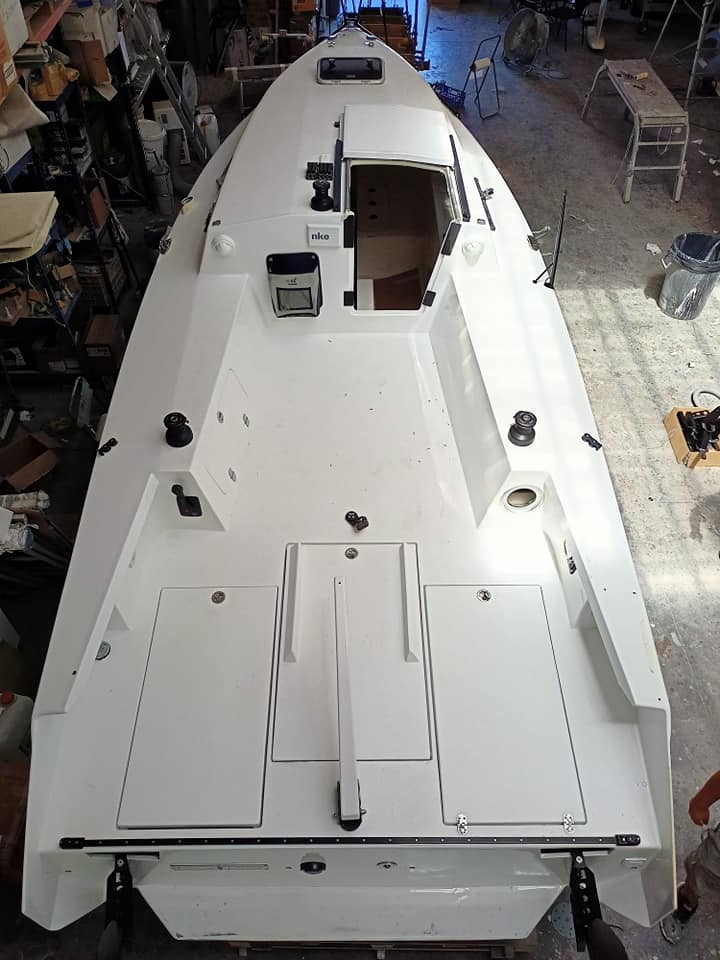
It seemed too good to be true, but the fact is that the boat is on the water and certified as Class A. That does not make it properly a bluewater boat but gives you the assurance the sailboat has passed the stability requirements that are needed for that certification, and they are, for a small sailboat, so high, that very few sailboats this size are able to have them.
It is even more difficult when the beam is limited due to the need for road transport in a trailer. Sailing this boat you will know you are sailing in an extraordinarily seaworthy boat for its size.
To my knowledge, this is the only class A that is trailerable and to understand how that is difficult to achieve it suffices to say that the bigger Oceanis 30.1 is only certified as class B, and can only dream to achieve the seaworthiness and safety stability of the smaller S8 (26.3ft).
And the differences between the two are not only about safety stability, because the superior ballast, draft and the much lower D/L (due to a high tech building) will give a lot more stiffness to the S8, and stiffness equals power to carry sails. That big overall stability will make the S8 uncomparably faster, a very fast yacht, by any parameters.
There is a reason for the Oceanis to be a Class B, and that reason is money: to have considerable more B/D in a sailboat is expensive due to the need for bigger hull reinforcements and bigger hull structure as well as the need of using superior quality materials, for assuring that the superior B/D does not translate also in an increase of the boat displacement, and therefore in a lower performance with lighter winds.
In fact, in what regards sailing, the S8 has nothing to do with the Oceanis 30.1, but more with the First 27 (Seascape 27), and that means a racing performance. The First 27 is a very fast sailboat, but, contrary to the Sarch S8, it is not a Class A sailboat, and the cruising interior has nothing to do with the cruising version of the S8, more like the S8 daysailing version.
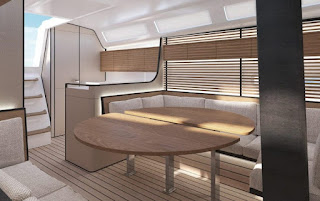
The S8 is proposed in two different versions, the DS8 and the CS8, a daysailer and a cruising yacht, having the same hull (immersed part), keels, but a different cabin, one more voluminous, offering the space for a good cruising interior, and a sleeker and lighter one. The less voluminous interior makes the S8 look absolutely gorgeous.
Both versions can be offered certified in Class A or Class B, depending on different keels, with more or less ballast, more or less draft. This has not only influence in what regards the boat stability, price, but also in what regards the easiness in putting the boat in and out of the water and in the trailer, but contrary to the First 27 all versions are easily trailerable. On the First 27 that only happens with the considerably more expensive version with a swing keel, which was the original one on the Seascape, but now is a marginal one, due to price.
The first sailboats (from both versions) have already been exhaustively sail-tested by the builder, Axel Sarch, and the results are very good, upwind and downwind. With 17kts of wind, gusting over 25kt the S8 was able to sail at over 7kt upwind and at 12.5kt downwind.
This performance, particularly the upwind performance, looked too good to be true, and many doubted that the S8 could be so fast upwind, but the doubts disappeared when the DS8 was tested by Nacho Braquehais, a top Spanish sail racer (Americas's cup, TP52), that said that the overall performance was similar, if not better, than the one of a J70, and that upwind the performance was no doubt better!
All the Sarch are built the same way, a high quality built: the hull is made with a carbon/glass sandwich with a core of marine grade okume plywood, using epoxy resin. The inside sandwich layer is glass, the outside carbon, with a single layer of glass, for cosmetic purposes.
On the boat structure, and bulkheads, marine plywood is used, and bonded with epoxy, and laminated to the hull and deck. The deck is made using vacuum infusion in an epoxy glass sandwich that has closed-cell PVC foam as a core. All furniture is included in the boat structure and in the end hull, deck, bulkheads, and furniture end up forming a monoblock, giving a great rigidity to the yacht.
This high-tech building allows for a light and strong boat. The DS8 has 1218kg displacement with the standard keel without a bulb (class B), even less with the bulbed keel (1118kg - ClassB) and 1338kg with the heavier bulbed keel (Class A). The cruising version (CS8 Class A) will be about 150kg heavier if an outboard is used and, if the inboard engine is mounted, it will be about 300kg heavier.
The S8 hull is 7.95m long, 2.49 wide and can have three different keels: a swing not bulbed one with 420kg ballast, with 0.50/2.00m draft and two torpedo lifting ones, with 350kg and 570kg ballast, for 0,5/1.75m draft and 0.5/1.95m draft.
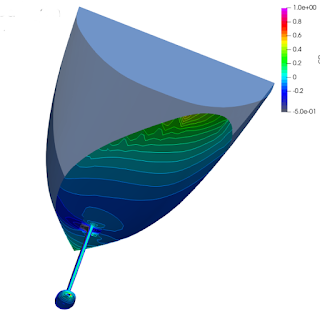
In the class A configuration the S8 has between 42.6% and 33.8%B/D (depending on the version and equipment), in the Class B version it has between 31.3% and 23.8%B/D (and less 20cm draft). The standard keel (Class B) is not comparable to the others in what regards B/D because it is not bulbed, and it is all in cast iron, while the other two have lead torpedos, but probably, being heavier and having more draft, it has a performance similar to the lighter torpedo keel. The class A keel is a high-tech keel made with a composite fin, and that allows the lead bulb to be heavier (a great part of the 570kg of ballast) lowering the keel CG and increasing RM.

With so many options you should be thinking about which one I would choose. Well, it depends on the use I would give to the boat: if for racing and weekend cruising I would choose the daysailer (DS8), that I find gorgeous, and would have it with an outboard. Regarding the keel, it depends on the type of racing, with a crew, 4 to seat on the rail in inshore regattas, probably the ClassB would get better results in handicap racing. For offshore racing, duo, or solo, the heavier Class A keel would give certainly a better performance and probably better also with a crew.
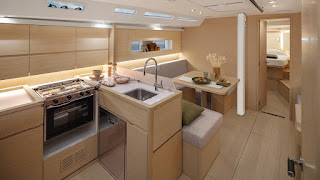
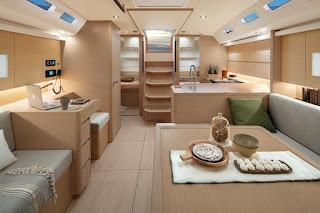
For more extensive cruising I would choose the cruising version, which has a very nice and good cruising interior, can have a true marine head, with a black water tank, a decent galley with a gimballed two-burner stove (option), and a good-sized refrigerator. On this one, I would choose without any doubt the Class A keel, for the better seaworthiness it will provide.
Regarding the type of engine choice, it depends: If some racing was on the program, I would ask Axel to do me a version with outboard engine on a well, similar to the one that is offered in the First 27 (Seascape 27). I believe that there is space for a 10 to 20hp outboard with electric start, and that would be more than enough, saving about 200 kg in the boat displacement (that in a 1500kg sailboat is a lot), not to mention that it would be less expensive, not only the engine, but the maintenance and even an eventual replacement.
If I was not interested in racing, or in taking from the boat all the speed I could get, I would have the 15hp inboard engine that provides better reliability and a bigger battery charge when running, at the cost of a bigger price and considerably more weight. The difference in speed the lighter boat will gain would be very little upwind, more noticeable downwind, in what regards the wind speed needed for the boat to plan, and some difference in what regards light wind sailing.
Anyway, even in its heavier version, the Cruising Class A, with an inboard engine and a displacement of 1688kg, or a bit over (depending on equipment), is a very fast sailboat, and the extra weight contributes to increasing the stability and to make it a less nervous sailboat, and that can be a good thing for extensive cruising.
The SA/D and the D/L of the heavier Class A cruising version with inboard give an idea of how fast this boat is: It has an upwind of SA/D 29.1, downwind 64.1, for a D/L of 109.7. If we consider the Class A version with an outboard the numbers are the ones of a true racer: upwind SA/D 34.0, downwind 74.8 for an 83.9 D/L.
Who, will be interested in this sailboat? Well, for sure a younger version of me LOL, this boat is the answer for young sportive sailors that have a small family, like to cruise fast in a seaworthy sailboat, with a nice cozy interior, that are still working, have not much time and want to save money, keeping the boat in a garage, not paying an expensive marina berth.
It will also be suited for cruisers that like to race and have the same concerns. For cruisers and racers alike it offers the possibility to transport the boat on a trailer to distant cruising grounds, or race locations, inexpensively and fast, saving in time (that they don't have) and in money.
This boat, like the other Sarch, has systems to lower the mast and to raise the keel that makes it relatively easy for two to put it on the water, or from the water in a dedicated trailer, which is also offered by the manufacturer.
Of course, high tech and high performance come with a high price and even if I don´t find it high for what is offered, this boat is a bit more expensive than a First 27, even considering the one with the swing keel, the only one that is easily trailerable and comparable. They say the model with a fixed keel is trailerable too but you would need a crane, and will have to tow it very carefully due to the high CG.
It is difficult to find price information for the First 27SE, because almost all the information regards the fixed keel version, which comes without an engine but with sails, and it is considerably less expensive than the swing keel version.
From what I could understand a F27 SE with a swing keel costs about 85,000 € without an engine and with dracon sails. That compares to 86,560€ for a DS8, also Class B, but with much better quality 3D Nordac North Sails and an 8hp outboard. Both prices are without VAT.
The daysailer (DS8) Class A, with the heavier torpedo keel costs 87 560 € and with an inboard 15hp Yanmar engine, 99 400€. The cruiser (CS8) Class A costs 97 580 € and 109 420 €, respectively, with an 8hp outboard, or with the interior Yanmar engine, both come with 3D Nordac sails. The Class B version, with less ballast and less draft, costs 1000 € less in each of them. All at the shipyard without VAT.
They offer two dedicated trailers with 4 wheels, both with brakes and a winch, one is able to carry 1350kg, the other 1500kg, for respectively, 4240€, and 4650€. This allows Europeans to pick a Sarch directly at the shipyard, without transport costs. The shipyard is in Spain, near Alicante.