Tuesday, January 1, 2019

THE INADEQUACY OF IRC FOR MAJOR OFFSHORE RACES


The below comment by Cherylle raises questions in what regards handicap and women in sail racing and because the subject is important I will take the opportunity to introduce, through my reply, the theme for discussion. You are invited to express your opinion and above all if you are not a sail racer but a sailor or someone that likes sailing and sail racing, meaning part of the public that watch and like sail races. 

Cherylle: All nonsense. 
The sexism inherent in the author’s non-acceptance of the capabilities of the crew on WO X is illustrative of why there are so few women actively participating in racing. 
The author needs to get a grip on the fundamental differences between an offshore self governing race and an inshore regatta with judges on course.  The author has a very limited grasp of handicapping. 
I was very surprised BJ thought he could have the Committee do his protesting for him or that he could believe it would get him where he wanted to be. 

Paulo: Normally I don’t publish rude or insulting comments and I find yours rude and borderline in what regards insulting but I will open an exception in your case just to show how inadequate and wrong your comments are. 

The ones that follow this blog, and there are many, know that I rejoice with women’s achievements on sailing particularly when they sail in equal terms against men. In what regards top sailing I don’t miss to report any of those occasions on this blog. 

Women in most sportive disciplines are disadvantaged towards men and that’s why they compete in different categories, separated by sex. Sailing, particularly ocean short crew or solo racing, is one of the few disciplines where women have actually showed they can beat men and occasionally they have done so. The last time was in 2018 on a professional race for top class IMOCA, where a woman duo beat all men’s duos. And also why on races where it is not mandatory a duo to be constituted by a man and a woman we see many times top women sailors making team with top sailor men. 

Because that is so I have said that it is ridiculous, that is a nonsense, the new Olympic category for Ocean duo racing to be raced by a couple, a man and a woman, an approach that assumes that women are less competitive than men on a discipline where it has been proved that it is not necessarily so. 
In what regards crewed ocean racing things are a bit different and I don’t know if women can be as competitive as men, at least on the actual format that allows for big teams and systems that make the handling of sails very dependent on physical strength. 

On Top Ocean crewed racing it has never happened and as it is known that when a women’s team raced a VOR they were advantaged by the rules that allowed for a bigger crew. The same happened on the last VOR where the teams that included women could be bigger making the choice to have women as members of a team, a choice not based on efficiency of a particular sailor (man or woman) but one based on profiting of an advantage related with the crew number allowed. 

That shows that there is an assumption that women in what regards Oceanic crewed racing are not as competitive as men and the fact is that I don’t know of any victory of a women’s team on a top offshore crewed sailing race. The best result was a victory on a Port Race on a VOR, but again, they were not racing in equal terms because their team was bigger. 

Regarding race regulation, on offshore races, the self-regulating race system is still used in top handicap races and show at what point they still are at an amateur stage, notwithstanding the importance of some of them. 

Major oceanic and offshore races, out of the handicap world are not auto-regulated anymore; you can have as example the Vendee Globe, IMOCA races, Route du Rhum and many others. Auto-regulation is a first stage in all sports before they have become big, important and professional. The fact that auto-regulation is used in sailing in some major offshore races shows how offshore sailing, as a sport, still is a very amateur affair. 

In fact it allowed the winner of the Sydney Hobart to violate the race rules, with knowledge of the organization, escaping any investigation or penalty, a fact that would be impossible in any professionally managed top race. The situation was dealt by a very incompetent and amateur race committee that filed a protest, that by the race rules, they should have known was invalid even if they had verified first the veracity of the information. 

The correct procedure was to communicate the situation to the protest committee that after having received information from any source that an irregularity had been committed should open an hearing and verified if the rules have been breached or not. 

Regarding my limited grasp of handicap racing it seems to me that it is quite the contrary. It is you who doesn’t understand that on an offshore long race, bigger boats and smaller boats don’t race under the same meteorological conditions being either one necessarily negatively affected by those different conditions, influencing in a decisive way the handicap results, in what regards measuring in equal terms all teams’ performance.
Just this would be enough to make any competition in handicap among boats with very different handicaps unfair, like on the Sydney Hobbart, but there is more: anybody who knows anything about boat design and handicap racing knows that some hulls are advantaged by light conditions, others by strong downwind sailing and others by strong upwind sailing and as IRC rating does not take any of this into account and does not change the handicap of each boat according to the meteorological conditions on a given race (and those are very different from race to race), therefore it cannot serve as a reliable indicator of comparative absolute crew efficiency, which is what it is supposed to do. 

Everybody who knows something about handicap racing knows all this and also knows that some hull shapes have a very bad global IRC rating, meaning that even if the boats are able to win the race in real time, they would never win it in handicap, no matter the crew efficiency and that is also a clear indicator that handicap racing is flawed in what regards a reliable measure of crew performance (and that is what it is supposed to do). 

A good example of a type of hull with a bad IRC rating is Comanche, that “won” the Sydney Hobart in 2017 and 2015, but being only 19th and 13th in compensated. No one doubts that Comanche (as any of the other top contenders) has a top professional crew with some of the best sailors on the planet and that is not credible that they would be 19th or 13th on the Sydney Hobart if the sailing performance of the crew was correctly measured by the IRC handicap, the one that serves to determine the “winner” of the Sydney Hobart and many other top races. 

Handicap racing is adequate to amateur racing and to club racing but not to major professional offshore races and that’s why in all those races the winner that is celebrated by the public and mentioned on the press is the real time winner, the one that arrives first. Unfortunately that happens only in what regards the overall winner when it could and should happen also in what regards several divisions based on boat length and also raced in real time. 

Any sort of racing based not on real time performance and where the winner is not necessarily the one that is the first to cut the line is voted to public failure, even if it was possible to measure accurately the crew absolute performance (and it is not). Public interest is absolutely necessary to the growth of any sport and more so on one like offshore racing where top racing machines cost many millions. 

Public interest is necessary to bring offshore racing out of the hands of billionaires, to have more competitive top sailboats and to have the best sailors sailing those sailboats, independently of how wealthy they are. This can only be possible through big sponsorship and for that it is needed publicity revenues, meaning that offshore sail racing has to have a large audience and a vast public. Only this way will it be self sustained, escape the association with billionaires and able to create many professionals making a good living out of their passion, as it happens on all major sports.

And I will take the opportunity to wish all an happy new year wind fair winds and lots of sailing.

Saturday, December 29, 2018

THE SYDNEY HOBART MESS


The race rules say clearly that on all yachts a transponder should be receiving and emitting an AIS signal during the entire race, a thing that can be easily controlled by the race committee. The first yacht to arrive, Wild Oats XI had not complied with that rule.

The race committee was informed that had happened, has verified independently the fact through the AIS public register and filed a protest. The protest was not considered because: "for the protest to be valid under racing rules of sailing, a competitor with the information about a potential rule breach must lodge a protest". 


If this is true it is simply ridiculous and it shows the incredible amateurism of a race that is among the biggest worldwide by the quality of the boats and crews. The organization, through the racing committee, had sure knowledge that a boat had not complied with the rules and even so no penalty was attributed? Who is responsible to enforce the rules? 

Regarding the race itself, on the changing light winds that were experienced on the final part of the race, Wild Oats XI was lucky to have chosen the best route on approaching the river Derwent, but the inexistence of an AIS signal blinded the other nearby yachts to that change of course and prevented them to eventually cover that move. 


Also on the light and changing winds that demand a lot of maneuvering Wild Oats automatic winches (that are illegal everywhere except here) allowed for an unfair advantage. For the ones that don’t know, some call the Wild Oats XI a power boat, due to the need of having his engines running permanently to power the systems, including sail systems. 

So, the victory on the Sydney Hobart went to Alive, an "old" Reichel Pugh 66 followed by an also “old” Wild Oates X, the ladies’ boat, with an entire feminine crew, who curiously spent much of the race fighting against Alive. 


Of course everyone knows that who really won the race, despite having broken the rules, was the much faster and more modern Wild Oates XI. What many don’t know is that formally it was not the case because the winner of Sydney Hobart is not the one that arrives first but the one who wins in IRC, one of three handicap formulas used in the race. 

The situation is odd. It is given much more importance to the classification at the arrival, which euphemistically is called, "line honors", than to the classification on one of the used handicaps, where old boats can be benefited by an inadequate handicap or by different meteorological conditions that can be experienced by slower boats.


The handicap classification was created to ensure that what counted was the performance of the crew, not the performance of the boat but everyone knows that it does not work. Of course, no matter how good the women's race has been, no one believes they could have been much better than the best teams, namely Comanche and Wild Oates XI, but they finished in 2nd place while Wild Oates XI was 11th and Comanche 20th. 

Maintaining this type of classifications, based on handicap, makes sense in club racing but not on top races and I believe that on major races it is a question of time till they become obsolete. In fact they are already obsolete.


In some sail races instead of considering divisions by handicap they are considering divisions by the length of the boat. It makes sense since the best and most professional crews already have the fastest boats and therefore it does not make sense to attribute false advantages to less efficient crews in slower boats, not to speak of the nonsense of the boats being designed not to be as efficient and as fast as possible but to better adapt to a given set of rules.

Friday, December 14, 2018

ANOTHER DREAM BOAT: FC3 53


Since we are talking about dream boats, this one is for Pip Hare the “ultimate” cruising boat. Pip Hare is a Yachting World journalist and test sailor and one of the best British solo racers. She will enter the next Vendee globe. I had already posted about this boat:

There you can find the technical characteristics, but this test sail, the great sailing performance of one of the FC3 53 on the last ARC and the boat quality more than justify another post, not to mention that I really like this boat.

Pip Hare says about the FC3 53: “I can’t just tell you what an extraordinary and special sailboat this is: It is built by a design house that has a proven track record in producing offshore race boats in collaboration with a yard that has a vast experience working with carbon and nomex. It is lightweight, it has a great sail area which is easily handled by two people and it is fun to sail. As an all package this is for me the ultimate cruising sailboat.”

The designers (Finot-Conq) say about it: “The project's highlights are : a fast cruising yacht, comfortable, safe, very easy to handle double-handed, and very stylish, both outside and inside.

Inspired by our IMOCA racing monohulls, this is a wide, light yacht, with one ton of water ballast each side, for maximal performance. It is entierly made of carbon fiber sandwich, with Corecell and Nomex cores. The pivoting lifting keel reduces the performance-oriented 3.75m draft to 1.6m for access to all harbours and creeks. It also provides unmatched safety in case of grounding.

The fromt part of the cockpit is comfortable and well-protected, separate from the manoeuvres, which are regrouped in the aft part. All lines are led below the deck. The longitudinal garage opens to the transom and makes the tender's lauch a breeze.

The liferaft door doubles as a bathing platform. The inside is vast and light, with very high-level finishes and equipment. The panoramic coachroof gives a great view towards the sea, even to the front. Large water and gas-oil tanks give peace of mind for even long passages.”

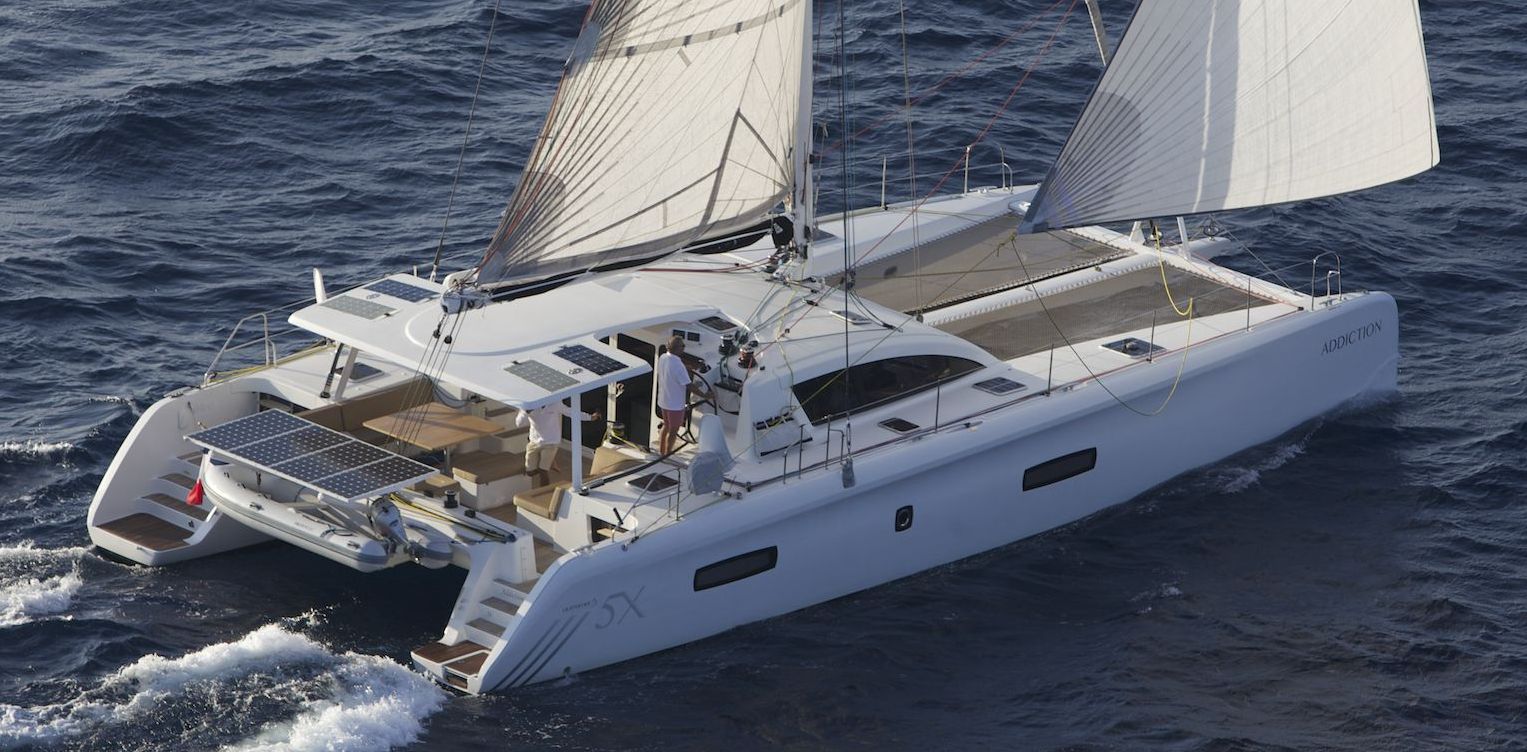
On the ARC, Nica, one of the three FC3 53 built made a fast transat being the 9th boat to arrive (out of 200) ahead of a well sailed explorer 60ft catamaran and not far from the two first multihulls, a Aikane 56 and a Outremer 5X (59ft). The Fc3 53 did not use the engine for propulsion; we will have to wait for the results to see if that was the case with the two bigger cats.

I would chose the previous dream boat, the Agile 42, to do the type of sail that I do, mostly on the med with the possibility of crossing the Atlantic once or twice, but if I was doing a circumnavigation or crossing oceans frequently, for sure I would prefer the FC3 53 and I would not mind much to change the Agile 42 for this one, even for med sailing.

That swing keel (1.80m draft) comes very handy for entering all small ports and find a place out of reach for most sailboats.

But please, not one with a green Kawasaki racing color. I had one and it did not look out of place on the motorcycle, in fact it looked rather well, but on a beautiful 53ft yacht? No way!


Thursday, December 13, 2018

AGILE 42: A DREAM BOAT


Some years ago, when I saw the drawings of this boat, designed by Maarten Voogd and proposed by a Dutch shipyard, one specialized on old school classic sailingboats, I thought: Wow! Beautiful…but one of those boats that are never going to reach the water.

I am very glad to have been wrong. The boat is on the water and it is absolutely gorgeous with a beautiful cruising interior too. It is going to make someone very happy and it is a pity the price is so high, otherwise it could make a lot more people happy, myself included. I am not saying that the boat is expensive considering the quality and the materials used, what I am saying is that such a boat is necessarily very expensive. Dreams are expensive LOL.

And this was the dream boat of the designer, Maarten Voogd that says about it: “I designed this boat on spec for myself. My brief to myself was more speed, so I could do the occasional medium distance race, and more comfort, so I can sail with my family.”


It was important to be able to sail the boat shorthanded, and that she handled easily…. so I added 750 litres of water ballast per side with additional 250 litres in the aft corner each side for downwind trim…… The biggest surprise is the actual feel of the boat,” adds Voogd. “It feels so much bigger than a 42-footer, very stiff in structure and sailing behaviour. It’s a real blast, downwind as well as upwind. So far we have achieved 20 knots of boatspeed on the IJsselmeer in 20-25 knots of TWS.”
 
The builder is Maarten’s best friend, van Daal and that explains the mystery of this boat being made on a classic boat’s shipyard. He says: “It’s delivering so much more than even we expected. Everytime Maarten Voogd joins us for a sail, he says the boat keeps on surprising him. 

In 30 knots of wind you never hear anything in the boat, it’s completely quiet, which is quite rare for a carbon boat. It’s so stiff, that’s one of the things we’re so happy about. Maarten said ‘I’ve built lots of boats, but never with this level of quality,’ which was a great compliment.”


For a perfect boat, perfect building methods and materials: “We CNC milled the frames, plated them and fixed Corecell foam to that, then we laminated the outer skin with pre-soaked carbon fibre, vacuumed it, and the carbon inner skin was vacuum-injected. Both skins have 0.8mm of carbon, two layers, and there are unidirectional carbon fibre reinforcements in specific areas. There is a web frame under the floor with 30 layers of carbon that supports the keel”. 

And a perfect design: Length:12.70; beam: 4.10m; draft: 2.40m with a torpedo keel; 46% B/D. No wonder the boat has a HUGE stability and can support a big sail area that makes it not only very fast but able to sail with very light winds. Don’t miss the video with the Etap, both sailing in light winds.

I like the interior that is fully customizable. If it was for me I would just add an upper central long handhold and a folding table around that mast but these are only details. The interior is of great quality and very light being the “wood” in fact cored to save weight and increase strength. 

The engine is electric but although the boat is very light, 10kw are too little, except for docking maneuvers or moving on flat water. However the system is probably autonomous in what regards energy. 

The motor works as a hydrogenerator when sailing over 5kt and that means almost all the time on this boat and due to the easy boat speed the generated energy, stored on a 8kWh Lithium-ion battery pack, will be probably enough. 

Maybe that system can be boosted doubling the battery pack, putting solar panels on the deck and increasing the power of the engine. It would be wonderful to have an autonomous sailboat with a decent engine performance, when needed and not only for short day sails. 


I really like this one, I like the design, I like the way it sails with almost no wind, I like the overall performance, the huge stability, including reserve stability. This is one that would be on my short list if I won the lottery, because costing over 600 000 euro without tax, it is really an unattainable dream. But is it not what most dreams are about?
https://beesonboats.wordpress.com/2018/05/09/agile-42-talking-to-vmg-yachtbuilders-and-designer-maarten-voogd/?fbclid=IwAR3uWsXSqYY4W9b4v0Lg-ml85wKTE-oPHJxW6-Qttf0rXZuDhqQ10_A6vpI

Monday, December 10, 2018

A MOCKERY OF A SHORTHANDED OFFSHORE WORLD CHAMPIONSHIP


World Sailing is going to have a Championship whose “objective is to create a pinnacle endurance competition to be pursued by the best sailors from all nations of the world”. Finally a world championship for offshore shorthanded racing, a type of racing that in what regards public attention has become the world’s most popular and that has already a large number of professional racers. 

Races like the Vendee Globe, the Route du Rhum, the Transquadra, the Barcelona World Race the Silverrudder, the Mini Transat, La solitaire du Figaro have become classics. The number of duo or solo races is increasing and many IRC and ORC top races have already a duo class. 

The most popular and the most important races are Solo offshore events even if there are some duo races that are raced by the same sailors that do solo racing championships, namely the Transat Jacques Vabre, the Barcelona World Race, the Transat AG2R and some others. 

It is clear to all that the main focus is on Solo racing and while there is not a championship specific for duo crews there are several Box design or Onedesign offshore solo championships that integrate some duo races, namely the Class Mini championship, the Figaro championship, the Class 40 championship and the IMOCA championship. 

However there is a champion for each class (not a duo). France was the precursor of this type of endurance solo sail racing but today it is popular in many countries and if France still dominates we can see that this year the 3rd on the minis is a German, on the Class 40 the 1st is British and on the ranking of the IMOCA class the 3rd is British and the 4th is German. 

L30, the boat for chosen to to create "a pinnacle endurance competition to be pursued by the best sailors"
So, the 1st big question is, why this new World Sailing championship is not a solo championship, as all existent offshore shorthanded endurance championships are, but a duo championship?

The 2nd question is, why on hell, on the only discipline where the women have shown that can stand on equal foot with men, it is not any duo but a couple (man and woman) championship?

The 3rd question is, why on a discipline that has already several classes, on a clear progression, from the beginners class of mini-racers to the top class of IMOCA racers, the boat chosen “to create a pinnacle endurance competition to be pursued by the best sailors from all nations” was a small 30ft boat not adapted for solo racing (narrow beam)? 

That would be as if on car racing the FIA created a class of small low power touring cars and declared that the world track champion would be the one that won three small races with that car. 

On top L30, below Mini 6.50 and a Class40
Of course that’s unthinkable and it would be a laughing stock to everybody. No top driver, namely not any top F1 driver or top Endurance driver, would have participated on such a ridiculous affair, even more if he had to find a lady driver to exchange the wheel with, on a underpowered ridiculously easy to drive car. 

The 4th question, related with what was said above, is, what kind “of a pinnacle endurance competition” would be attained by sailing duo a 30ft underpowered sailboat on two short coastal races (30 and 90 mile) and a three day / two-night offshore race ?

Even the ones that sail on the initiation class of solo ocean racing, the mini-class racers, would be laughing about that “pinnacle of endurance”. 

The 5th and last question is why, having decided that the Onedesign boat should be “8-12 meters hull length, high-performance offshore shorthanded racing monohull keel boat” they have chosen a boat with a type of hull not suited for shorthanded sailing instead of closing a well adapted existing shorthanded onedesign with a large fleet, the Figaro 3, or instead any of the existent production Class 40? 

Both boats are faster, much more adapted to solo sailing, much more seaworthy, able to do really long endurance races and suited not only to be used on this championship, but also in many other existing solo and duo races. 

For what I said one can have the idea that I am not in favor of a World Sailing Championship whose “objective is to create a pinnacle endurance competition to be pursued by the best sailors from all nations of the world” but it is quite the opposite. 

What I don’t want is a World Sailing Championship that makes a mockery of sailing endurance as a discipline, by the type of boat used, by the short races proposed and by the ones that would race them, certainly not the best solo sailors in the world, not by far. 

It may be said that there is no alternative, but there are several, the best of them created by the opportunity that is given by the VOR to be raced on an Onedesign IMOCA.

 I don’t know how many boats will be made but between the ones that are going to be built for VOR sponsors and the ones that are going to be bought by other sponsors to make the next vendee, it would not be difficult to reunite 20 sailboats and certainly, if the price is right, everybody will be interested in chartering them, or even racing them, on a set of major existing ocean races that would determine the Offshore World Sailing Champion. 

Somebody that thinks it is possible to organize an Endurance Offshore World Sailing Championship the same way it is organized a World dinghy Championship, with a series of regattas on the same location, does not understand what Endurance Offshore sailing is.


Friday, December 7, 2018

ARC, THE 200 SAILBOAT TRANSAT: HOW THEY SAILED

JP54
Mobile 53
The ARC+ has become bigger but the ARC continues to be the benchmark of all transats in what regards number of boats. And it is not bigger because they limited the entries to 200 and divert the excess to the ARC+.

There are two main differences to the ARC+ : On the ARC there is a small racing class and this Transat is a direct one going from the Canary Islands to the Caribbean without stopping in Cabo Verde. 

The racing division in what racing is concerned is a low profile one, 2nd rate race, used for some racers that are going to make the IRC racing season on the Caribbean and for some sportive cruisers, just to have more fun doing the boat transfer and do a bit of competition. The main difference from the cruising transat is that on the racing division the engine cannot be used.

Aikane 56
This year we had a racing star doing it on his cruising sailboat, a JP54. Jean-Pierre Dick, for the moment without an offshore racer, decided to make it for the fun of it and to attract potential sponsors for more serious racing. His crew is composed by CEOs that he wants to interest in offshore sail racing. 

Well, they should be interested by now because Jean-Pierre smashed the competition having already arrived, beating with his 54ft performance cruiser a Swan 80 (by 14 hours) and a Bill Tripp 128ft Maxi yacht, that entered just one hour and a half after the Swan. 
Outremer 5x

Other boat that is impressing me is the Mobile 53, a strange boat not because its design has something special but because it is a 16 year old aluminum cruiser racer designed by Almaz a Russian cabinet design specialized in warships: the number of vessels built over their plans are over 26 000!!! 

It seems that they can design good sailboats too and that Russian shipyards that once built mainly warships are up to the task of building light and fast aluminum sailboats. 


Oyster lightwave 48

Anna, the Mobile 53, is beating the two fastest and bigger multihulls, a 59ft new Outremer 5X and an older Aikane 56. I did not know the Aijkane 56 but it is a very fast and light catamaran, with daggerboards, a 8 year old cat designed by Van Peteghem / Lauriot-Prevost. The three boats clearly very well sailed and racing are involved in a very interesting battle. 


Grand Soleil 43
Another one making a great Transat is Nica a FC53. That’s among the very short list of boats that I would like to own, if I was a rich man (LOL). If you look at the blog you will find a post about it, a kind of carbon Super Pogo with a dinghy garage and a swing keel, a beautiful yacht with a good cruising interior. 

More 55
The FC53 is fighting with a Swan 70, a Shipman 80, a Southern wind 72 and a 60 ft beautiful Catamaran, an Explorer 60, a yacht that Toby Hodges (Yachting World) says it is a kind of a Swan, in what regards cats.
Laggon 560
 
On ARC they insist in not making a racing class for cats even if some do the ARC racing and declare 0 liters of consumed fuel at the end of it. It is a shame, unjustified and discriminatory since the number of cats certainly is enough to create a racing division for the ones that want to make a more sportive transat, without using the engine. 


X46

Grand Soleil 43
And of course, the Scarlet Oyster, a habitual costumer, a well known old cruiser racer Lightwave Oyster 48, that is used for extensive racing on both sides of Atlantic, is doing, as usual, a fantastic race, not far from the boats mentioned above. A very well sailed boat with a good and very experienced racing crew. They are in a particular fight with a Swan 68.

Nautitech 47
At some distance behind a new catamatan Outremer 4x (45ft) is going at the same pace of an Amel 64. Not far comes the first 40ft boat, a Pogo 12.50 fighting with a Corby 45, a First 47.7, a Grand Soleil 43, a Hanse 575, a Lagoon 560, a More 55 and a Farr 520. 

Close comes another group with a Halberg Rassy 54, another Grand Soleil 43, a XC45 a Nautitech 47, an X46 and another More 55. 


Outremer 51

At some distance from those, the first boat with less than 40ft is a little Pogo 30 that is making a fantastic passage and that is sailing at the same pace of a Pogo 36, an Outremer 51 and a new Fountain Pajot Saona 47.

All these boats are being sailed fast in a sportive way or racing and are way ahead of most other monohulls and catamarans on the Transat.


Thursday, December 6, 2018

REVOLUTION 29: A MINI VOYAGE BOAT


I have already talked about this very unusual boat when it was being built but since then the boat is on the water and two major sail magazines sail tested it and the results were better than I hoped for. No wonder since the design is by David Raison and follows the lines of his mini racer designs, the ones that have been dominating the mini transat on the last years.

But the Revolution 29 is a lot heavier and I was afraid that the performance was not there. I was wrong: Voile and Voiliers, the French magazine made a 150nm test on the boat in hard conditions, blowing between 20 and 29k and they loved the boat and the way it sails. 

On a beam reach with 20kt of wind the average speed was around 8kt!!! With a gennaker and on a broad reach the speed was around 10 with a maximum speed of 15.8kt!!! Later with an increasing wind (25 sustained) they sailed with main and genoa “at a more reasonable speed”. 

This type of hull offers maximum form stability and a decent B/D (28% with a draft of 2.60m) what makes for a stiff boat that will excel on a beam reach and downwind. Obviously the strong sailing point of this boat is not upwind but they said that the performance was not bad and that if the boat is hand steered it can, sailing close hauled, pass frontal waves without losing too much speed, even if the boat tends to slam. 

Without significant waves this boat has no problem sailing upwind. Even with waves it can power on, since it has a lot of power and stability, but the wave drag is big, resulting in an uncomfortable ride and the need of opening the angle to increase speed and decrease drag. The compromise is not that bad because the boat is powerful but not as good as a more conventional fast yacht with the same size. 

The German magazine Yacht de. tested the boat with very light winds and the numbers are good, except in what regards wind angle upwind, that is not as good as on a more conventional fast boat: with 6k wind at 50º-4.8kt, at 60º-5.2kt, at 90º-5.5kt, at 120º(gen)–5kt, at 150º(gen)–3.9k. 

The big advantage of this kind of hull for cruising is the maximized interior space, about 30% more than on a conventional boat and I have to say that the interior space is here very well treated making it an interesting proposition for a couple to live aboard for extensive periods. 

The outside area, including the cockpit, is also maximized and it has a nice finish with projected cork that contributes to the insulation, gives a very good adherence and a nice touch. The running rigging is well thought for a tiller set up and according to the ones that test sailed it, everything works fine.

The Germans complained about boat ventilation, lack of insulation and about a not very detailed boat, the French complained about the position of the engine command and about the size of the aft winches, too small for the forward sails. All the rest was pretty much positive with a lot of interesting features like a very good navigation berth and a huge traveler for the main. 

Looking at the boat dimensions we can see that it is not as wide as it looks, with 3.50m it has 20cm less than the Pogo, 8cm more than the RM 890 and 5cm more than the Mojito 888. In what regards displacement the Revolution with 4000 kg is considerably heavier. 

The Pogo 30 displaces 2800kg, the RM 890 3200kg and the Mojito 888 2850kg. Being heavier is not necessarily a negative point since it will give the boat a bigger overall stability and that can be important on a small offshore voyage boat. It makes it just a different proposition, closer to the RM than to the Pogo, in what regards performances.

The Revolution has a 28% B/D on a swing keel with 2.60m draft that compares with 30% on the RM with the 1.90m keel version, 34% of the Pogo with the 1.93 fixed keel version and the 31% of the Mojito with a 2,25m swing keel. A bit better on the Pogo, but values that will give a not very different AVS and reserve stability, a good one as it is mandatory for small class A sailboats. 


Regarding SA/D the Revolution has 26, a value similar to the other compared boats, 24 for the RM, 27 for the Pogo and 28 for the Mojito. The difference and what makes it a different type of boat is on the D/L, with 224 for the Revolution, 131 for the RM, 102 for the Pogo and 121 for the Mojito.


For the ones that don’t know what these numbers mean, the bigger the SA/D the more sail the boat carries for the weight, the smaller the D/L the lighter is the boat for its size. Above 20 SA/D means a lot of sail area for the weight and regarding D/L those numbers mean that the Revolution is a middle weight boat while all the others are light boats. 


The Revolution 29 comes standard with a 18hp engine with 30hp option, a 100L diesel tank and a 90L water tank, with space for a supplementary water tank if needed. It has two cabins, being the frontal one open to the saloon with the possibility of being closed and a huge space for storage, on the back of the boat and a bit everywhere. 

It can have a nice arch over the transom for solar panels (see the photos on French test)and a lot of options including heating and that makes the price to vary a lot. From about 100 000 euro to the 170 000 for a top equipped boat with a swing keel (the one on the French test). The prices are without taxes. With European VAT we will be talking about a bit over 200 000 euro for a true mini globe trotter. 

A boat like this could not come cheaper and the price is interesting, just a bit more expensive than the other compared boats. A Pogo 30 costs around 100 000, the Mojito 90 000, the RM 104 000, all prices without tax. A ready to sail well equipped boat will cost significantly more, depending on equipment needed and chosen. Yes, that’s a bitch; boats are expensive and really good ones considerably more than mass production boats.

https://www.afep-marine.com/presse/voile-mag-juin-2017.pdf
https://www.afep-marine.com/presse/yacht-test-juin-2017.pdf