Most people that do a circumnavigation do it on a schedule. Some do it even without stopping, just to prove themselves they can do it. Some do it in a rally with the support of an organization, like the ones that choose to do it on the ARC World, that circumnavigates in 15 months.
Most do it alone on a period that ranges between 2 and 4 years, some sell the boat or navigate much less extensively, others after some years, start a new circumnavigation and some have done it 3 or more times.
Christophe Mora, a French who found an Estonian mate, Carina Juhhova, in Chile, seems to do it as a way of life and contrary to most seems not to have any schedule regarding their circumnavigation, that seems to be a lifetime exploration. Christophe sailed from France 7 years ago and is now circumnavigating Australia after having done the same in New Zealand, all South American East coast and a good part of the West, before exploring Polinesia.
There are several unusual things regarding this never-ending voyage, one of them is that they enjoy as much exploring the wilderness and the mountains as they love exploring by sea, the other is the choice of the boat, which was new when he bought it.
He chose a kind of slightly bigger mini 6.50-racer, built by a shipyard that started by doing racing minis and that today makes cruising boats that have many similarities to Pogos.
For several years Marée Haute specialized itself in making seaworthy and fast small cruising boats derived from the mini racers, exploring a market that was also the one of the first cruising Pogos, a small market abandoned by Pogo today (the smallest cruising Pogo is a 30ft boat). Marée Haute makes now also a 9.80 and a 12.70 but its success was due to the cruisers that were derived from the Mini 6.50 racers, the Django 6.70 and the Django 7.70.
And the chosen boat was a Django 7.70, the smallest boat I know that manages to pass the requirements to be certified as Class A and a boat that I would say is a radical choice for a circumnavigation, even more now that is not made solo, but by a couple.
But Christophe is not the type of traditional cruiser, being its previous profession mountain guide, he was used to living in tents, was used to a very spartan comfort and he wanted the smallest, less expensive possible boat that would offer ocean seaworthiness.
One that would be reliable, well built, with inexpensive maintenance, that sailed well and that had minimum accommodations and comfort. The logical choice was Django 7.70.
Later, in the Magalhães strait, he met a girl that had the same approach to life. Carina had been backpacking for most of the 12 years she had traveled around the world (57 countries) and had settled at Port Williams as a Tourist guide, but could not resist Christophe neither the call to continue the nomadic life, this time on the water.
She has to be a very special woman because the boat does not have a head, a shower, warm water neither a refrigerator and sometimes almost all interior saloon floor is full of jerrycans with gasoline for the outboard.
The Django 7.70 can have a diesel inboard engine but that is expensive so Christophe opted for two 9.8 Hp two-stroke outboards.
The engines have not alternator so he has inboard a small Honda generator (1kw) for the heating and for recharging the battery a two 100 Ah battery set-up. For electricity production they have a solar panel with 140W and a Watt&Sea hydro generator.
As tankage, they use for gasoline many jerrycans, that you can see on the photo and for water a tank with 56L plus a container with 30L and a 5.5L/H small hand-operated water maker.
For communications, they use a VHF radio with AIS and for weather information they have an Iridium with ZyGrib. For safety a light liferaft, waterproof TPS survival suits and they don't mention an EPIRB.
Almost all would say that it would be impossible to live like that while circumnavigating but they have been doing it for several years and even myself, being used to hear about people with much more spartan tastes than mine, am amazed.
That's true that when I was their age I sailed for two months with my wife, living aboard a boat that would make theirs luxurious, but they were 2 months out of twelve, not several years in a row! If you look at the map of their voyage (bottom) you will see that in almost all places where they stop they make big exploration trips of several days on land and I bet it feels good after being cramped for so long on a boat with so little space.
Of course, this probably is the only way they have to do it since they say they spend about 500€ a month and that includes boat maintenance. That is only possible because they have a small boat with very little things that can break or malfunction. The bigger and more complex the boat is, the more expensive the maintenance becomes.
Their blog is full of interesting stories but unfortunately, a big part is only in French, others handwritten, it is not very well organized, with nice small pictures. The movies are not many and are not easy to find, without a direct link.
A pity that from so many incredible places so little has been put on photos and videos, but even the blog is well worth exploring.
I believe that if they took the care to share more quality photos and movies, making all of us dream more about their amazing voyage and the incredible places they visited, they could support themselves easily and who knows, start to save for a bigger boat.
They would not be the first that would succeed in doing that and they are among the ones that deserve it more.
All the pictures posted here are taken by them and posted on their blogs.
You can read about their adventures and voyages as well as see many photos clicking on the links below, but if you click on "English" you will only have access to a small part and no photos but nice drawings by Carina. For photos and more information you have to read it or translate it from the French. Below, one of Carina's drawings.
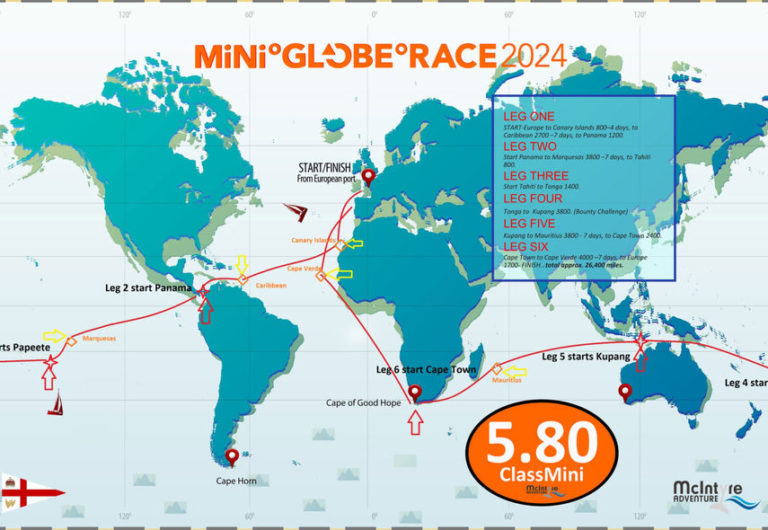
Contrary to what is usual I am not posting about this boat because I find it interesting but because I find it impossibly dangerous for doing what the class mentor, the same that created the Golden Globe Race, has meant it for: a Globe Race disputed on this sailboat, to take place in 2024.
The profile design looks nice, kind of an old mini with a bigger freeboard, big protection over the entry hatch and an old wind pilot, the general aspect is solid, kind of look of a TT machine, a boat able to sail anywhere and the truth is that it had raised a huge interest and has been publicized on some of the main yacht magazines, including the biggest of them all, Yacht.de.
The boat is to be built at home by the "racers" using plywood, the plans are from the Polish yacht designer Janusz Maderski and cost only 300€. The complete boat would cost around 6000€ for a basic version, and 20 000€ for what is described as a fully equipped boat suited for bluewater racing.
Probably you are thinking that at least two mini-racers, that are only 0.8 m shorter in length, have already circumnavigated and that was not that dangerous because both had made it, although both had broken their masts in capsizing situations, having one of them the mast replaced and the other jury-rigged.
Except that a mini-racer stability has nothing to do with the one of this boat. Stability on a sailboat comes from hull form stability, which has to do with beam, with lowering the boat CG, that has to do with B/D, with draft and type of keel and comes from displacement.
It has also a great deal to do with displacement because RM is obtained multiplying displacement by the lever (GZ) that is obtained measuring at each point of heel the horizontal distance between the center of gravity (CG) and the center of buoyancy (CB). This video helps to understand how the lever (GZ) varies with heel and if you want to know more about this there are two links below, one to the site of the video, other to an inexpensive book that explains the basics of stability on a boat.
That is why generally a bigger and heavier sailboat has more overall stability than a much lighter sailboat and why some very heavy small sailboats can have better stability than what their size leaves to suppose, but of course, to sail well a sailboat needs to be light, more even if it is a race boat and therefore having a heavy sailboat is not a good idea in what regards sail performance.
That's why the small 6.50class mini, having to be light to be fast, maximize all the other ways to increase RM without adding weight, increasing the lever (GZ), namely through beam and through lowering the CG. That's why the 6.50 mini is so incredibly beamy.
The center of gravity is lowered on the 6.50 mini through a big B/D, an efficient lead torpedo keel and a big draft (2.0 meters on protos, 1,6 on Series). The lowering of the CG increases not only overall positive stability but even more AVS and safety stability but also reduces greatly negative stability, making the proportion between the two much bigger.
The Mini Protos needs less ballast for about the same needed RM (to pass the safety stability tests) due to a bigger 2.0 meter draft. The 1.60m draft of the Production boats makes them more adequate to compare its stability with the one of the 5.80 class, which has 20cm less draft, but a not very different keel with a lead torpedo.
Let's then compare a production Mini 6.50Class dimensions, for instance, a Pogo 3, with the ones of the new 5.80class:
Regarding hull form stability the 5.80 is not only 0.8 m shorter (5.70 to 6.50) but has 0.7m!!! less beam. Regarding the keel, the Pogo has 0.2m more draft (1.40 to 1.60) and 245kg more ballast (220kg to 465kg, more than the double !!!) displacing the 5.80 only 220kg less than the Pogo (700kg to 920kg) for respectively a 31.4%B/D and a 50.1%B/D. And of course, that uncomparable superior B/D effect is maximized, regarding the one on the 5.80Class, due to a bigger draft. As you can see looking at the drawing of the new 5.80 class, it seems that the boat is just a slightly smaller, much less beamier, older designed 6.50class, but the stability of the two boats has nothing in common and while the mini is an offshore boat, to be sailed not in strong sea conditions, the 5.80class is a coastal boat and it is irresponsible to propose this as a boat for a circumnavigation race that passes in places and seas where the conditions are much stronger than on the low latitudes of the Atlantic on the calmest period.
Comparing the two boats, the 6.50mini will have a much better overall stability, incomparably better safety stability, and a much higher AVS. The inverted stability would be much smaller and the considerably less windage and a much superior stiffness will contribute to a far better dynamic stability.
Reading the above one may think that a Class 6.50 Mini-Racer is an extraordinarily seaworthy boat for bluewater racing and crossing oceans, when it is really a boat on the limits of what is considered safe for doing that. The mini racers on a transat are accompanied by several support boats, 7 last year, that are there to provide a quick help if anything goes wrong and to relay VHF distress messages.
If you follow the mini transat you know that it is raced on the season when conditions are better to make an Atlantic crossing from France, that even so the departure date is frequently postponed for safety reasons due to bad weather (like last year), and that some times the race is just stopped, bringing all boats to safe ports to wait for conditions to improve, as it was the case in 2013.
There is also another difference: mini sailor racers to participate on the mini transat have to qualify themselves for it and have to do a 650Class 1000nm solo race or several ones totalizing 1500nm, having at least 500nm of those being made solo.
This assures that all the sailors doing the Transat have considerably minimum experience and know their boat very well. Looking at the new 5.80 class and taking as an example what the requirements are to race a Transat on even smaller boats (by the same NA) we will see that it is enough to have 18 years and "the skippers are participating on their own risk". No previous solo racing experience on that boat (Setka 5.0) verified. It seems that race this year is going to be a success at least in what regards participation since there are already 10 entries. http://www.maderski.pl/setk--przez-atlantyk-2020.html?fbclid=IwAR0h0IPgaimv3twVTX1N8DHe13F2ochia1oSkSgp9Bc_1KkD4xsaj3Y8lN4
It starts from Portugal, November 2020 and it seems to me that they don't have a clue on what the sea condition can be in November there.
The frequent bad weather in November between France and the Canary Islands is the reason why the Mini-Transat starts in September/October from France and the reason they wait some time on the Canary Islands before going South.
It is to be sure they make the last leg on the best possible weather window, which is in November.This race on these boats is famous in Poland and it is already on its 3rd edition, in 2012 they were 5, only two finished but in 2016 all 8 boats finished on a Transat that experienced exceptionally good and fair winds.
You can see the conditions on the tracker below and I can tell you that rarely have I seen so good conditions and I follow several transatlantic races every year. Most of the time the max winds are of 30kt or more and on this particular year max winds stayed in the lower 20's. You can check that on the link below.
Of course, it is possible to cross the Atlantic in very small unsafe boats and get away with it most of the time but that does not mean an acceptable risk. For instance, on the ARC they only accept ClassA sailboats with 30ft minimum. Obviously, as the success of the 2016 edition showed, it is possible to do a Transat with much smaller boats and get away with it, most of the time. The question here is where you put the line in what regards seaworthiness and safety.
I salute the courage of those that want to race solo bluewater in manifestly unsafe sailing boats for ocean racing, but sailing competitions in crafts that do not offer minimum safety requirements should not be allowed and that is why World Sailing demands specific stability requirements and safety equipment on boats for participating in Ocean Races that draw that line at what they consider an acceptable safety and minimum risk.
Note that I don't have anything against somebody risking his life the way he wants, sailing or otherwise, but that should not have anything to do with sport. There are many sports that involve risk and Ocean Solo Sail Racing is one of them, but the risk has to be a controlled one and all the measures needed to diminish that risk should be and are taken.
Sailing as a sport should be regulated within acceptable risks without creating significant conditions to put sportsmen and other people's lives in jeopardy, namely, the ones that will have to rescue some of those who participate in excessively dangerous races, races where rescues will not be a small possibility but a big possibility.
Not to mention the cost of those operations and the increased risk that someday those costs will be passed to all of us through the need for compulsory rescue insurance for offshore sailing.
If you want a small reasonably seaworthy sailboat for offshore sailing instead of building one of these buy a second-hand old mini. There are many not competitive anymore that can be bought for the same that would cost to build a 5.80class sailboat or if you want to build yourself a boat there are plans to build one like these on the link below by Dudley Dix (above on the photo):
Now that the Arcona 345 has just been announced let's have a look at these entry-level performance cruisers, boats with a very good cruising interior and pointed more for cruising than for racing even if they can do very well in club racing.
Arcona 340, Diva 34SC, Dehler 34
The Arcona 345 is the newer model, not yet on the water, but uses a 10-year-old hull (Stefan Qviberg), the one of the 340 that I would say shows already its age, especially in what regards transom design with the max beam still not pulled back as much as the one of the new 435, for instance.
The Arcona comes with several improvements, some aesthetical some functional. Aesthetically the boat has the same cabin but several hatches have been substituted by a long and continuous plexiglass panel with some openings, like it was already done on the other models. The transom is now an open one.
On the interior there are finally two small hull windows and instead of mahogany it can now be done in white stained oak and it is possible that some minor alterations will happen due to the introduction of the hull views and due to a bigger head. That will not result in a smaller saloon due to the elimination of the chart table dedicated seat.
Functionally the two biggest improvements regard the use of a standard single tiller and an optional two-wheel setup instead of a single wheel as well as the possibility of an integrated nice bowsprit with an anchor stand. There is also a small increase in the standard upwind sail area.
Arcona 340, Diva 34SC, Dehler 34
The improvements make the boat look nicer, the head is better, has now a dedicated shower compartment and the interior will look bigger and more luminous in a less dark wood but I really don't like white oak and find it a pity they don't offer more possible wood finishes.
The Diva 34SC has a more recent hull (Bernt Lindquist), only 3 years old with all the beam pulled aft and it has a very nice interior with an interesting solution that maximizes the galley and the saloon at the cost of a narrower stair, an integrated chart table on the saloon table and a smaller head even if with a separated shower.
The galley is really very good for a 34ft boat as well as the saloon. The galley can also be mounted in a conventional way (without extra costs) with the loss of some space.
It can have a tiller and in that case, it has an open transom or two wheels and in that version, it has two seats behind the wheels that I don't like and restricts the space for the helmsman but I guess that they can be taken off if somebody does not want them.
Both boats have a single rudder set up, a deep one. Both have L keels but the one of the Diva is more efficient having a torpedo while the one on the Arcona is bulbed. Both have the same draft (1.95m).
The two have mainsail travellers but the Arcona uses a more versatile genoa traveler while the Diva uses a 3D system for the jib. The Arcona uses for the mainsheet a german sheeting system and the Diva a purchase system and that is why the Arcona has 6 winches while the Diva has five.
Arcona 340, Diva 34SC, Dehler 34
The Dehler 34 is probably the Dehler I like more, it is a 4-year-old design (Judel/Vrolijk) with some little details that spoil a bit the nice look, like the integrated bowsprit with anchor stand that does not really look integrated, looking like a plastic piece and with a different white than the one of the boat and the swim platform that is too big and makes the transom too large. The swim platform is optional but if you don't have it the transom shows a step that is not nice.
The interior is spacious, has a good galley, a big head and a saloon that is only a bit spoiled by those rounded cabinets that you really like or hate. But the truth is that they are not functional and look kind of fragile.
The rudder is a single deep one, the keel can be an L bulbed one or a torpedo keel, it can have a tiller or two wheels, it comes with 6 winches, a german mainsheet system, travelers for the genoa and the main.
Let's look at the technical characteristics (m, kg, hp), first the Arcona then the Diva and finally the Dehler. Hull Lenght - 10.40,10.33,10.30; LWL - 9.80, 9.21, 9.60; Beam - 3.45, 3.48, 3.60; Displacement - 5200, 4750, 5950; Ballast - 1900, 1850, 2100; Draft - 1.95,1.95,1.95; B/D - 36.5%, 38.9%, 35.3%; D/L - 153.6, 170.5, 185.8; SA/D - 25.3, 24.5, 20.1.
The Diva has another version with a lighter interior with the furniture made of a lighter (and more expensive) material and with a keel that instead of being a cast iron fin with a lead bulb, like on the Arcona, it is a steel lighter structure (with foam on the interior) that supports the same lead bulb. The boat is 300kg lighter and has a 34.8% B/D, a 159.6 D/L and a 25.6 SA/D.
Diva ugly seats, Dehler open transom, and cover
Curiously the two keels have the same draft and that can only be explained because most of the sailors that buy this boat sail on the Baltic that has many parts with shallow water, otherwise it would have made much more sense to do as on the Dehler, proposing a 2.1 m performance keel. That would have resulted in a boat 500kg lighter (instead of 300kg, for the same RM) or if they had maintained the same bulb would result in a more powerful sailboat.
The Dehler also has a more expensive version called "Race", 500kg lighter, with carbon spars a 2.10 m torpedo keel (the keel on the other version is a bulbed one) that has 31.2% B/D, 173 D/L and 23.3 SA/D.
We can see that even if the hulls are different in what regards the main characteristics these boats have many points in common especially if we consider the upgraded "Race" version of the Dehler. The Dehler cruising version is clearly below in what regards performances in all points of sail, being the one with proportionally less sail area, the heavier, even if in what regards B/D is only slightly below the Arcona that has the same type of keel.
The Diva has a slightly bigger B/D and has, among the standard boats, the most efficient keel. The keel of the Dehler is bulbed and all cast iron, the one on the Arcona, like the one on the Diva has a fin in cast iron but while the Diva one has a lead torpedo the one of the Arcona has a lead bulb.
Arcona 345, Diva 34SC, Dehler 34
I am not saying that the cruising version of the Dehler 34 is not an excellent boat, only that the one that is comparable in performance with the two other boats is the one they call Race version. Neither that the cruising version is not interesting, in fact, it is an excellent cruising boat for the price (that is much lower) and even if it does not offer the same performance it offers bigger overall stability and comparable safety stability.
I can say this with confidence because I saw the stability curves of the two Dehler. Contrary to some brands where, with some logic, the faster version with a deep draft has a bigger RM coming from the keel, on the Dehler they chose to give about the same stability to both boats.
The faster one has a much more efficient 2.10m keel with a lead torpedo, only 1700kg ballast but the standard one with 2100kg ballast, on the all iron 1.95m keel, has about the same stability. The same happens with the Diva that on the standard version, with a cast iron fin and a bulb keel, needs 1850 kg ballast to produce the same effect as 1550 kg ballast on a high-tech steel keel with the same torpedo, but in this case maintaining the same 1.95m draft.
Arcona 345, Diva 34SC, Dehler 34
It seems that many sailors know that the Dehler 34 is a very good deal and that's why the boat is one of the most successful Dehler of the new generation but that does not mean that it has the same building quality of the Arcona or Diva, it is a boat built to be as good as possible while maintaining the costs down, a different approach from the ones of Arcona and Diva that aim at a superior quality.
In what regards building quality the Dehler is in between the Hanse and the other boats on this comparative, using sandwich with a balsa core, hand-laid lamination, polyester resins and only on the outer layer vinylester resin. It uses a structural cage with carbon reinforcements and the plywood bulkheads are bonded to the hull.
There is imprecision regarding the core material used on the Dehler hull, it says balsa on the standard specifications (2019) and foam on the brochure, but referring a drawing with the Race version. Some years ago the 38 Cruiser version had balsa core while the Race version had foam so, it is possible to be the case here, even if they don't make it clear.
The Arcona 345 uses vacuum infusion and vinylester resins on a sandwich, using as core 20mm divinycell, a very good foam core. The marine plywood bulkheads are bonded to the hull and deck. It has a galvanized steel structure that takes the loads from the keel and rig and distributes them by the hull.
Arcona 345, Diva 34SC, Dehler 34
The Diva 34SC has a high tech building method that is used mostly on race boats, the same that is used on JPKs. The vacuum infused hull, using vinylester resins and a Divinycell core includes the boat structure that becomes an integrant part of the hull giving it a better weight/ratio strength and dispensing the use of bonding agents or lamination of parts.
The bulkheads and structural furniture are also vacuum infused sandwich cored parts, some of them infused with the hull, others laminated to the hull forming an integrated structure with few joints and this allows not only to make a stronger boat but also to save hundreds of kg and that explains why the Diva is the lightest of the three.
In what regards performance cruising all these boats (considering the Dehler Race) have very close performances although with different hulls that give them different sailing characteristics. Another common feature, all that test sailed them loved the way they sailed, so these are three little great boats that I would recommend without hesitation.
The Arcona has the narrower and more classical hull, with the max beam more to the middle of the hull, a boat with excellent light wind and upwind performance and a good overall performance due to its big B/D and a well-proven and well-designed hull. It is from the three the one that has the best race record (and continues to win races) but probably that's also because compared to the Diva there are many more boats built and much more racing.
Arcona 430, Diva 34SC, Delher 34
The Diva 34 SC has a hull with a prominent chine and a large transom with all the beam brought back. It is only slighter beamier than the Arcona (more 3cm), it is designed to sail with less heel, probably has a worse light wind performance but will be easier to sail fast downwind and maybe even on a beam reach. It has a bigger hull form stability and an RM coming from the keel probably bigger than the one of the Arcona.
Not many boats around and even less racing so it is difficult to know what the real performance is in handicap races. In what concerns performance cruising it seems to be at least as good as the very good one of the Arcona, and probably easier to sail due to less heel and an easier downwind ride, with some stronger and weaker sailing points.
The Dehler is by far the beamiest of the three (more 15 cm than the Arcona) but a hull that cannot be considered a very beamy one. For instance, the Oceanis 35.1 that has about the same length has more 12cm at the max beam and the smaller Pogo 30 more 10 cm. The hull shape is in between the one of the Diva and the one of the Arcona. The Dehler 30 without having the same racing success of the Arcona is perfectly capable of good results in club racing.
I have seen the three boats (Arcona 340) and I confess that although the others don't look bad and have a nice interior when I saw the Diva 34SC I had an irrational desire to have one. The boat is so cute, the interior so nice and the sail characteristics so attractive that it is difficult to resist its charm, especially knowing that it is also a very well built sailboat.
The only thing I don't like are those ugly seats behind the steering wheel that reduce the space for helming the boat, but I saw boats without them so they can be removed and maybe bring the price a bit down. And talking about the price that is one of the factors to have into account because if the price of the two Sweedish boats is more similar, the one on the German boat is lower even if it is difficult to know the price of the "Race" version, assuming it can have a hull built in a different way and with better resins.
The Arcona 345 announced price is 135 456 €, the Diva 34SC costs 149 778 € and the Dehler 34 "cruising" costs 123 900 € (7/2019) and I have no price for the "Race" version (assuming it is possible an upgrade in the hull with vinylester resin, vacuum infusion and high-quality foam core) but without that upgrade, the extras needed to put the Dehler 34 with the same equipment of the other two boats (in what regards performance) cost 14 500€ raising the price to 138 400€.
These are prices of standard boats at the factory, without transport or taxes and the comparative value of each boat can be different depending on the equipment you chose, with prices varying from boat to boat. For example, on the Diva an upgrade for carbon mast and rod rig costs 17 150 € while on the Dehler it costs 25 700€ (the Diva has a bigger and better standard aluminum mast) and the opposite may happen regarding other equipment.
It is worth mentioning that the Dehler comes already with sails, Elvstrom FCL performance (full battened, triradial, main and jib) and that similar sails cost 7980€ on the Diva. The Arcona does not come with sails, neither the 6 winches that are standard on the Dehler as well as the battery charger that is also an option on the Diva.
In the end, the price of the Arcona and the one on the standard Dehler turn out to be their best arguments. The Dehler not offering on the Cruising version the same performance, neither (in any version) the same quality of interior and built quality of any of the other two boats, offers a boat that considering the difference on standard equipment will be about 20 000 euros less expensive (15%) and it makes sense to the ones that will not need or desire the extra performance and like its interior.
On the Dehler, like on many other boats, if you start adding more expensive equipment to have a similar performance of a faster sailboat, in this case, to have the same performance of the Arcona, then the difference in price will become much smaller and the Arcona continues to be better built, having a better quality interior and a better resale value and it does not seem such a good deal to buy a Dehler Race instead of an Arcona, unless you really fall in love with the Dehler, but love is blind LOL.
The Diva offers a more expensive and superior high-tech build than the Arcona and it seems to offer the best of the two worlds, especially in its more expensive version, offering the nicest interior and a very good sail performance but at a price that only you know if it is worth paying.
It is also the most modern-looking boat and the sexiest one but the difference to the Arcona (both boats standard) is 14 332 euros that will rise to 26 421 euros if you chose the version with the high-tech keel and the lighter interior.
Arcona 340 Katriina II has already an open transom
It looks to me that the lighter version of the Diva should have a superior performance than the Arcona, especially in offshore races but that remains to be proved and in fact, the race results that I saw do not confirm this, not even in real-time and in compensated the Arcona 340 has some top results to show for:
A 2nd place on the 2019 European ORC championship (with a modified keel), a 2nd on the same championship in 2016 and 3 times winner on the Baltic Offshore Championship (all results obtained by the same boat and crew -Katriina II).
Another Arcona 340 won the class on the 2019 AF Offshore Race (Round Gotland race, the most famous and participated offshore race on the Baltic) and the Arcona 340 has many other smaller victories and good results.
But to win you just don't need a fast boat but also a great crew and as the Arcona 340 has been around already for 10 years it is much more raced than the 3-year-old Diva 34SC. There is at least a professional team racing the Diva in duo but I was not able to find any significant results. Anyway for sure I would like to see the comparative results of one raced by a good duo on the Fastnet for which the boat characteristics seem very well suited.


 But Christophe is not the type of traditional cruiser, being its previous profession mountain guide, he was used to living in tents, was used to a very spartan comfort and he wanted the smallest, less expensive possible boat that would offer ocean seaworthiness.
 But Christophe is not the type of traditional cruiser, being its previous profession mountain guide, he was used to living in tents, was used to a very spartan comfort and he wanted the smallest, less expensive possible boat that would offer ocean seaworthiness.