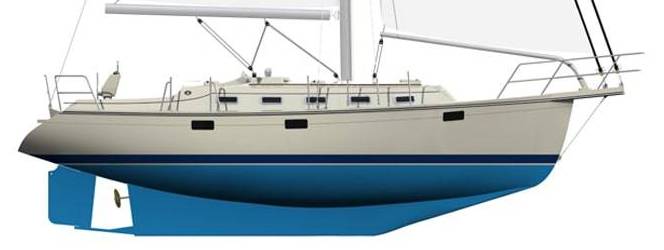
The Deck Saloon cruiser is an interesting concept that has been losing prominence over the last decades. In the past, many sailboat brands had smaller than 45ft deck saloons in their line: Jeanneau, Hanse, Dehler, Arcona, Southerly, Fantasi, and Wauquiez were some of them, and there were famous brands that produced mostly deck saloons, like Nauticat.
2002 - Nauticat 37, above and below
First, we saw many deck saloons, maintaining the same cabin configuration, be transformed into false deck saloons, using the bigger interior height only to increase interior space and volume, but having not a raised saloon that allowed outside views.
The best example was Jeanneau, which for some years maintained a line of false deck saloons yachts, that they called DS anyway. But other brands, including Bavaria, followed this trend, which is today used by many brands, including Contest.
The true deck-saloon concept offers advantages and disadvantages, the more obvious advantage being allowing an all-around outside view, which is only possible on this type of boat, or on a catamaran.
With an outside view, when it is cold or raining, you will not only be able to sail protected, sailing the boat from the interior but will also continue to enjoy the scenery, while at anchor.
With the evolution of automatic pilots, modern DS, to be sailed from the interior, don't need an interior steering wheel anymore, just a joystick.
1996 - Above and below, Dehler 41DS
The most obvious DS disadvantage is an increased price in production, making this type of sailboat more expensive. There are other disadvantages like the need to cover most window surfaces from the outside in hot climates, not to increase the interior temperature too much. For this reason, this type of sailboat was never very popular in the Caribbean or Med, where people tend to sail mostly in the spring or summer, when the temperatures are already high.
Sure, in the Med or the Caribbean, it still offers a big advantage in night passages, or while sailing out of the main season, but the ones that do that are few, and in the end, the superior production costs and the more marginal market are the main reason why this type of configuration was abandoned by big brands, even if Hanse, through Moody, still proposes a line of deck-saloons, that is a bit a cross-over between a catamaran and a monohull.
That's because of the temperature problem in hot climates that most of the surviving deck-saloon brands are from the North of Europe, where the temperatures in summer are a lot lower than in the South. This problem is not a relevant one for bigger yachts, that use air conditioning full-time. Even so, not even in them the true deck saloon configuration is today the dominant one, being the false deck saloon much more popular.
The three main brands that today produce relatively small deck saloons are all in the North of Europe, CR in Sweeden, Nordship in Denmark, and Sirius in North Germany. Sirius's main model was for many years a 38 ft boat but now they have only a 35 and a 40ft boat, and that leaves them out of this comparison.
You may ask why I have chosen 38ft and not 40ft, or bigger, for this comparison. Well, these are already very expensive sailboats and cost a lot of money, but, due to their configuration, they offer at least as much interior space as "normal" 40fters, a space that I find enough for a couple, or even two, to live in the sailboat. These 38fters can offer two cabins, two heads and more than enough storage space, and that is enough for most.
Above, 2003 Southerly 35RS
They are also heavier than most "normal" cruisers and have a good B/D offering good overall stability, good safety stability, and a bluewater ability. So, why bigger and more expensive, if this size seems more than enough to most? To be completely true I have chosen these two also because I like them a lot more than the Moody or Sirius, both very beamy boats that are not a sailing match for these two.
Regarding sailing, a boat of this type is at a disadvantage in regards to "normal" type of sailboats, they have more windage and they are not designed for performance. But all is relative and these two are good sailing boats. On the comparative sail test below, by Yacht.de, you can see that the smaller Nordship 380DS had no difficulty in beating clearly the bigger Moody 41DS or the Sirius 40DS, in all points of sail and all wind conditions.
The testers say that this is not important in this type of boat, and I disagree. A sailing boat is a sailing boat and it is not because you chose a DS configuration that you will want a slower boat, or that you will not appreciate a bigger speed sailing potential while cruising, not to mention, that being a lot less beamy the Nordship will have a much more comfortable motion upwind.
CR 385DS
And besides all that the CR 385DS is a new model, not yet in the water, and a nice-looking sailboat. Some don't care about that, but I do, and I would be incapable of buying a sailboat if I did not find it good-looking, and designing a nice-looking 38ft deck saloon is not easy, due to proportionally higher cabin height on a relatively small length boat, but in this case, Ben Rogerson, a British naval designer, managed an elegant design that looks good.
On the CR site, they mix pictures of the older CR380 with the presentation of the new boat, and that seems to me counter-productive and inadequate, given the idea that the 385 is just a new version of the older boat, when in reality it is a completely new model, with a different hull, and a better-looking cabin, finishing with all that black cabin look that makes the previous model not as nice as it could be. The new 385 HL is slightly longer than the older model, 11.70m to 11.50m but the LWL is much bigger, 11.20m to 9.75m partially due to a less raked bow.
CR 385DS
The new one is also much beamier, 3.85m to 3.63m it has a bit more draft 1.80m to 1.72 (with an option to 2.10m) on a similar L bulbed keel, it is slightly heavier, 7800kg to 7700kg and it has a bigger B/D, 38.5% to 37.7%.
It has a bigger overall stability, due to the bigger beam, more displacement, and to the bigger B/D on a keel with a bigger draft. Even if it is slightly heavier, due to the much bigger LWL, the D/L is much smaller 155.3 to 232.4. Even if they have standard the same sail area, the SA/Ds are very similar, 20.2 to 20.4.
The 385 is a more powerful boat and will be faster in most conditions, needing to reef later. In lighter winds, it will be slower than the older model and maybe also upwind, due to the increase in beam that generates more drag. But this boat, with more stability than the previous one, with the shrouds near the cabin, will have no problems in having a 135% genoa, as a standard sail, and that will match in lighter winds the performance with the previous model, or can even give it a better one, except upwind with stronger winds. Let me also point out that because the boat is light, the sail area does not need to be big, and that is a big advantage in what concerns handling sails.
Above CR 380DS, below CR 385DS: two cabins, two heads.
It is especially important regarding the size of the code 0 and the gennaker. The smaller size and displacement means that, sailing alone or in a couple, you will be able to use them a lot more often, and with a lot more wind than you would if you were using much bigger ones, on a much heavier boat. In fact, the code 0 has here the same area as a 135% genoa on a 46ft fast sailboat (70m2).
As the previous model, the CR 385DS is a fast boat, even if we compare it with other types of sailboats that look faster, and will surprise many sailors, even if having a simplified running rigging with only two winches near the wheel, another one over the cabin and one at the mast. This configuration implies a standard self-tacking jib. It comes also with a traveler for the main mounted over the cabin.
The CR 385DS is not only fast as it is seaworthy, but it also has a lot of stability, and very good safety stability and AVS, due to a big ballast. However, let me point out that in extreme situations the large glass surfaces of a deck saloon may constitute a liability, and in strong storm situations, at least the lateral ones should be protected from the outside with covers, even if they are made from very strong insulated double glass, mounted in stainless steel frames, and are not particularly big.
Rescue boat
And if you think that the problem is really a big one, one that cannot be solved with technical solutions, remember that rescue boats have also glass windows, some of bigger size, also mounted in steel frames. To make them strong the glass should be very resistant (remember that glass can be bullet-proof) and having the proper glass is not a problem.
The way they are fixed into the cabin is even more important and it has to be very solid, which means costly. Contrary to what many think, if the boat is not very well built, having the windows covered from the outside, is not enough, as an accident with a DS showed some years ago when, in a storm, a widow was popped out (not in) due to the flexion in the cabin wall. That's one of the reasons why these boats, if well-built, have to be more expensive.
CR 380DS, a big rig narrow boat that sails fast with considerable heel
In the Yacht.de magazine video covering the test on the CR380, you can see how well the boat sails, even if over-canvassed, more like a performance cruiser than a boat of this type. You can also see how well the deep single rudder is able to control the yacht, even with too much sail, and under gusts.
The new one is beamier, has more stability, a different hull in the aft sections, and will sail with less heel. Normally I do not appreciate the increase in the beam on the new models, which is a generalized tendency these days, for giving them more interior volume at the cost of sailing performance, but the 380DS was not a beamy boat and the increase in beam, even if big, does not make the 385DS a very beamy boat. For instance, the Dufour 390, almost 2 feet shorter, has a 3.99m beam, which compares with 3.85m on the CR 385, and with a DS configuration, limiting heel makes sense, much more than in the Dufour.
I have always been impressed by the quality of the CR interiors, and even if I haven't seen one in several years, I believe that the standard of quality is maintained. They manage to look traditional and modern at the same time, modern in the layout and general clean look, and traditional in the craftwork and detail.
Three cabin version
The older 380 offered two different layouts, both so good that I never understood why they did not choose only one and lower production costs, and the same happens with the 385 that offers 4! different layouts. The logical choice on both boats would be to have two cabins, two heads, and managing that on a not hugely beamy 38ft sailboat, without limiting the storage (outside or inside), neither the size of the galley, and offering a good elevated pilot chart table (with an all-around view), it is an incredible achievement, only possible in a very well-designed Deck Saloon layout configuration.
You can see the two optional winches
In the interior, the main difference between the 380 and 385 has mostly to do with having a bigger saloon and a bigger galley, as well as more space for equipment and storage, so much space that I wonder why they choose to maintain a relatively small aft head when they have the space to make it bigger, but with so much possible customization it should not be a problem to modify that.
The forward head is a very good-sized one with a separate shower cabin, the two cabins are adequately dimensioned and, contrary to most boats, the saloon berth that you can have using the seats is not only wide but also a raised one, which will be optimal to keep a watch at night, while solo sailing, between small naps. However, the layout that they offer as standard does not make much sense, because it takes away the possibility of sailing the boat from the chart table, one of the advantages of the DS configuration.
CR 380DS chart table
Sure you can also do it from the main interior table, but it is not the same thing because all navigation instruments are on the chart table.
They have another configuration without a chart table and a huge galley, and two more, that are the ones that seem to make more sense to me, offering both the raised chart table, one with two cabins with plenty of storage space and two heads, and the other with three cabins, only one head, offering limited storage space, but still space for a generator.
Above and below, CR 380DS interior, the one from the 385 will be very similar, even if bigger
If one does not cruise for several months and has a large family the three-cabin configuration, which still offers four cockpit lockers (two of them deep) may turn out to be the best option.
If one will cruise and live aboard extensively the layout that makes more sense is the one with two cabins, but it makes no sense to have a small aft head when you have the space to make it bigger, and if we look at the standard layout we will see that the head goes far aft in the hull, so it is possible (I mean, does not pose a problem with bulkheads).
The outside storage, contrary to most modern cruising boats, is excellent (on the versions with two cabins), with a dedicated space for liferaft, two very deep lookers under the aft seats (ideal for fenders and ropes), and two under the cockpit seats, one of them huge, giving access to the main storage space, that can also be accessed from the interior.
One of the more interesting solutions is the cockpit table, which disappears under the cockpit floor, allowing for a big table and for an uncluttered space while sailing. But if that is a plus I find it a pity to have a boat with a fast hull and a good sail area, without the means to explore its full sailing potential.
Yes I know, for many it will be more than enough to have a cruiser that is already faster than most of the cruisers of that size, and I know that most don't have this compulsion of having the boat always perfectly trimmed to get just those extras decimals of knots in speed, but there are also some like me, that would not know what to do in a sailboat while sailing if they were not doing that. Time passes slowly if you are doing nothing and trimming correctly a sailboat is a pleasure for the ones that like to sail.
The simplified rigging with almost all lines going to two winches and with the halyards going to another (that is over the cabin), will only work well with the self-tacking jib, and if you want to use as standard a 135% genoa or use a code 0 or gennaker, you will not only need genoa travelers, but also two extra winches, that can be mounted as an option. It comes already with a Selden rodkicker but a backstay tensioner is an option.
I don't like the position where they have put the optional winches, because they interfere with the best place to be seated at the wheel, but I am sure they can be moved forward. Anyway, one of the shipyard trademarks is the high degree of customization, and I have no doubt that I could figure out with them all the changes needed to turn this deck saloon into a true performance cruiser, with all that is necessary to give a perfect shape to the sails.
They are an old shipyard and they have made many classic performance cruisers, so they know what to do, and what is needed. In fact, I like a lot this boat, with its good sailing potential, allowing to do night watches comfortably from the interior, permitting to extend the sailing season, with the possibility of taking shelter inside when it rains, or when it is disagreeably cold. The bigger problem is price. As I have explained this type of boat, if well built (and this one is) is necessarily expensive.
The main competitor is the Nordship 380DS, even if in fact they are very different boats, and I would say that only by mistake someone that is interested in one will buy the other. If my wife chose our cruising boat, the Nordship would be the one. In every boat show where the 380DS is exposed, she wants to see it again, so I have seen the 380DS plenty of times because it is a model that has already been around for some years.
Above and below, Nordship 380DS
My wife is an experienced cruiser and knows more about cruising boats than most, I mean about interiors, that is the thing that mostly interests her, and not only about nice interiors but about functional ones, so, you can be sure that in what regards that, this is a very well designed sailboat.
Of course, the possibility of making night watches from inside the boat ranks high even if I bet that if we had one she would pass more time outside than inside, to see better.
She hates doing night watches and is always afraid of misinterpreting ship lights and the direction ships are moving, and in the med there are plenty of them, mostly fast ferries.
Having a nice view from the inside of the boat is also an important advantage, but the thing she really likes most about this sailboat are the two very good comfortable interior seats, on the small but very cozy semi-open open space that she would use for reading, and that most would use to watch TV, a kind of space that we can only find in much bigger yachts, and that is amazing to find in a boat of this size.
Of course, she loves also the aft big king-size cabin and the big storage that comes with it, only possible because besides being a DS this is a central cockpit yacht, and not a typical one because it has the steering and sailing working space separated from the one for the "passengers".
All the rest is very similar to the CR380DS, even if the galley is smaller, the space for instruments and chart table bigger, and the standing height bigger, due to the bigger freeboard and higher cabin (on the CR varies between 1.85 and 1.90m).
Above, Nordship 380 cockpit
The interior storage space is bigger, in what concerns small cabinets, but smaller in the bigger storage space, which can also be accessed from the cockpit. But most of all, the CR 385DS can have two cabins and two heads while the Nordship can have only one head, a good one, at the bow near the cabin.
Even if they have only one layout, they can make you a boat with two cabins and two heads, but that would occupy practically the whole of the bigger storage compartment, and the boat would end with very little storage and would be inadequate for extensive cruising.
That's the price for that nice little cabin to read or watch TV. It is a bit odd because being the king's cabin the main cabin (the bigger and the one with more storage), the head is on the other side of the boat, near the other cabin, and if the aft cabin ventilation may work in the Baltic, in the hot Med or Caribbean you would need AC, because even at anchor you would not have a way of making enough air flow into the cabin. On the forward cabin, while at anchor, the wind is canalized by the big zenithal open hatch, but on the king-size cabin you don't have a hatch on the ceiling, only relatively small side hatches.
Above and below, Nordship 380DS
So, if you don't like and don't use AC, and you sail in the Med or Caribbean, that big cabin would not be your main cabin, but the smaller one at the bow. In compensation, you will have the head closer. If there are differences in what regards the interior, both are incredibly well finished and of very high quality, in what regards sailing, the differences are huge.
If the hull length and the beam are not very different, with the Nordship with 11.60m and 3.75m, respectively of LOA and Beam, and the CR with 11.70, and 3.85m, the LWL of the CR is much bigger, 11.20 to 10.30, indicating a more modern hull, and that is evident if we look at them with attention.
Both hulls have relatively fine entries, and more so on the beamier hull of the CR, which has the max beam not all pulled to the transom, but much more than on the Nordship.
But the main difference is displacement, being the Nordship much heavier, with 9000kg to 7800 and having a smaller B/D, 35.5% to 38.5%, in a keel with the same draft (2.80m), the one of the Nordship (a kind of torpedo keel) a bit more efficient into bringing the CG down, being that compensated by the superior B/D on the CR.
Above and below, Nordship 380DS
In the end not very different results in regards to AVS or safety stability that is good in both cases, even if the Nordship's overall stability will be bigger due to the bigger displacement.
Regarding sail performance, even if the Nordship is not a slow sailing boat, the difference to the CR will be huge, and we can see that by the SA/D, 16.8 for the Nordship, 20.2 for the CR, and by the D/L, 228.2 to 155.3.
That is why it makes sense, for someone that wants a performance cruiser, to better the CR 385DS running rigging, while on the Nordship 380DS it does not make sense to do that.
Even if it sails well the Nordship 380DS is the wrong boat for someone that wants a performance cruiser, and the running rigging is perfectly adapted for the ones that want a DS cruiser, with a sail performance similar to main market cruisers.
In some aspects the standard Nordship running rigging is better than the one on CR, having a very nice direct purchase system for the main on a travel car, near the wheel and two winches near the single wheel, while on the CR 385DS the traveler is over the cabin and the main is controlled with the help of the two single winches aft, as almost everything else.
I wonder if it would not make sense to have a similar mainsheet system on the CR385 DS, which probably can be installed on demand.
Above, king-sized aft cabin, below, the only head
However, I wonder if that system is not under-dimensioned for the 43.2m2 main sail area. Like on the CR the Nordship uses a jib mounted on a self-tacking rail. All the rest, in regards to running rigging, is as basic as on the CR385 and while curiously the Nordship comes standard with a single line furling the CR comes with a furling mast. I have never seen a Nordship 380 equipped with a one-line reefing, but I have seen plenty CR380 equipped with them.
The Nordship comes equipped standard with a sprayhood, and a cockpit table that can be easily taken away and stored, leaving a structure that serves as a holding bar.
It comes standard with a pod for instruments and two winches near the wheel, a small one at the mast a mechanical backstay tensioner, a self-tacking rail for the jib, a traveler for the main as well as a direct purchase system for the main.
The tankage is good on both boats, with the CR385 having 400L water, 250 fuel and 77L in the holding tank. The Norship has 370L of water, 200L of fuel and 110L in the holding tank. The lighter CR comes with a 40hp Yanmar engine and the Nordship with a 48hp Volvo Penta. Both can have as option more powerful engines.
Regarding the way they are built, the CR is equipped with a keel-stepped mast and the Nordship with a deck-steeped mast. A kell-stepped mast has more stability than a deck-stepped mast but this one allows for an interior without a mast intrusion even if on the Nordship a strong steel bar connects it to the steel frame.
Both use hand-laminated sandwich construction using good-quality polyester resins. The core on Nordship is Dyvinicel foam and they use a steel backbone for the keel as structure, and the structure and bulkheads are laminated to the hull.
CR hull structure (410)
CR uses as core PVC foam and a big and very strong GRP structure that is laminated to the hull. In both boats, the building quality is high, but being the techniques and materials similar, it is to be expected the much heavier Nordship to be a stronger boat.
But this does not mean the CR will be weak or not very solid. In fact, for a 38ft boat, it is as heavy as some 40ft yachts from big brands, that have no sandwich hulls (should be heavier with a monolithic hull), have inferior quality structures, are only bonded together and have a much less labor-work-intensive construction.
Above, CR 380DS hull structure
These boats have to be expensive, and expensive they are, costing the Nordship 380DS, standard without VAT, 462 364 euros while the CR 385DS cost 395 402 standard and 401 758 with two heads.
But in fact, the difference in price between the two boats is much bigger, because if the Nordship comes better equipped than most boats, the CR is a sail away boat, and as that, a very well equipped boat, with everything, from Pentex sails to electronics, autopilot, cockpit table, sprayhood, windlass, stainless steel anchor, heating, they even included synthetic teak decks, that you may not want.
The hull steel structure on the Nordship (360DS)
In the end, the Swedish yacht (CR) fully equipped, even with more equipment than what is standard (code 0, bow thruster, two more winches) with European VAT will cost less than 500 000 euros, versus over 650 000 euros for the Danish Nordship (with similar equipment) and that makes the CR price an interesting one, for the ones that can afford it. Two very interesting sailboats, in their own way, survivors of an almost dying species, one of small pilothouse/deck saloon sailboats.
These two manage to have nice looks, to sail much better than their ancestors and I really hope they have the success they deserve because I would hate to see them disappearing and becoming a memory. The CR is the last descendent of performance-fast DS, like the Dehler 41DS or the Arcona 40DS and the Nordship more on the main DS branch.
If you are interested in Deck-Saloons you can have a look at other posts in the blog about them:
Now it is time to do the same about the same type and size of boats, but regarding better-built yachts, necessarily more expensive ones, even if they are few.
Taliesin, Pardeys' sailboat
They are also Class A sailboats, but they are stronger and more seaworthy than any of the boats that were mentioned in the previous article and have in fact few points in common, except for the dimension and the general purpose, even if they have a better offshore potential.
Several decades ago there were plenty of 28/32f Ocean going cruisers in this category, strong boats that were meant to cruise extensively. It is good to remember that the Pardey's and many others circumnavigated and lived full-time in boats of this dimension, but I would say that the time of these small ocean cruisers is over, and the last one was probably the Hallberg Rassy 310, a great boat that marks the end of an era.
Hallberg Rassy Monsun 31
Probably you have no idea, but since 1964 Hallberg Rassy has produced 4679 cruisers with less than 32ft (I had to check the number twice, to be sure that I was not making a mistake) being by far the more popular the Monsun 31, that in 9 years, from 1973 to 1982, sold 906 sailboats! The last of these small cruisers, the Hallberg Rassy 310, in 13 years of production sold only 132 boats, and I am quite sure, most of them in the first 5 years.
Above and below, HR Monsun 31
You can think that this was HR's fault, that the Monsun was truly a bluewater boat, full keek and all, and that the 310 is not comparable in seaworthiness, but you would be wrong. As would be expected the 310 is a much better sailboat on all counts, including overall stability, seaworthiness, safety stability and AVS, and I am not meaning that Monsun was not a seaworthy boat. One of them, "Golden Lady", made three and a half circumnavigations.
Above HR Monsun 310, below, HR 310
The Monsun 31 (30.7ft) has 9,36m HL, 7.50m LWL, 2.87m Beam, 4200 kg Displacement, a 45.2%B/D (needed due to a 1.40m draft), on a full keel, one that is not very effective (regarding lowering the boat CG). The HR 310 (30.9ft) has 9.42 HL, 8.80 LWL, 3.18 beam, 4350kg displacement, and a 38.6% B/D on a modern lead L bulbed keel, with 1.80m draft, which is much more effective lowering the boat CG.
In the end, an equally seaworthy boat, with more overall stability, a considerably bigger LWL, and faster, even if the difference in SA/D does not tell all the story, because the older boat is a lot narrower and needs less sail for the same speed. The Monsun has a 15.2 SA/D, the 310 18.0 (optionally 19.3), the Monsun 275.4 D/L, and the 310 a D/L of 178.9.
This last number (D/L) is very curious, indicating the 310 as a lighter, faster boat when in reality both boats have about the same HL, and the 310 is heavier than the Monsun.
This apparent contradiction is possible because of the very different LWLs of both boats. On the 310 the LWL is 1.3m (4.3ft) bigger than the one on Monsun.
So, the reason for the decline in interest in this type of boat has nothing to do with yacht design evolution or its offshore potential, it is about what cruisers want as a cruising boat and about an always-increasing demand for living space, which has not happened only in regard cruising boats, but also in what regards houses.
If you lived in the 70's and can remember the size of the average middle-class house, and compare it with the average size today, you will see that the increase in living space has been huge, even more, if you focus your attention on the average high medium class.
Above, Contest 42CS, below, the two cabin layout
Like on sailboats, most of that space has no use and is not really needed. It is just a matter of looking spacious, being space identified with wealth and good living. It is the cultural definition of what is appropriate for a given living standard that changed, not really the space that is needed for a function. We have all become a lot richer than we were in the 70's, when today's houses and boats would look as flamboyant and unnecessarily luxurious.
We can like it or not, but that is the reality, and it is with this reality that boatbuilders have to count, and that is what explains the disappearance of this type of cruiser.
That and the fact that a bigger cruiser is proportionally less expensive to build. I have heard boatbuilders referring to size/cost disadvantages in relation to much bigger boats. It seems the best compromise is between 43 and 45ft boats and that helps to explain the huge increase of that segment in the overall boat market.
Above, HR340, below Xc35, then IP449
Look for instance at Contest yachts, a brand that could be included in this category of boats, if still produced boats of this size, but even if in the past they have built more than 1600 cruisers with less than 35ft, today their smaller cruiser is a 42 ft yacht, and one that is a good example regarding the space most regard today as ideal, on a two cabin boat.
You can point out that if the space is not really needed for a couple to live aboard comfortably, even for extended periods, and if the boat has the seaworthiness to sail offshore, surely there are some sailors that would prefer a new smaller boat, over a used bigger one, cruisers that don't mind to live and cruise in a simpler way, with lesser costs and with a minimum of hassle.
Yes, there are, but almost all of those prefer performance cruisers, to a more sturdy mainstream cruiser, and many of them enjoy a race, from time to time, or even racing along the year, enjoying cruising with the family in the summer holidays. For that reason, the number of cruisers in this category of higher-quality cruisers, are mostly performance cruisers, more or less pointed for racing, or cruising, and the boats that follow the tradition of the Monsun 31 have become very rare. Let's look at them:
Above, HR340, below Xc35
The Hallberg Rassy 340, is now, on HR line, the descendent of that tradition of cruising with safety in a small yacht, with an interior space that is considered by many as a minimum to offer adequate storage and comfort to live extensively aboard. Liking it or not, that amount of space considered necessary for comfort changed from the 70'/80s till today. I would say that the HR340 represents today what Monsun 31 has been in the 70's.
Above, Xc35, below, IP349
The HR 340 is a great cruiser and it is not by accident that the ones that test boats for magazines, and have many times to be political about what they say regarding sailboats (they live partially from publicity), have no problems saying openly and clearly, what they really think about the HR 400:
"I loved sailing the 340. She feels solid on the wheel and the high coaming gives security and protection..... As with most of the Hallberg-Rassy range, the 340 was designed to be sailed by a couple, maybe with occasional family or friends, and for this, she excels.....
The 340 has all the hallmarks and many more – it’s the little details and features that contribute to making life afloat that little bit easier and more comfortable....
She is a genuinely great boat that sails superbly and is beautifully made".
"There’s no doubt about it, she’s a fast boat. In three passages of over 80 miles we averaged 5.5-6 knots. On a close reach in flat water she made almost 6 knots in little more than 6 knots of wind under code zero and full main....what the Hallberg-Rassy 340 does particularly well is to blend spritely performance with bluewater build quality and good old-fashioned manners."
"Now to the important bit – how did she perform out on the water. Well, I have to say this was a revelation to me.
First HR340, then Xc35 and IP349
The day was brisk and breezy with around 18-20kt of wind – conditions a Hallberg-Rassy should relish – and she did. She performed well and felt incredibly solid and reassuring....I hate to admit it, but the 340 is a fun boat. That is not something you generally associate with heavy, serious cruising yachts....the result is a boat that sails extremely well and also provides really good accommodation.... For a small cruiser, this is a yacht that inspired confidence and could do that rare thing – work as a weekender or a blue water cruiser."
You can look at the HR340 specifications by opening the link below and also look at what I said about the boat, when it was still on the production stage, back in 2017:
"If this is what you are looking for, meaning a medium to lightweight 34ft sailboat that will be very easy to sail, that has a good (even if not sparkling) sailing performance, with a big stability (for the boat size), a good build and a cozy interior with a luxury finish with a hint of classical taste, this may be the right boat for you, ...
A very nice boat and a good looking one too, a great design from Frers, now the son."
Or what I said in this post, after sail tests had confirmed what I had said about the boat, looking at the drawings and specifications:
"One of the nicest Hallberg Rassy ever and that is amazing because it is only a 34ft boat and it is more difficult to design a good-looking small boat than a bigger one. Chapeau to German Frers!.....And it does not only look good as it sails very well and has a beautiful interior"
And if you think all this is too laudatory wait to hear what the testers from Yacht.de said about it:
Above, HR340, below, Xc35 and IP349
"Hallberg-Rassy 340 – the ideal cruising yacht: Conservative? That was once! The HR 340 heralds the generation change in a spectacular way. One of the finest cruising yachts Hallberg-Rassy has ever built."
I saw it again, some weeks ago, at the Dusseldorf boat show, and it looked as beautiful and cozy as when it came to the market six years ago.
As the Germans said, it ticks many cases as the ideal yacht for a couple, but it has to be a couple that does not care about ostentation, one that really enjoys the simple pleasures of life, one of them the love of sailing and another cruising without luxury but with comfort and a minimum of fuss. You can virtually visit the HR340 on this link:
But unfortunately, quality has always a high price, even if in this case it has no pretension to luxury, just a well-designed, well-made, and well-crafted yacht, that will take you where you desire to go, with a minimum of complications and cruising costs, and that will offer you sail pleasure in return.
It costs about 234 110 euros standard without taxes, about the same as a 40ft yacht from the big production brands, but take into consideration that the HR is a true 34 ft boat, while most of the others are not 40ft boats, but 39ft boats.
Even so, a 5ft difference is a lot, and in most conditions, due to a bigger LWL, mass production 40fters will be faster, but not by much. But if you like to sail fast it would be a lot easier to use a gennaker or code 0 on the HR (due to the size of the sails), even with more wind, and that can change things in regards to cruising speed and the faster boat.
Above, HR 340, Xc35 below, IP349
You may need, or not, the superior space a mass production 39ft boat provides over the HR 340, that, if you cruise extensively, is not so much as you can think, because for doing that you will need both boats with 2 cabins. The bigger difference is the size of the cabins and mostly to have a head for each cabin or not, and to be fair, if you need a separate shower cabin or not. The bigger storage space of the 40fter will probably make not much difference being the one in the 34fter already enough.
If you cruise a lot with two couples, the extra space of the 39ft can make all the difference, due to the privacy that an individual head can offer. If you sail most of the time as a couple, or with kids, then you may very well dispense the two heads, and the HR 340, as a choice, can make a lot of sense, depending on the way you enjoy life.
You should take into consideration that the proportionally higher price of the HR will pay dividends in the future, having a lower devaluation, a lower maintenance cost, and lower cruising costs, not to mention that I am quite sure that 15 years later, you will still be very proud of your Hallberg Rassy, while if you buy a mass production boat, by that time, all glamour of the new boat, and new design, will have faded away, and you will have just one more Beneteau or one more Bavaria.
The obvious competition to the HR 340 is the Xc 35, but sadly X-yachts have taken it out of production only 5 years after being launched. They sold 30 yachts. That can be a good number (over 5 years) for a small boat builder, but for a medium one, over a small boat (not much money for each one built) it is very little, and they probably found out they were losing money, not investing in more profitable yachts.
Above, HR340, below, Xc35 and IP349
The small number of boats sold shows to what point this type of sensible cruiser, which is very much what most desired 40 years ago (not as a design, but as a program) is today marginal in the cruiser's dreams. To point out how small seaworthy comfortable cruisers are marginal in the market just look at the number of produced XC 42 (also discontinued), a much more expensive yacht that sold 99 yachts, and even so was discontinued because the even more expensive XC 45 (still in production), is selling more.
If you don't know the XC35 open the link below, it deserves to be known, an absolutely gorgeous yacht, more classical than the HR340, but not less beautiful, and desirable (even if with a smaller interior), for the ones to whom this sailing and cruising program makes sense:
When the boat was presented to the public nine years ago, I was impressed with the boat's quality and design, but was already predicting its failure. In fact, the HR 340, which comes to the market 3 years after, without being beamier (but with all the beam pulled aft) or slower, proposed a boat with a more voluminous interior, and I would say with a more interesting interior design, with a bigger galley, bigger cabins (at the cost of the chart table). All that in a small cruiser is very important. Sure, the XC 35 had a more classic look, but the HR340, being more modern, has great looks too.
The XC35 is a great sailing boat and a great little cruiser that deserved enthusiastic comments from test sailors, but that unfortunately you can only find now at the used market. Some of the comments:
"She is the smallest in the X-Yachts cruising program - and yet a big one in terms of comfort and sailing performance."
"This is not a boat for those who like maximum onboard living space; it is for serious sailors who want to cruise comfortably in a vessel that is fast and responsive. If you are addicted to bloated interiors, you will think the accommodation space on the Xc 35 is too small. But if you are addicted to performance for its own sake and are thinking you’d like to cruise in something that is not too large and unwieldy, this is the boat for you."
It is a pity that such a beautiful sailboat, which only deserved great critics regarding quality, sailing, speed and comfort, has stayed only 5 years on the market.
IP349 sugar scoop stern
The boat is still perfectly updated, and you can try to find one of the 30 that were built on the used market, but you will be surprised to find that at this moment there is not a single one for sale, and that when they appear they sell quickly, and for high prices, much more than the mass production bigger boats that at the time the Xc35 was bought, cost the same price.
If you want to try one to be sure that it is the boat you are looking for, there is one doing quality charter in Croatia, out of Split. You can have a virtual Xc35 visit here:
These two are really the two best survivors from a long, and almost lost tradition of small bluewater cruisers. There is another one in the market, the Island Packet 349, curiously the last to be launched (2019), a nice looking boat with a classic style, a bit like the Xc35, even if the references are very different. The three are strong and seaworthy boats that can be sailed with confidence offshore, offering a very nice high quality and comfortable interior.
45 years ago, when I started sailing, knowing very little about sailing or sailing boats (I bought then a 40-year-old traditional wooden sailboat, recovered it, and then I learned to sail it, by myself), the Island Packet was among my favorite sailboats.
At the time Island Packet was only building small sailboats (29ft) and I remember when they made a "big one", back in 1988, a 35ft, that became for some time my favorite sailboat.
The hull of the IP 35 was not very different from the one of my old boat, a Canoa, which I modified for better seaworthiness. The Canoa hull was rooted in an old several-century tradition, still a distant relative of the Caravela, the boat with which the Portuguese mapped the trade winds and opened the seaways to intercontinental commerce, and was designed for power, being used to drag a net, sometimes between two of them.
It was a good sailing boat, taking into account its century-old design, I loved it, and the Island Packet, having a not-very-different hull offered a better sail performance, better stability, better seaworthiness and a good cruising interior (the Canoa had a closed deck and a low naked interior).
Above, HR340, below, Xc35 and IP349
The IP35 was a good boat, already a bit outdated in performance (even if I had no idea at the time) and it was a very successful design that in 6 years sold 178 boats, and was substituted in 1997 by the 350, a very similar design, that was built till 2004.
Amazingly the new 349 is not very different from the 31-year-old IP 35. Island Packet does not provide the IP349 HL, which I suppose, corresponds roughly to the boat denomination, it gives only LOA, and the IP has a big kind of bowsprit. The 35 LOA is 10.8m and the LWL 9.14m. The 349 has 11.66m LOA and 9.58m LWL, being the difference in LWL probably mostly due to a much less raked bow. Even so, the 349 is a slightly bigger boat.
The IP 349 is very beamy, with a 3.81m beam that compares to 3.66m on the older IP model, 3.52m on the XC, and 3.47 on the HR. The IP349 has a very shallow draft (1.22m) that compares to 1.37m on the older IP, 1.90 on the XC and 1.90m on the HR. The IP 345 has a 38.0%B/D, the older IP a 45.7%, the XC 33.3%, and HR 38,5%.
For that kind of keel and draft, the IP 345 has surprisingly little ballast (38.0% B/D), and if we compare its B/D with the older IP 35 (45.7%), which has an identical keel but more draft, that is evident.
This means that the general characteristic of Island Packet yachts, in regards to having good stability curves with high safety stability and AVS (like the 35 which has an AVS of around 140), which was an IP trademark, does not apply to this design. In fact having the ballast placed high (1.22, draft) and a B/D smaller than the one on the HR340, the AVS and safety stability can only be bad, if compared with the ones from HR.
Being the HR340's ballast placed much lower (1.90m draft) on a much more efficient bulbed keel, it means that the boat CG is lowered much more than on the IP, and due to that the AVS and safety stability are much better. The same happens with the Xc 35, even if on this one the B/D is slightly less (33.3% to 38.0%). But like the HR 340 the Xc 35 has most of the ballast into a bulb, in a 1.90m draft keel, while the one of the IP349 is on a non-bulbed keel, with only a 1.22m draft.
Above HR340
The IP349 has a high STIX for the boat size (40) but that is due to the huge displacement for a boat of this size and also due to a small SA/D. However, too much displacement is never good for a sailboat.
I am not saying that the IP349 does not sail better than the IP 35 (with 31 years separating the two designs it should), even if I am sure that upwind, with strong winds the IP349 would not be a match. Like in mass-production boats, on the IP349 the power for sailing (stiffness) is taken mostly from hull form stability (therefore the very beamy hull), at the cost of safety stability and AVS (low B/D).
Above, Xc35, below, IP349
If you really want to understand what I mean read this article, where all that is explained in detail:
Comparing the IP349 with the very similar IP35, it is not only the low ballast that is odd, but also the much bigger displacement. The IP349 has 227 kg less ballast, but it is 1134 Kg heavier. If we consider only the boat without the keel, the IP349 would be 1361 kg heavier.
That is huge in a small boat and inexplicable, especially having into consideration the 31 years that separate the two designs, and all the developments in boat building, with superior building techniques and better resins available now.
The 349 is slighter longer than the 35 and beamier, but that does not justify that increase in weight unless the boat is still built like 31 years ago.... and even so! Maybe the weight of the beautiful but very heavy interior has to do with it.
Regarding sailing performance and comparing it with the IP35, the IP 349 has a 44cm bigger LWL, and a bigger SA/D (17.0 to 15.3). Probably that increase in sail area is enough for, in light winds, compensating for the smaller IP35 drag (lighter, narrower), but with stronger winds, especially upwind, the 31-year-old design should be a match, and in some cases better than the new one, and that is surprising.
Above, HR340, below, Xc35 and IP349
It is obvious that they tried to better the light wind sail performance in the IP349 by diminishing the ballast, like they do on mass-produced, less expensive boats, but because they have ended up with a heavier boat (even if with less ballast) it does not seem to me that they have reached what they wanted. For having a better sailboat they needed to lower the weight and for that, they would have needed to use modern building techniques, like vacuum infusion, a cored hull, and high-quality vinylester or epoxy resins, but it is obvious it was not the case.
Compared to the HR 340 or the XC 35 the IP 349 is a slow boat, with the performances that would be expected in a 30-year-old design with a full keel. You can see that in the SA/D, that is respectively 17.0 for the IP, 19.8 (or 20.6) for the HR, and 19.2 (or 21.6) for the XC.
You can also have an idea about the difference in performance by looking at the D/L, with the IP having 288, the HR 162 and the XC 202 (the smaller the number the lighter the boat).
If that was not enough to show the huge difference in speed potential, we could also consider that the IP, even if being the longer boat, is the one with the shorter LWL, which is 9.58 m, while the HR has 10.10 and the Xc 35, 9.60, or that the IP is by far the one with more drag, due to a full keel and a much beamier hull.
On the positive side the IP has a classic wonderful (and heavy) interior, with many possible layouts (all with only one head and two cabins) but the bigger interior volume due to a bigger beam and less finer entries does not become more usable than the one of the HR 340, due to the HR beam pulled aft. Anyway, a very good cruising interior, with plenty of storage and a big tankage.
Tankage and a smaller draft and a better-protected rudder are really the only three advantages the IP has over the two other boats. The small draft and better-protected rudder (full keel) are linked to poor sailing performance, as well as the tankage, because tankage is related to the boat displacement, and excessive displacement is never good for sailing performance.
Above, HR340, below, Xc35 and IP349
The IP offers 379L water tankage and 208L diesel while the HR offers respectively 277L and 188L, offering the Xc 245L and 188L. The superior water tankage is an advantage in regards to long-range cruising, but the superior diesel tankage not really, because, sailing the HR and the XC much better, faster, and needing less wind, they do not need to use the engine as much. And when they need it, they spend less fuel because they are lighter and have less drag, having a 30hp engine, while the IP needs a 45hp one, due to being a much heavier and beamier boat.
Anyway, the big water tankage is relative because, if like me, you like to drink mineral water instead of the water that is provided in the marinas, and use only the water in the tank for showering and cooking, then both the HR or the XC have the space for packs of mineral water.
10 packs carry about 120 of water and that, with the water in the tank, for an emergency, would be more than sufficient for any passage.
The common point about these boats is that they are really seaworthy and capable of bluewater sailing, more than the cheaper, but also class A sailboats from the big brands. That's because they are better built, and stronger, the HR and Xc with a better safety stability and AVS, the IP with a considerably bigger displacement and bigger overall stability.
The importance of having a stronger build is evident and there is no doubt these boats are stronger than mass-produced boats,. The IP 349 is built like in old days with a thick monolithic hull and a small but fully encapsulated keel (but also secured with bolts), the HR and the XC using modern composite sandwich hulls, the HR (like the IP) hand laminated, the XC using infusion and also higher quality epoxy resins.
Xc35 chart table
All of them use aluminum keel-stepped masts as standard, and all have very good running rigging and sail hardware, that can be bettered with optional items. All this of very good quality in the three boats.
They all have a strong keel and hull structure, the Xc has an internal steel frame for holding the keel and shrouds. Even if there are not any known seaworthiness problems in regards to any of the boats produced by these brands, it is true that the IP offers better protection to the rudder (possibly due to the long keel), that the HR offers the reliability of having two rudders, and that in case of a hard grounding the IP offers an added security, that only a full keel can provide.
Bow cabin, above HR340, below, Xc35 and IP349
Regarding overall stability, the IP, is the one that offers more, not due to a better stability curve (quite the contrary) but due to sheer weight, which is a by-product of its outdated design and building process. In fact, due to that, it has the displacement of many 40ft sailboats (9072kg), while the HR has 5980kg displacement and the XC 6450 kg. The HR and XC, have much better stability curves (GZ) and that diminishes the relative differences in overall stability due to the displacement differences. But even so, due to the big difference in displacement, the IP overall stability will be bigger.
In regards to dynamic stability, it is the opposite and in this case, the two other boats will be way better, with relevance to the HR, that has one better than the one of XC, even if the one of the Xc is already a good one.
Again, if you want to understand the big importance of dynamic stability, safety stability, and AVS for overall seaworthiness, you have it explained here:
Basically, the reserve stability will have directly to do with the easiness and speed with which a boat will recover from a knock-down (a situation where it will be exposed to waves with very little stability), and the AVS will have to do directly with the time the boat will take to re-right itself if it is inverted by a wave.
All in all, the three boats, will be, for different reasons, more seaworthy than almost all boats of that size and that makes them suitable for offshore sailing and cruising. The HR340 and the XC35 offer a very good sail performance.
The IP 349 has a below-average sailing performance, typical of 30 or 40-old designs with a full keel. To know if the advantages the IP49 design offers over the other two boats can compensate for the much worse performance as a sailing boat, only you can say, and it is a personal choice.
If you read the IP349 Sailing Magazine sail test, you can be confused regarding the boat's performance because it is implied that it is much better than it can possibly be. The tests were only done by American sail magazines. European ones normally only say what is not very damaging to the boat's image, but they don't usually mislead the reader with information, and that is what it seems to me that it is done in the IP349 Sail Magazine test:
" there was little if any wind on the day of our test sail—perfect conditions for the Island Packet 349. ....we immediately unrolled our Code Zero and were soon doing 3.5 knots at a 50-degree apparent wind angle, generating all of 9 knots of apparent wind out of seemingly nothing. ...At one point we actually found ourselves drag-racing a similarly sized lightweight European model (whose identity shall remain unknown) and coming out the winner. Granted our competitor was handicapped by an in-mast furling main and blade jib."
Stating that very light winds are the perfect sailing conditions for an Island Packet 349 is utter nonsense, and implying that in those conditions an IP 349 would be faster than a "similar sized lightweight...model" is not only not true, but also very misleading.
How can anyone seriously compare, in light wind, the performance of two sailboats, one with a jib and the other with a gennaker?
The IP 394 does not come standard with a gennaker and any boat of the light European boats can have optionally a gennaker, like the IP.
First one, HR340, then Xc35, and directly above IP349
Also, it is very misleading to say that the IP349 can make 9kt of apparent wind "out of seemingly nothing". In fact, using a calculator for real wind we can see that for doing 9kt apparent wind on a boat doing 3.5kt speed at 50º apparent wind it is necessary 6 kt of real wind, and that is not "out of seemingly nothing".
In fact, if we look at the polar speeds from HR or XC, we can see that with 6kt true wind, the two boats will be making about 4.5kt speed with their standard sails, and experience tells me that using a gennaker they would be making close to wind speed.
That means that if on that IP349 test the HR and the XC were sailing alongside, all with gennaker, their difference in speed would be almost 2 knots, meaning 50% faster. That shows at what point that statement about very light wind being perfect sailing conditions for the IP 349 is misleading.
The IP 349 is much slower, in all points and wind conditions, than the HR or Xc, being the biggest differences in lighter wind and upwind, where the difference in pointing ability is huge. Even with stronger winds, beam reaching or downwind, the difference will be big, being the HR and the XC able to sail between 7 and 8 kts with only 12kts wind, and over 8kt with 20kt wind or over, leaving very quickly the IP far behind.
The Xc35 has a steel backbone and can be lifted by the ring we see in the structure above
As I have pointed out, for an Xc 35 you will have to wait for any of the 30 owners to put her down in the used market, and that is very rare. The HR 340 costs at the factory without taxes, 234 110 € and the IP 349 costs 399 000 USD. In euros, it is approximately 373 042 €, a price that I find not attractive if compared to the one of the HR 340. The IP 349 is even more expensive than the bigger HR brother, the Hallberg Rassy 372 (338 000€) and that explains why the IP 349 is not imported to Europe.
For an American, the difference between the two boats will be less, due to expensive transport costs, but even so, a huge difference in price, that I find difficult to justify, from a customer's point of view.
Buying one may not be a rational choice, but owning an expensive boat has nothing to do with rationality, just with love, and the IP 349, like any of the three, is a lovely boat, and love is a very subjective, irrational affair, and the fact is that many Americans seem to love the IP 349, that notwithstanding the price, has sold 20 boats in 3 years.